Trump Departs England Aboard Former Air Force One at RAF Mildenhall
Synopsis
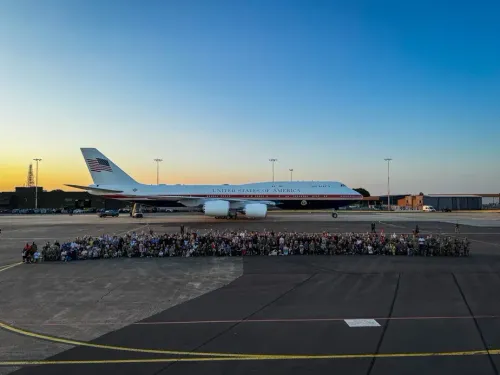
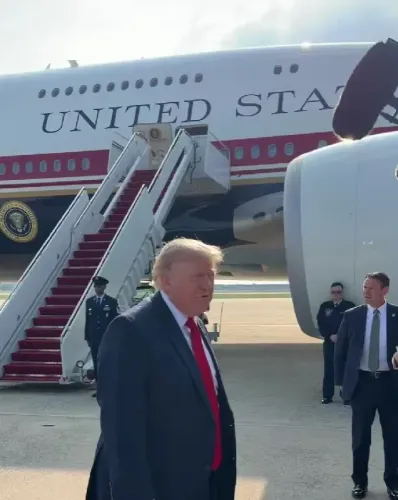
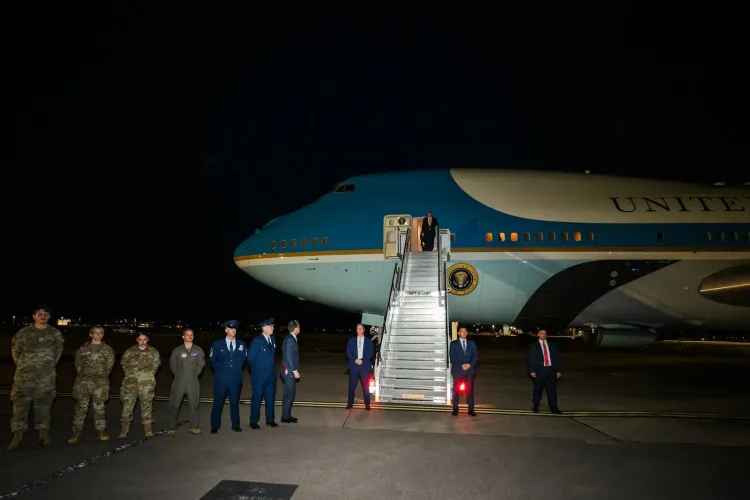
President Donald J. Trump touched down at RAF Mildenhall in Suffolk, England on 8 July 2026 aboard the former Air Force One before heading back to the United States. The White House confirmed the stop at the long-standing US Air Force base, a standard transit point for presidential transatlantic travel.
Key Takeaways
President Trump landed at RAF Mildenhall , a US Air Force base in Suffolk, England , on 8 July 2026 .
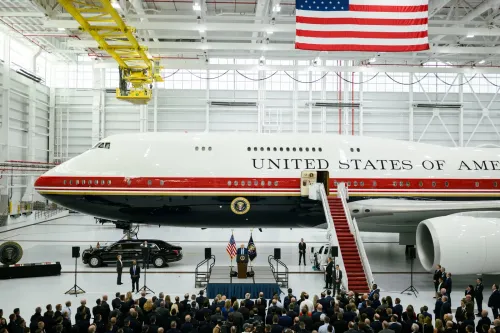
He travelled aboard the former Air Force One , a retired presidential airframe used for VIP transport.
The stop preceded his departure back to the United States .
RAF Mildenhall is a standard transit point for US presidential travel in Europe, providing secure communications and logistics support.
Trump visited the UK twice during his first term, in 2018 and 2019 , reinforcing the US-UK special relationship .
Follow-on statements from the White House and Downing Street on the visit's diplomatic outcomes are anticipated.
President Donald J. Trump landed at RAF Mildenhall in England on Wednesday, 8 July 2026, touching down aboard the former Air Force One before departing back to the United States. The White House confirmed the stop at the long-established US Air Force base in Suffolk, marking the final leg of his transatlantic trip.
Context
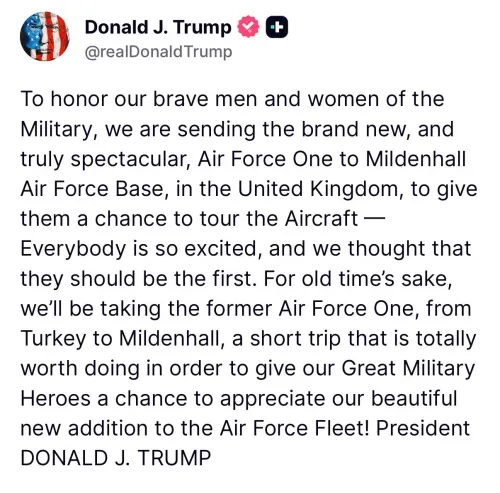
RAF Mildenhall, located in Suffolk, England, is a forward operating location for American military aircraft in Europe and a standard transit point for presidential travel. The base provides the secure communications infrastructure and logistics support required for movements of the US head of state. The White House post confirmed Trump used a retired presidential airframe — referred to as 'the former Air Force One' — for this leg of travel.
The designation 'Air Force One' technically applies to any US Air Force aircraft carrying the sitting president; a retired airframe used for VIP transport would not carry that live designation, making the White House's phrasing notable as a reference to the aircraft's historical identity.
Policy Backdrop
Presidential transatlantic travel has long served as a visible affirmation of the US-UK special relationship, underpinned by NATO membership, the Five Eyes intelligence-sharing arrangement, and bilateral trade ties that gained new urgency after Brexit. Trump visited the United Kingdom twice during his first term — a working visit in July 2018 that included meetings at Chequers and Blenheim Palace, and a return in June 2019 for D-Day commemorations and bilateral talks with then-Prime Minister Boris Johnson.
The use of established US bases in England for arrivals and departures is standard presidential practice, ensuring continuity of secure communications and reducing the logistical footprint on civilian airports.
Stakeholders and Impact
US Air Force personnel stationed at RAF Mildenhall were central to facilitating the stop, as they are for all presidential transits through the base. UK defence officials and Downing Street would have been coordinated with in advance, given the security protocols governing foreign head-of-state movements on British soil.
For the broader US-UK bilateral relationship, presidential visits — even brief transit stops — carry diplomatic weight, signalling continued American engagement with its closest European ally at a time when NATO burden-sharing and transatlantic trade remain active policy conversations.
What's Next
Follow-on statements from the White House or Downing Street on the substance of any engagements during the visit are expected to clarify the diplomatic outcomes of Trump's time in England. Scheduling of future NATO or G7 engagements between Washington and London will be closely watched as an indicator of the relationship's current trajectory.
The return of Trump to US soil closes the transatlantic leg of what the White House presented as a significant moment, with the imagery of the former presidential aircraft at a storied US base in Europe underlining the ceremonial as well as operational dimensions of the trip.
Point of View
Invoking the symbolism of the presidential aircraft and a storied American base in Europe. For Indian observers, the visit is a reminder that US-UK ties remain the anchor of Western alliance politics, with direct consequences for how Washington calibrates its relationships across the Indo-Pacific. The timing, amid ongoing NATO burden-sharing debates and post-Brexit trade negotiations, gives even a brief transit diplomatic weight beyond its operational footprint. How Downing Street characterises the engagement will signal the current temperature of the special relationship.
NationPress
8 Oct 2026
Frequently Asked Questions
Why did Trump land at RAF Mildenhall in England?
RAF Mildenhall in Suffolk is a long-established US Air Force base in Europe that serves as a standard and secure transit point for presidential aircraft, providing the communications infrastructure and logistics required for movements of the US head of state.
What is the 'former Air Force One' that Trump used?
The White House referred to the aircraft as 'the former Air Force One,' indicating a retired presidential airframe used for VIP transport rather than the active VC-25 that carries the live Air Force One designation when the sitting president is aboard.
Has Trump visited the UK before?
Yes. During his first term, Trump visited the United Kingdom in July 2018 for meetings at Chequers and Blenheim Palace, and again in June 2019 for D-Day commemorations and bilateral talks with Prime Minister Boris Johnson.
What is RAF Mildenhall?
RAF Mildenhall is a US Air Force base located in Suffolk, England, that functions as a key forward operating location for American military aircraft in Europe and a frequent transit point for high-level US government travel.
What does Trump's England visit mean for US-UK relations?
Even brief presidential stops carry diplomatic significance, reaffirming the US-UK special relationship at a time when NATO burden-sharing and transatlantic trade remain active policy issues. Formal statements from the White House and Downing Street will clarify any substantive outcomes.