Trump Halts Federal Use of Anthropic AI Technology
Synopsis
US President Donald Trump has ordered federal agencies to stop using Anthropic's AI technology, igniting a fierce debate over military AI usage and its implications for national security.
Key Takeaways
Trump's Directive: All federal agencies must cease using Anthropic's AI technology.
Consequences: Major civil and criminal repercussions are threatened if compliance is not met.
Anthropic's Response: The company claims to have acted in good faith and is prepared to challenge the government's actions.
Political Backlash: Lawmakers from opposing parties criticize the directive as a misuse of government power.
AI and National Security: The debate raises questions about the intersection of advanced AI technology and civil liberties.
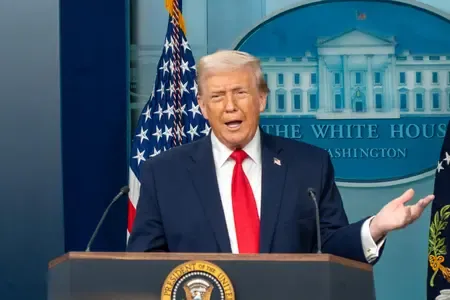
Washington, Feb 28 (NationPress) In a bold move, US President Donald Trump has mandated that all federal agencies cease the use of technologies developed by the AI firm Anthropic, intensifying the ongoing debate regarding the military's adoption of cutting-edge AI systems.
“THE UNITED STATES OF AMERICA WILL NEVER ALLOW A RADICAL LEFT, WOKE COMPANY TO DICTATE HOW OUR GREAT MILITARY FIGHTS AND WINS WARS!” Trump proclaimed on Truth Social. He criticized the company for committing a “DISASTROUS MISTAKE” by attempting to “STRONG-ARM the Department of War” and insisted that they prioritize the Constitution over their own Terms of Service.
Trump instructed “EVERY Federal Agency in the United States Government to IMMEDIATELY CEASE all use of Anthropic’s technology,” allowing a six-month transition period for those already utilizing their products, and warned of “major civil and criminal consequences” should the company fail to comply.
The conflict centers around Anthropic's refusal to permit two specific applications of its AI model, Claude: mass domestic surveillance and fully autonomous weapons.
In a statement, Anthropic indicated that they had reached a stalemate with the Department of War regarding “two exceptions we requested for the lawful use of our AI model, Claude: the mass domestic surveillance of Americans and fully autonomous weapons.”
The company claimed it had “endeavored in good faith to reach an agreement” and was supportive of “all lawful uses of AI for national security aside from the two narrow exceptions mentioned.” They added that, “To the best of our knowledge, these exceptions have not impacted any government mission to date.”
Anthropic further contended that “today’s frontier AI models are sufficiently reliable for deployment in fully autonomous weapons” and that permitting such use “would jeopardize the safety of America’s soldiers and civilians.” They also stated that “mass domestic surveillance of Americans represents a breach of fundamental rights.”
Secretary of War Pete Hegseth announced that he would classify Anthropic as “a Supply-Chain Risk to National Security.” He noted on X that “the Department of War must have complete, unrestricted access to Anthropic’s models for all LAWFUL purposes in defense of the Republic.”
“Effective immediately, no contractor, supplier, or partner associated with the United States military may engage in any commercial dealings with Anthropic,” Hegseth stated, while allowing the company to provide services for “no more than six months to facilitate a smooth transition.”
In response, Anthropic labeled this designation as “an unprecedented action—historically reserved for US adversaries, and never before publicly imposed on an American corporation.” They announced plans to “contest any supply chain risk classification in court.”
The decision faced backlash from opposition lawmakers. Senator Mark Warner expressed concerns that the president’s directive and “inflammatory rhetoric” might indicate that national security choices are influenced more by political motives than rational analysis.
In a joint statement, Senators Chris Van Hollen and Edward Markey denounced the Pentagon’s actions as “an extraordinary and deeply concerning misuse of governmental power,” asserting, “This is retaliation, and it is intolerable.”
Representative Zoe Lofgren characterized the administration’s tactics as “bullying,” while Congresswoman Valerie Foushee cautioned that “AI companies have an obligation to uphold the safeguards they have publicly committed to.”
Point of View
It is imperative to analyze Trump's directive through a lens of national security and civil rights. The clash between technological advancement in AI and constitutional rights raises significant concerns that warrant thorough examination from all angles. Ensuring that AI is used in alignment with democratic values is critical.
NationPress
3 Oct 2026
Frequently Asked Questions
What prompted Trump's order against Anthropic?
Trump's order was prompted by Anthropic's refusal to allow mass surveillance and fully autonomous weapons applications of their AI technology.
How long do federal agencies have to phase out Anthropic's technology?
Trump announced a six-month phase-out period for agencies currently using Anthropic's products.
What are the consequences if Anthropic does not comply?
Trump warned of potential major civil and criminal consequences if Anthropic fails to cooperate with the order.
What is Anthropic's position on the matter?
Anthropic states they have made good faith efforts to reach an agreement and believe their models are safe for lawful use.
How have lawmakers reacted to Trump's directive?
Opposition lawmakers have expressed serious concerns about the implications of Trump's directive on national security and civil rights.