Why Did the US Reject Global AI Governance at the Delhi Summit?

Synopsis
The United States has taken a bold stance against global AI governance during the India AI Impact Summit 2026, urging nations to adopt a sovereign AI model based on American technology. Michael Kratsios, leading the US delegation, emphasized the importance of local governance in AI, while unveiling new initiatives to promote US AI exports.
Key Takeaways
The US opposes global AI governance.
Advocacy for sovereign AI models is emphasized.
New initiatives aim to boost US AI exports.
Importance of local governance in AI is highlighted.
The gap between developing and developed nations is widening.
On February 21, Washington (NationPress) firmly dismissed the notion of global governance over artificial intelligence and advocated for nations to embrace a sovereign AI framework that is based on American technological standards during the India AI Impact Summit 2026 in New Delhi.
Leading the US delegation, Michael Kratsios, Assistant to the President and Director of the White House Office of Science and Technology Policy, conveyed a clear message regarding AI policy and national sovereignty.
“As the Trump Administration has reiterated: We categorically oppose global governance of AI. We believe that the advancement of AI cannot promise a brighter future if it is subjected to bureaucratic red tape and centralized authority,” he stated.
Kratsios argued for the necessity of local governance in AI that aligns with national priorities. “AI governance should cater to the unique requirements and interests of specific populations; thus, it must be localized,” he emphasized.
The US stance was framed around the concept of what Washington refers to as “real AI sovereignty.”
“Real AI sovereignty signifies the ownership and utilization of top-tier technology for the welfare of your citizens, and it involves steering your national trajectory amidst global shifts,” Kratsios explained.
He warned against the idea of complete technological self-sufficiency. “Total technological self-containment is impractical for any nation because the AI framework is exceedingly intricate,” he noted. “However, achieving strategic autonomy while rapidly adopting AI is essential for independent nations. America is eager to assist.”
Kratsios encouraged countries to collaborate with Washington through the American AI Exports Program. “We believe that independent partnerships are vital to unlocking the prosperity that AI adoption can offer. This is why the president initiated the American AI Export Program,” he asserted.
During the summit, he unveiled several initiatives designed to expedite the global acceptance of US AI technologies.
These initiatives comprise a National Champions Initiative aimed at integrating leading AI firms from partner nations into tailored American AI export frameworks. The Commerce Department’s National Institute of Standards and Technology will establish interoperable and secure standards through a new AI Agent Standards Initiative.
To tackle financial obstacles, he mentioned that the US International Development Finance Corporation, the Export-Import Bank, the US Trade and Development Agency, the Millennium Challenge Corporation, and “a new World Bank Fund have all launched new AI-centric programs.”
Kratsios also introduced the Tech Corps, which will place volunteer technical experts in partner nations to assist with the deployment of AI technologies in public services.
He cautioned that the gap in adoption is widening. “Developing nations are lagging behind developed countries during a critical turning point,” he remarked, citing financial limitations and gaps in technical capabilities as significant hurdles.
Emphasizing US technological supremacy, Kratsios proclaimed: “The benchmark for AI is set in America.”
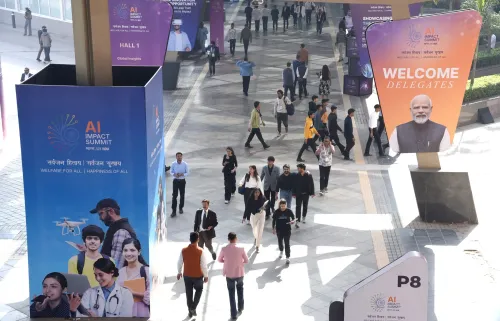
The India AI Impact Summit has emerged as a vital platform for discussions on global AI policy, attracting political leaders, technology executives, and policymakers. India is striving to navigate rapid digital growth alongside discussions about regulation, safety, and equitable access to emerging technologies.
Point of View
It is essential to recognize the significant implications of the US's rejection of global AI governance. This stance highlights the ongoing struggle for technological supremacy and the importance of national interests in shaping AI policies. It is crucial for nations to navigate these discussions thoughtfully, balancing rapid technological advancement with ethical considerations.
NationPress
30 Sept 2026
Frequently Asked Questions
What was the US's stance on AI governance at the summit?
The US firmly rejected global governance of AI, advocating for a sovereign AI model based on American technology.
Who led the US delegation at the India AI Impact Summit?
Michael Kratsios, Assistant to the President and Director of the White House Office of Science and Technology Policy, led the delegation.
What is the significance of 'real AI sovereignty'?
Real AI sovereignty emphasizes owning and using top-tier technology for the benefit of a nation's citizens while shaping its own national trajectory.
What initiatives were announced at the summit?
Initiatives include the National Champions Initiative, AI Agent Standards Initiative, and the Tech Corps to support AI deployment in partner countries.
Why is the US promoting the American AI Exports Program?
The program aims to foster independent partnerships to unlock the prosperity that AI adoption can bring to nations.