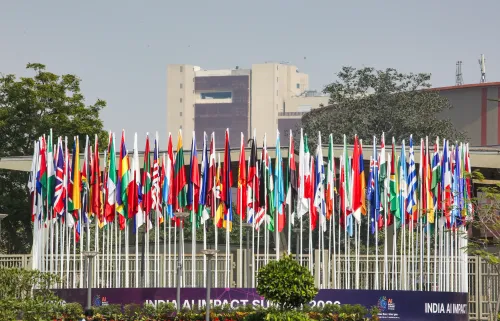
Did 88 Countries and International Organizations Endorse the New Delhi Declaration on AI?

Synopsis
The New Delhi Declaration on AI Impact, approved by 88 nations at the AI Impact Summit 2026, signifies a groundbreaking step in global AI cooperation. With a focus on equitable benefits, international collaboration, and innovation, this declaration aims to harness AI for economic growth and social good.
Key Takeaways
88 countries and organizations have endorsed the New Delhi Declaration on AI Impact.
The Declaration focuses on equitable sharing of AI benefits.
It emphasizes the need for international cooperation and multi-stakeholder engagement.
Seven key pillars define the framework for global AI collaboration.
The Declaration promotes innovation for social good and economic growth.
New Delhi, Feb 21 (NationPress) The grand ‘AI Impact Summit 2026’ wrapped up on Saturday with the formal adoption of the New Delhi Declaration on AI Impact, which has received endorsement from 88 countries and various international organizations — representing a pivotal moment in global collaboration on artificial intelligence.
This Declaration embodies a widespread global agreement on utilizing AI for both economic advancement and social welfare.
Anchored by the principle of “Sarvajan Hitaya, Sarvajan Sukhaya” (Welfare for all, Happiness for all), it emphasizes that the advantages of AI should be fairly distributed among all of humanity.
Moreover, it stresses the importance of enhancing international collaboration and engaging multiple stakeholders; respecting sovereign nations; and promoting AI through frameworks that are both accessible and trustworthy.
The Declaration is organized around seven fundamental pillars, which serve as the cornerstone for global AI collaboration.
These pillars are — Democratising AI Resources; Economic Growth and Social Good; Secure and Trusted AI; AI for Science; Access for Social Empowerment; Human Capital Development; and Resilient, Efficient and Innovative AI Systems.
It illustrates AI's potential to drive economic transformation, the significance of open-source AI ecosystems, the urgency for energy-efficient AI infrastructure, and the expansion of AI's role in science, governance, and public service.
The Declaration states, “Robust digital infrastructure and meaningful and affordable connectivity are prerequisites for deploying AI and unlocking its full potential.”
Inspired by the concept of “Vasudhaiva Kutumbakam” (the world is one family), it highlights the necessity of making AI resources more affordable and accessible for all nations to develop, adopt, and utilize AI for their citizens' benefit.
Furthermore, it acknowledges the Charter for the Democratic Diffusion of AI as a voluntary framework aimed at promoting access to essential AI resources, supporting localized innovation, and fostering resilient AI ecosystems while adhering to national laws.
It also stresses that enhancing secure, trustworthy, and robust AI is vital for building trust and maximizing societal and economic advantages.
“We recognize that eliminating structural barriers and increasing the availability of AI research infrastructure can significantly boost the application of AI in scientific research and development globally,” it noted.
“International scientific collaborations can unleash AI's potential in research and development by merging diverse expertise, perspectives, and resources,” it added.
“We acknowledge that the AI Impact Summit will play a crucial role in enhancing global cooperation and the multi-stakeholder approach to advance shared priorities while promoting voluntary guidelines that support a prosperous future for humanity,” it concluded.
Point of View
I believe this declaration paves the way for a future where AI is an instrument of progress and equality. It highlights the need for collaborative efforts and shared benefits, ensuring that technological advancements contribute positively to society as a whole.
NationPress
19 Sept 2026
Frequently Asked Questions
What is the New Delhi Declaration on AI Impact?
The New Delhi Declaration on AI Impact is a formal agreement adopted at the AI Impact Summit 2026, endorsed by 88 countries to foster global cooperation in artificial intelligence for economic growth and social welfare.
How many countries support the New Delhi Declaration?
A total of 88 countries and international organizations have endorsed the New Delhi Declaration on AI Impact.
What are the main pillars of the New Delhi Declaration?
The Declaration is based on seven pillars: Democratising AI Resources, Economic Growth and Social Good, Secure and Trusted AI, AI for Science, Access for Social Empowerment, Human Capital Development, and Resilient, Efficient and Innovative AI Systems.
Why is international cooperation in AI important?
International cooperation in AI is essential to ensure equitable access to technology, promote innovation, and maximize the societal and economic benefits of AI for all nations.
What does the principle of 'Vasudhaiva Kutumbakam' signify in the context of AI?
The principle of 'Vasudhaiva Kutumbakam' emphasizes the idea that the world is one family, highlighting the importance of making AI resources affordable and accessible for all countries.