Is the India AI Summit a Game Changer for Global South and West?

Synopsis
The India AI Impact Summit 2026 in New Delhi is set to redefine global AI discussions by fostering inclusive growth and bridging the gap between the Global South and West. With participation from influential leaders and tech giants, the summit aims to establish a shared roadmap for responsible AI governance.
Key Takeaways
India AI Impact Summit 2026 promotes an inclusive vision for AI.
Over 20 heads of state and tech leaders are participating.
The summit aims to bridge the gap between the Global North and South.
Key discussions include ethical AI governance and its role in livelihoods.
India positions itself as a key player in global AI governance.
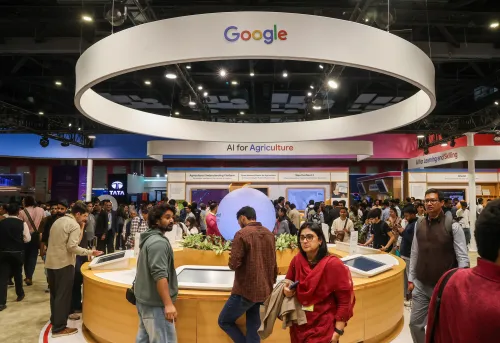
New Delhi, Feb 18 (NationPress) The India AI Impact Summit 2026 in the national capital is being regarded as a refreshing departure from the typical AI discussions held in the US and Europe, bringing forth a more practical and inclusive vision that emphasizes human progress and equitable growth.
“As the largest democracy and the first major AI summit in the Global South, it confronts the dominant narrative and establishes India as a legitimate bridge-builder in a fragmented technological landscape,” notes a piece from the online publication One World Outlook.
“Policymakers from Washington to Brussels should perceive the New Delhi Summit as a complementary effort rather than a competitive one. While the West excels in frontier research and safety standards, these must be integrated with the scale and urgency demanded by the developing world,” the article authored by Daniel J. Kaplan asserts.
Should the summit produce a cohesive roadmap for global AI governance that merges innovation, inclusion, and accountability, it may signify a pivotal moment, the article suggests.
The discussion around AI in the West has oscillated between exaggeration and alarm. Optimists like Sam Altman of OpenAI and Sundar Pichai of Alphabet highlight AI’s potential to address climate issues, cure diseases, and enhance productivity. In contrast, regulators and ethical scholars express concerns regarding job loss, bias escalation, misinformation, and even existential threats.
However, with a population of 1.4 billion, a vast digital infrastructure featuring Aadhaar and UPI, and the world’s largest pool of STEM graduates, India is poised to redefine AI not as a hazard to be restrained but as a catalyst for inclusive growth, the article indicates.
It also points out that AI summits in the UK and France have primarily been dominated by a select few powerful nations and companies, relegating developing economies to the role of rule-takers instead of co-creators. In contrast, the India AI summit unites over 20 heads of state, including Emmanuel Macron of France and Luiz Inacio Lula da Silva of Brazil, along with tech leaders from OpenAI, Anthropic, Google, Microsoft, and Nvidia, with participation from more than 100 countries.
The article emphasizes that the summit is distinguished by its focused approach on applicable, real-world AI rather than abstract doomsday scenarios. Sessions aim to bridge the AI adoption gap between the Global North and South, where usage rates in many regions of Asia, Africa, and Latin America remain below 10 percent, while exceeding 50 percent in some affluent countries.
Conversations center around developing sovereign tech stacks, ethical governance, and the role of AI in enhancing livelihoods—think AI-driven healthcare diagnostics for rural communities, precision farming for smallholders, or training programs to prepare workers for an automated future.
This methodology resonates as it fills a gap in Western AI discussions focused on frontier regulation, which often overlook the immediate and practical benefits (and drawbacks) that AI is already providing in daily scenarios. India's summit redirects focus to “small AI, big impact,” practical tools that bolster public services, empower entrepreneurs, and foster sustainable development.
“By hosting this in the Global South, India compels a reckoning: AI governance cannot thrive if it disregards the priorities of the global majority,” the article concludes.
The piece also argues that India’s qualifications for this role are substantial. The nation has quietly emerged as an AI powerhouse, with startups innovating in vernacular language models, cost-effective computing solutions, and sector-specific applications.
Importantly, India’s dynamic democratic system serves as a counterbalance to the state-driven approaches of China and the laissez-faire strategies of early U.S. leadership. As Prime Minister Narendra Modi highlighted during the summit's inauguration, AI must benefit humanity inclusively, rather than further concentrating power.
Point of View
I recognize the significance of the India AI Impact Summit 2026 in redefining AI governance. This summit not only positions India as a leader in fostering inclusive growth but also highlights the necessity for collaborative efforts in the global AI landscape. The participation of diverse nations and stakeholders emphasizes the importance of understanding and addressing the needs of the majority while navigating the complexities of AI technology.
NationPress
29 Sept 2026
Frequently Asked Questions
What is the focus of the India AI Impact Summit 2026?
The summit emphasizes a pragmatic and inclusive vision centered on human progress and equitable growth.
Who are some notable participants in the summit?
The summit features over 20 heads of state, including Emmanuel Macron and Luiz Inacio Lula da Silva, along with tech leaders from companies like OpenAI, Google, and Microsoft.
How does India position itself in the global AI landscape?
India positions itself as a bridge-builder between the Global South and West, focusing on inclusive and equitable AI governance.
What are some key topics discussed at the summit?
Key discussions include bridging the AI adoption gap, building sovereign tech stacks, ethical governance, and AI's role in enhancing livelihoods.
Why is the summit significant?
The summit is significant as it challenges prevailing narratives and aims to establish a shared roadmap for responsible AI governance that benefits the majority.