Did Trump Use the South Asia Conflict as a Model for Peace?
Synopsis
In a recent press conference, President Trump touted his role in resolving conflicts, particularly highlighting the India-Pakistan situation. He criticized global institutions and proposed a new Board of Peace as a means to enhance conflict resolution. Trump's claims raise questions about the effectiveness of existing international frameworks.
Key Takeaways
Trump claims to have resolved eight conflicts.
He criticized the UN's effectiveness.
Proposed a new 'Board of Peace' for negotiations.
Emphasized direct leader engagement over multilateral processes.
Claims of saving millions from potential conflict.
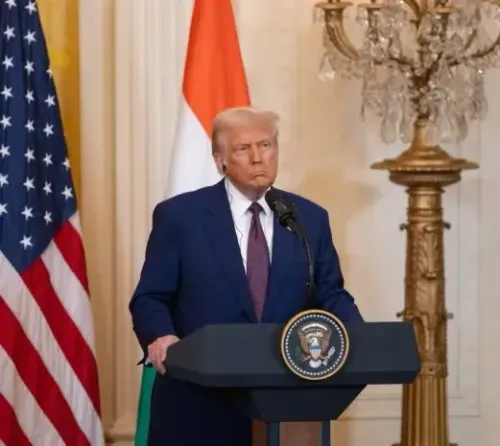
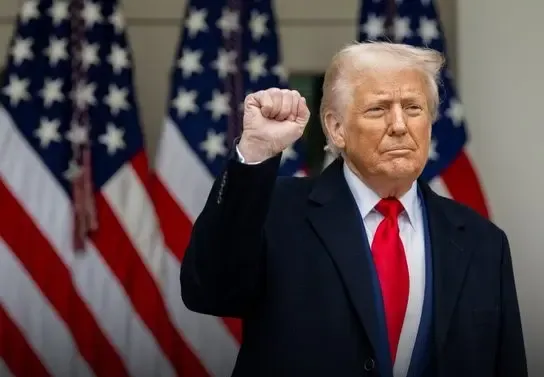
Washington, Jan 21 (NationPress) As he commemorated a year since his return to the White House, President Donald Trump highlighted the India-Pakistan conflict as one of the various global flashpoints he claimed were resolved under his guidance. During his remarks, he reiterated his criticism of international organizations while promoting himself as a deal-oriented peacemaker.
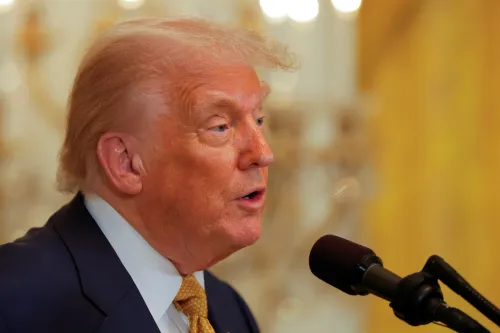
During a crowded media session at the White House, Trump asserted that he had played a part in resolving eight conflicts in a brief period, frequently referencing South Asia as a prime example of his decisive intervention.
“I resolved eight wars,” he stated, placing the India-Pakistan situation alongside other disputes he asserted to have alleviated. However, New Delhi has consistently maintained that no external mediation was involved in resolving last year’s tensions with Pakistan.
Trump remarked on the rising tensions between New Delhi and Islamabad, claiming that both sides were “really at it” and suggested that the situation was on the verge of escalating dangerously. “Eight planes shot down. They were on the brink of going nuclear, in my opinion,” he claimed.
He mentioned that the Prime Minister of Pakistan had personally acknowledged his role in averting mass fatalities. “The Prime Minister of Pakistan was here, and he stated that President Trump saved 10 million lives, or perhaps even more,” he added. “They’re both nuclear powers.”
Trump argued that the India-Pakistan incident illustrated the high stakes of his foreign policy approach. “Considering the potential loss of life, that could have been 10, 15, or even 20 million people,” he claimed, emphasizing the need for swift, leader-level action in such high-risk situations.
The president linked these assertions to broader criticisms of international bodies, particularly the United Nations. “The UN should have resolved every one of the conflicts I addressed,” Trump stated, asserting that he did not depend on multilateral negotiations. “I never even considered engaging them. I brought the presidents and prime ministers together.”
Recently, Trump announced plans for a new “Board of Peace,” proposing that it could be more effective in conflict resolution.
When asked if this body was meant to substitute the UN, he replied: “Well, it might. The UN has not been particularly helpful.” While acknowledging the UN’s “potential,” he criticized its repeated failures to achieve results.
Trump confirmed that Brazil’s President Luiz Inacio Lula da Silva had been invited to join the proposed initiative. “I did,” he said when inquired about Lula's invitation, adding: “A significant role. I appreciate him.” He described the board as a mechanism focused on direct negotiation rather than extended diplomacy.
The president also revisited his ongoing complaint about the Nobel Peace Prize, arguing that his contributions to conflict resolution had gone unrecognized. “I should have received the Nobel Prize for each conflict,” Trump stated, while insisting that personal accolades were not his goal. “I didn’t do it for a Nobel Prize; I did it to save lives.”
Trump criticized Norway and the Nobel committee, expressing that he had “lost considerable respect” for the process. He alleged that leaders involved in the conflicts had submitted strong recommendations in his favor, yet the prize remained elusive. “They control the process,” he remarked.
Throughout the event, Trump framed his peace claims as intertwined with what he described as a resurgence of American strength. He cited military capability, economic influence, and the application of tariffs as tools that, in his view, compelled both adversaries and allies to negotiate. “We created a remarkably powerful military,” he stated, crediting this stance with facilitating diplomatic breakthroughs.
He differentiated his approach from prior US administrations, accusing them of weakness and overdependence on global organizations. Trump contended that his method favored speed and pressure over lengthy processes, claiming this was why conflicts were swiftly resolved during his term.
While he did not divulge specific timelines or diplomatic channels regarding the India-Pakistan engagement he referenced, he portrayed it as part of a consistent pattern of what he termed rapid conflict resolution. He insisted that direct leader-to-leader dialogue proved to be more effective than multilateral mediation.
Point of View
We observe that President Trump's claims regarding conflict resolution highlight the complexities of international diplomacy. While he asserts success in de-escalating tensions, the lack of third-party involvement in certain conflicts raises questions about the efficacy of unilateral approaches. The proposal for a new Board of Peace could reflect a shift in diplomatic strategy, emphasizing direct negotiations over multilateral processes.
NationPress
22 Sept 2026
Frequently Asked Questions
What conflicts did Trump claim to have resolved?
President Trump claimed to have resolved eight conflicts, including the tensions between India and Pakistan.
Did Trump provide evidence for his claims?
While Trump asserted that leaders credited him with averting crises, he did not provide specific details or evidence regarding the resolutions.
What is the proposed 'Board of Peace'?
The 'Board of Peace' is an initiative proposed by Trump to facilitate direct negotiations in conflict resolution, potentially replacing traditional multilateral approaches.
How did Trump characterize the UN's effectiveness?
Trump criticized the UN for failing to resolve conflicts that he claims to have addressed, arguing that he did not rely on their processes.
What was Trump's statement about the Nobel Peace Prize?
Trump expressed disappointment over not receiving the Nobel Peace Prize for his conflict resolution efforts and criticized the Nobel committee.