Trump Signs Order Allowing Dyed Diesel on Highways to Cut Costs
Synopsis
President Trump signed an Executive Order on October 6, 2026, temporarily allowing off-road 'dyed' diesel — normally barred from highways due to lower tax status — for on-road use, promising direct cost relief for American farmers, truckers, and workers.
Key Takeaways
President Trump signed an Executive Order on October 6, 2026 permitting temporary highway use of off-road 'dyed' diesel.
Dyed diesel carries a lower tax burden than standard highway diesel and is normally restricted to farm equipment, construction machinery, and generators.
The White House says the move will put money 'back in the pockets' of American farmers, truckers, and workers .
The order is described as temporary , suggesting it is a time-bound cost-relief measure rather than a permanent fuel-tax policy change.
Diesel costs are among the largest operating expenses for the agricultural sector, meaning even a short-term reduction has real downstream impact on food supply chains.
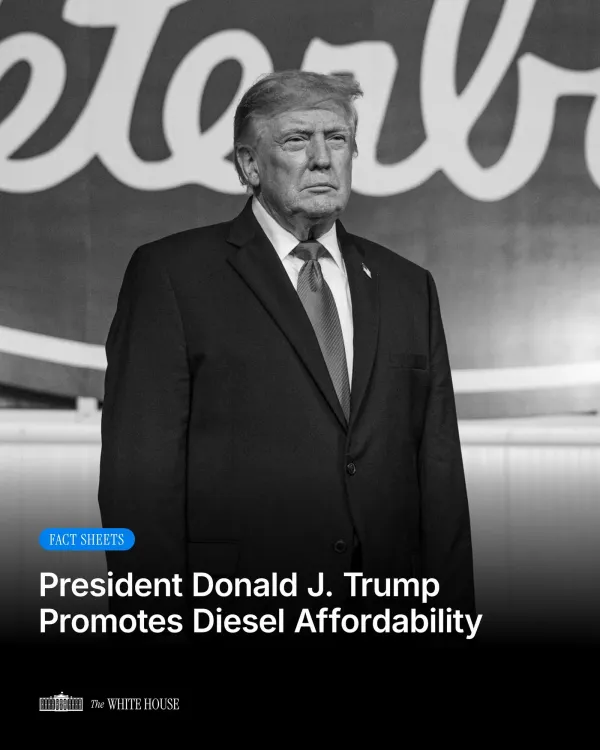
With a stroke of the pen, President Donald J. Trump moved to put cheaper fuel on American roads — signing an Executive Order on Tuesday, October 6, 2026, that temporarily permits off-road 'dyed' diesel to be used on highways, a shift the White House says will directly lower costs for farmers, truckers, and workers across the country.
What Is 'Dyed' Diesel — and Why Does It Normally Stay Off Highways?
Dyed diesel — named for the red dye injected into it to distinguish it visually — is a lower-taxed fuel legally reserved for off-road equipment: tractors, construction machinery, generators, and farm vehicles. Because it bypasses the federal highway fuel excise tax, selling or using it in on-road vehicles is normally a federal violation, carrying stiff penalties for both consumers and suppliers.
The core logic of the ban is tax equity: highway diesel carries levies that fund road infrastructure, and dyed diesel skips them. By temporarily suspending that restriction, Trump's Executive Order essentially allows a lower-cost fuel class — one already sitting in tanks on farms and job sites across America — to flow legally into the mainstream trucking and transport supply chain.
Farmers, Truckers, and Workers: Who Stands to Gain
The White House framed the order as direct economic relief, declaring it will put money 'back in the pockets of American farmers, truckers, and workers.' Diesel prices feed directly into food supply costs — when trucking fuel gets cheaper, that pressure can ease across the entire logistics chain, from grain haulers to grocery-store deliveries.
For American farmers in particular, diesel is among the single largest operating expenses of any harvest or planting season. Any meaningful reduction per gallon, even temporary, translates into real margin relief at a time when agricultural input costs have remained elevated.
A Temporary Measure With a Clear Political Signal
The word 'temporarily' in the White House announcement is doing significant work here. Executive Orders of this kind are typically bounded by a declared emergency period or a specific regulatory window — and the administration's framing suggests this is a cost-relief intervention rather than a permanent restructuring of fuel-tax policy.
Still, the political symbolism is unmistakable. The three groups named — farmers, truckers, and workers — are central to Trump's coalition and to the broader 'America First' economic narrative. A visible, immediate action on fuel costs lands as a concrete gesture rather than a legislative promise.
Whether the temporary window leads to a longer policy debate about highway fuel taxation or snaps back at its expiry, the executive stroke has already reshaped the conversation around diesel costs — and the administration clearly wants voters to feel that shift.
Point of View
Tangible benefit to a politically core constituency. By naming farmers, truckers, and workers explicitly, the White House is threading a populist economic needle — using regulatory flexibility on an obscure fuel-tax rule to generate a front-page moment on kitchen-table costs. The 'temporary' framing shields it from immediate legal scrutiny over highway fund revenue impacts, while leaving the door open for a permanent policy push if the relief proves popular. For India, where diesel price policy is also a perennial political flashpoint, the episode underscores how fuel economics remain a direct lever of executive political capital across democracies.
NationPress
6 Oct 2026
Frequently Asked Questions
What is dyed diesel and why is it normally banned on highways?
Dyed diesel is off-road fuel marked with a red dye; it carries a lower federal tax and is legally restricted to farm equipment, construction, and generators. Using it on public roads is a federal violation because it bypasses the highway fuel excise tax that funds road infrastructure.
What did Trump's Executive Order on dyed diesel do?
President Trump's October 6, 2026 Executive Order temporarily allows off-road dyed diesel to be used in highway vehicles, lowering fuel costs for farmers, truckers, and workers who can now access the cheaper fuel legally for on-road use.
How does cheaper diesel help American farmers?
Diesel is one of the largest operating costs in agriculture, powering tractors, harvesters, and transport trucks. Any reduction in per-gallon price directly improves farm margins and can ease food logistics costs across the supply chain.
Is Trump's dyed diesel highway order permanent?
No. The White House described the measure as temporary, indicating it is a time-bound relief intervention rather than a permanent restructuring of federal fuel-tax policy.
Why does this US diesel order matter for a global audience?
US diesel and trucking policy affects global commodity freight costs and agricultural export prices. A reduction in US transport costs can shift competitive dynamics for agricultural goods traded internationally, including with major importers like India.