White House Vows Trump Will Always Fight for Florida

Synopsis
The White House posted on October 23, 2026, pledging that President Trump 'will always fight for Florida.' The declaration reinforces Trump's deep personal and electoral ties to the state, which has backed him in three consecutive presidential cycles.
Key Takeaways
The White House posted on October 23, 2026 declaring President Trump 'will always fight for Florida .' Florida has supported Trump in the 2016 , 2020 , and 2024 presidential elections.
Trump's personal ties to the state include ownership of Mar-a-Lago in Palm Beach , which served as his primary residence after 2021.
The post follows a well-established pattern of U.S. presidents issuing state-specific loyalty pledges as part of domestic political messaging.
Florida's size — 30 electoral votes and a top-tier economy — makes it a perennial focus of federal political attention.
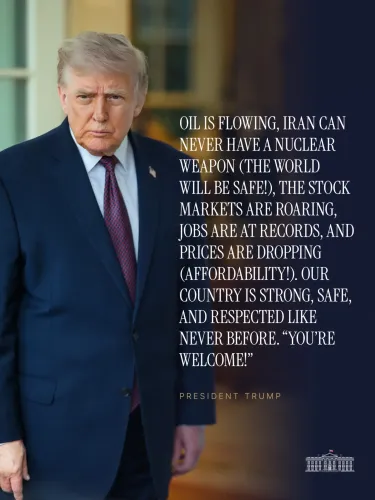
A short, sharp pledge from the highest office in the land — and one of the most politically loaded zip codes in America. The White House posted on X on Friday, October 23, 2026, declaring that President Donald Trump 'will always fight for Florida.'
The post, brief by design, carries the unmistakable signature of Trump-era political messaging: state-specific loyalty pledges that double as both governance signals and electoral reinforcement. Florida is no ordinary state on Trump's map — it is home to his Mar-a-Lago estate in Palm Beach, and it has delivered for him at the ballot box in 2016, 2020, and 2024.
Florida's outsized place in Trump's political universe
Florida, with its large and diverse population, has evolved from a classic swing state into a reliable pillar of Trump's electoral coalition. The state's mix of retirees, Cuban-American communities, and rapidly growing suburban counties has shifted decisively rightward across successive election cycles, making it a showcase for the coalition Trump has built over a decade.
Beyond politics, Trump's personal ties to the state run deep. Mar-a-Lago served as his primary residence after leaving the White House in 2021 and became the operational nerve centre of his political comeback. For millions of Florida residents, the pledge carries practical weight — the state faces recurring pressures from hurricane seasons, insurance market instability, and coastal climate exposure, all of which demand active federal attention.
What 'fighting for Florida' could mean in practice
White House statements of this kind typically precede or follow concrete action — federal disaster relief approvals, infrastructure investment announcements, or executive orders with direct state-level impact. Whether this post signals an imminent policy move tied to Florida or serves as a broader affirmation of the administration's political priorities, the research does not confirm. What is clear is the pattern: U.S. presidents have long used state-loyalty messaging to reinforce both governance credibility and political capital simultaneously.
For a state that punches well above its weight in national politics — 30 electoral votes and a GDP that would rank it among the world's top economies if it were a country — the message lands with real resonance. The White House has signalled its audience, and Florida is listening.
Point of View
A volatile property insurance market, and coastal infrastructure demands mean 'fighting for Florida' carries real policy stakes beyond rhetoric. The timing in late October 2026 may also reflect the administration's need to maintain base enthusiasm ahead of any midterm-cycle political dynamics. For Indian observers, it illustrates how U.S. presidents deploy state-level messaging as a tool to simultaneously signal competence, loyalty, and electoral intent.
NationPress
24 Oct 2026
Frequently Asked Questions
Why does Trump have such strong ties to Florida?
Trump has deep personal and political ties to Florida — he owns Mar-a-Lago in Palm Beach , which became his primary home after leaving the presidency in 2021, and Florida has voted for him in three consecutive presidential elections: 2016, 2020, and 2024.
What did the White House post about Florida in October 2026?
On October 23, 2026 , the official White House account on X posted that 'President Trump will always fight for Florida,' accompanied by an image.
How many electoral votes does Florida have?
Florida carries 30 electoral votes , making it one of the largest and most consequential states in U.S. presidential elections.
Is Florida still a swing state under Trump?
Florida has shifted from a classic swing state into a reliable part of Trump's electoral coalition over the past decade, backing him in 2016, 2020, and 2024.
What issues does the federal government handle for Florida?
Key federal issues affecting Florida include hurricane disaster relief, coastal infrastructure funding, flood insurance policy, and economic development — all areas where White House support has direct, tangible impact on residents.