Is Trump Questioning NATO's Reliability While Escalating Greenland Rhetoric?
Synopsis
In a striking turn of events, US President Donald Trump has intensified his rhetoric concerning Greenland and raised doubts about NATO's dependability. His remarks suggest a potential shift in how security commitments to Europe may be influenced by economic leverage. Discover more about his plans and the implications for international relations.
Key Takeaways
Trump questions NATO's reliability.
Economic leverage may influence security commitments.
Concerns about ally support in crises.
Increased defense spending targets set by NATO.
Foreign policy strategy connects trade and security.
Washington, Jan 21 (NationPress) Intensifying his remarks about Greenland, US President Donald Trump has raised doubts regarding the reliability of NATO, suggesting that security promises to Europe may increasingly be linked to economic and strategic power.
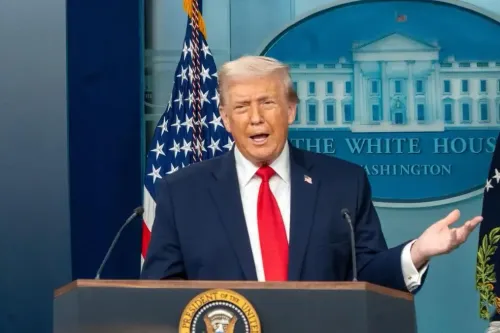
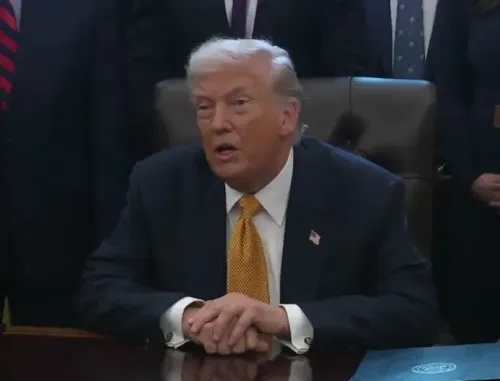
During a news conference at the White House commemorating one year since his re-election, Trump refrained from detailing how far Washington might go to protect its interests concerning Greenland. When asked directly, he responded: “You’ll find out.”
When pressed on the possibility of using force, Trump sidestepped specifics, choosing instead to highlight economic instruments. He mentioned tariffs, licensing, and “other alternatives” as viable options, labeling them as “the best, the strongest, the fastest.”
Trump stated that he has scheduled discussions regarding Greenland during his upcoming trip to Davos. “We have numerous meetings planned on Greenland,” he declared, adding that he believed “things are going to turn out quite positively.”
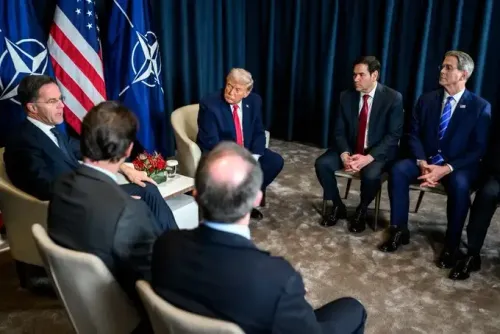
The president coupled these statements with renewed criticism of NATO. He reiterated claims that he has enhanced the alliance by urging member nations to increase their defense expenditure. He stated that allies agreed to boost spending from the long-established 2% of GDP to 5%. “Convincing them to reach five percent of GDP was something that nobody thought achievable,” he remarked.
Simultaneously, Trump expressed skepticism about whether the alliance would support the United States in a crisis. “NATO is only as effective as we are,” he said, emphasizing that without the US, the alliance would be significantly weakened. He voiced concerns about whether allies would aid Washington in times of need.
Trump asserted that he has fortified NATO’s position but remained doubtful about its framework. He contended that the US shoulders an excessive burden, arguing that his tactics compelled allies to contribute more financially and purchase more from the US.
The notion of attending a proposed G-7 emergency meeting in Paris was dismissed by Trump. When questioned about attending at the invitation of French President Emmanuel Macron, he stated: “No, I wouldn’t do that.” He raised doubts about Macron’s political stability and expressed a preference for engaging with leaders “who are directly involved.”
Trump mentioned that he shares a good rapport with Macron and British Prime Minister Keir Starmer, noting that both nations are grappling with significant challenges. He identified immigration and energy as primary issues facing Europe, urging leaders to reconsider reliance on wind energy and instead utilize domestic energy resources.
These comments align with Trump’s broader foreign policy strategy, often linking security assurances to economic pressure. He believes that tariffs and trade leverage compel both allies and adversaries to negotiate.
Trump claimed that this strategy has made the United States wealthier and more secure. “We’re the wealthiest we’ve ever been,” he stated, attributing this growth to his pressure tactics.
As competition intensifies in the Arctic and Europe, Greenland and NATO have gained greater significance. Trump’s remarks indicate that US policy is likely to continue intertwining alliances, territorial claims, and trade.
Point of View
It's vital to recognize the implications of President Trump's comments on NATO and Greenland. His statements reflect a significant shift in how the United States may approach international alliances, emphasizing economic leverage over traditional security commitments. This evolving dynamic requires close attention as it could reshape global relationships and alliances.
NationPress
22 Sept 2026
Frequently Asked Questions
What did Trump say about NATO?
Trump raised concerns about NATO's reliability, suggesting that security commitments might be linked to economic leverage.
How did Trump approach the issue of Greenland?
Trump was vague about US actions regarding Greenland, stating that details would emerge in due time.
What did Trump indicate about US allies?
He expressed skepticism about whether NATO allies would support the US in a crisis.
What was Trump's stance on defense spending?
Trump claimed he pushed NATO allies to increase defense spending from 2% to 5% of GDP.
How are Trump's comments linked to his foreign policy?
His remarks suggest a broader approach where security guarantees are tied to economic pressure.