Did Trump Just Expand Military Engagement with India?
Click to start listening
Synopsis
In a significant move, President Trump has signed the NDAA for 2026, marking a pivotal shift in US defense policy with an emphasis on military collaboration with India. This legislation not only allocates substantial funding but also aims to strengthen ties through the Quad, enhancing regional security in the Indo-Pacific.
Key Takeaways
- Expanded US-India military engagement through the 2026 NDAA.
- Allocation of $890 billion for national security initiatives.
- Increased participation in military exercises and defense trade.
- Establishment of an Ambassador-at-Large for the Indian Ocean Region.
- Focus on maritime security and humanitarian assistance.
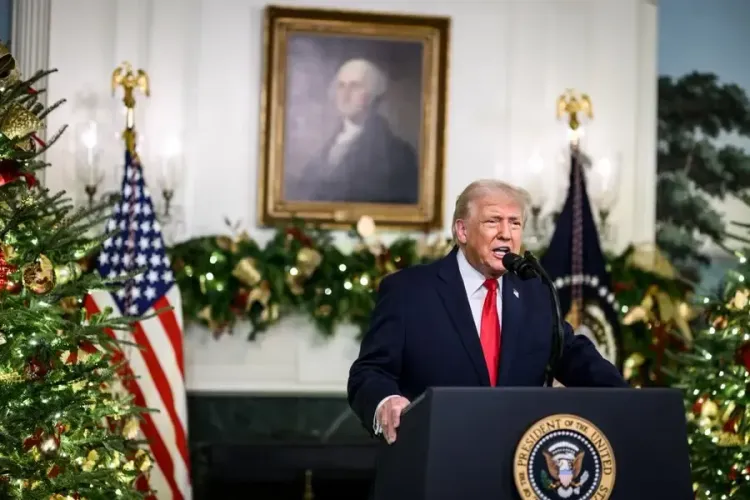
Washington, Dec 19 (NationPress) US President Donald Trump has officially enacted the National Defense Authorization Act (NDAA) for the fiscal year 2026. This comprehensive defense legislation notably emphasizes the need for enhanced US military collaboration with India and promotes stronger ties through the Quad as a component of the United States' Indo-Pacific strategy.
The NDAA allocates an impressive $890 billion for national security initiatives. It mandates the US to intensify its partnership with India, particularly through the Quadrilateral Security Dialogue, aimed at fostering a free and open Indo-Pacific.
In his statement during the signing, Trump articulated that the Act “will empower the Department of War to execute my Peace Through Strength agenda, safeguard the homeland against domestic and international threats, and bolster the defense industrial base,” while enshrining elements of over a dozen executive orders from his administration.
The legislation advocates for expanded bilateral and multilateral military interactions with India, heightened involvement in military drills, increased defense trade, and closer collaboration on humanitarian aid and disaster response. Notably, it highlights maritime security as a critical area for US-India cooperation.
The NDAA also instructs a joint US-India evaluation of nuclear liability regulations under the United States-India Strategic Security Dialogue.
It mandates the Secretary of State to create a regular consultative mechanism with India for assessing the implementation of the 2008 civil nuclear agreement, exploring ways for India to align its domestic nuclear liability regulations with international standards, and developing joint diplomatic strategies regarding civil nuclear cooperation.
The State Department is obliged to report to Congress within 180 days of the enactment and subsequently on an annual basis for five years.
The Act requires US assessments that encompass Russia's military relations with India and Russia's broader military stance impacting the Indo-Pacific and other regions.
In a separate provision, the NDAA authorizes the creation of an Ambassador-at-Large for the Indian Ocean Region within the State Department. This role would oversee US diplomatic initiatives throughout the Indian Ocean countries, focusing on counteracting malign influences from the People’s Republic of China in the area.
Additionally, the NDAA allocates $1 billion for the Taiwan Security Cooperation Initiative, incorporating provisions to prevent Chinese military enterprises from circumventing US restrictions via third-party nations.
On a broader scale, the NDAA provides for a 3.8 percent salary increase for US service members and allocates funds for housing, healthcare, childcare, and protections for civilian defense employees.
Having been passed annually for over six decades, the NDAA delineates US defense policy and spending priorities. The FY26 legislation officially integrates expanded military, nuclear, and regional engagement with India into the framework of US defense legislation.
Point of View
This development demonstrates a strategic alignment between the US and India, reinforcing the importance of bilateral military ties in an increasingly complex geopolitical landscape. The NDAA not only signifies financial commitment but also a long-term vision for Indo-Pacific security.
NationPress
22/12/2025
Frequently Asked Questions
What is the NDAA?
The National Defense Authorization Act (NDAA) is an annual piece of legislation that outlines the budget and expenditures for the US Department of Defense and establishes policies for military operations.
How much funding is allocated in the 2026 NDAA?
The NDAA for fiscal year 2026 allocates approximately $890 billion for national security spending.
What role does India play in the NDAA?
The NDAA explicitly calls for expanded military engagement with India, promoting deeper cooperation through the Quad and enhancing bilateral and multilateral military exercises.
What is the significance of the Quad?
The Quadrilateral Security Dialogue, or Quad, is a strategic forum comprising the US, India, Japan, and Australia, aimed at promoting a free and open Indo-Pacific region.
What new position is established in the NDAA?
The NDAA authorizes the creation of an Ambassador-at-Large for the Indian Ocean Region to coordinate US diplomatic efforts and counteract malign influences in the region.