Trump marks US 250th Independence Day with military, economy address
Synopsis
Trump's America250 address was part history lesson, part political manifesto. Delivered from the National Mall after thunderstorms forced a delay, it combined tributes to veterans with unverified military claims — including sinking '159 Iranian ships' — alongside a push for voter ID laws and a pledge to lead the world to the Moon and Mars. The speech crystallised the defining themes of his second term in a single prime-time moment.
Key Takeaways
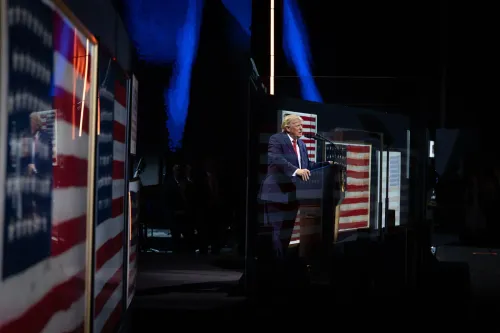
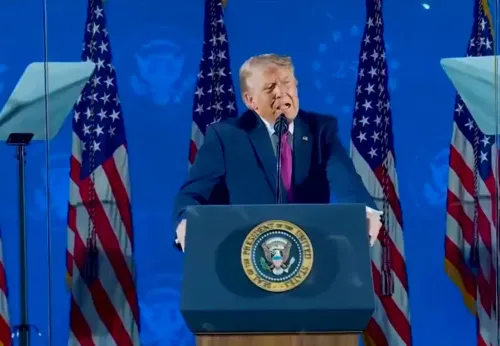
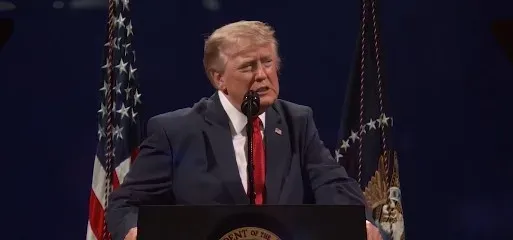
Donald Trump delivered a nearly 40-minute address from the National Mall on 5 July 2025 marking America's 250th Independence Day .
The event, part of the White House's America250 programme, was delayed by severe thunderstorms and lightning.
Trump claimed the US secured a major naval victory against Iran , asserting 159 ships were sunk — a claim that could not be independently verified.
He urged Congress to pass the 'Save America Act' , requiring voter ID and proof of citizenship and restricting mail-in ballots.
Trump welcomed NASA Artemis II astronauts and pledged US missions to the Moon and Mars , defending the US Space Force .
He claimed the US had attracted $19.2 trillion in investment and described the current era as 'the golden age of America.'
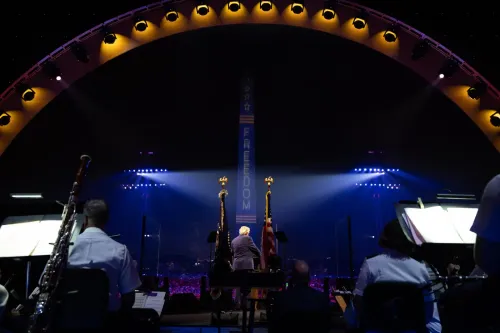
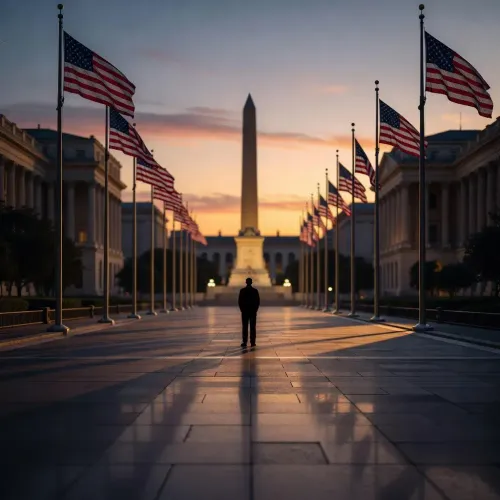
US President Donald Trump delivered a sweeping nearly 40-minute address on 5 July 2025 from the National Mall in Washington DC, marking America's 250th Independence Day with tributes to military strength, economic achievements, and an ambitious vision for US leadership on Earth and in space. The speech, the centrepiece of the White House's America250 celebrations, was delayed by several hours after severe thunderstorms and lightning forced thousands of supporters to evacuate temporarily.
Key Moments from the Address
Opening to a crowd that had returned after the weather delay, Trump called the occasion 'one of the most joyous and glorious milestones of all time.' He described the 250th anniversary of the Declaration of Independence — signed on 4 July 1776 — as a defining moment, saying the United States had been 'the hope, the promise, the light, and the glory among all of the nations of the world' for two-and-a-half centuries.
Using a series of historic American flags displayed on stage, Trump walked through key chapters of US history — from the Revolutionary War victories at Saratoga and Yorktown, through the Civil War, two World Wars, the Korean War, Vietnam, and the fall of communism. He invited decorated veterans to the stage, including Colonel Paris Davis, Pearl Harbour survivor Ken Shubrin, D-Day veteran Arthur Rose, and Iwo Jima veteran Corporal Graves, describing them as symbols of American courage. 'They saved the world, and they made America very, very proud,' he said.
Military Claims and Election Law Push
Military strength was a recurring theme. Trump said recruitment across the armed forces, police departments, and fire services had surged, attributing it to renewed national pride. He claimed to have 'rebuilt' the military during his first term, and referenced what he described as a conflict with Iran this year, asserting the United States had secured 'one of the greatest naval victories in history' by 'sinking the entire Iranian navy, 159 ships to the bottom of the sea.' The claim could not be independently verified.
Trump also urged Congress to pass the 'Save America Act', which he said would require voter identification, proof of citizenship, and sharply restrict mail-in voting — allowing exceptions only for illness, disability, military deployment, or travel.
Anti-Communism Rhetoric and Space Vision
Trump repeatedly denounced communism during the address, calling it 'a cancer' and declaring that 'America will never be a communist country.' He said communist ideology was 'a loser, and it always will be.'
On space, Trump welcomed NASA's Artemis II astronauts and Apollo 17 astronaut Jack Schmitt to the stage. Presenting the Artemis crew with a US flag flown over the Capitol, he said it would one day be planted on the Moon. 'We're going to do the Moon, and we're going to go from there. We're going to go to Mars,' he said. He also defended the creation of the US Space Force, claiming the United States was now leading China and Russia in space.
Economic Claims and Closing Vision
In the closing segment, Trump argued the nation was experiencing renewed prosperity. He claimed the US stock market was 'the strongest it's ever been', that the country had attracted $19.2 trillion in investment, was building more factories than ever before, had record employment, and that retirement accounts were at historic highs. He also claimed Washington DC had become 'safe and gleaming and beautiful again.'
Ending on an optimistic note, Trump declared: 'We may be the oldest constitutional republic on earth, but our country is just getting started, because the best is yet to come.' He called the present era 'the golden age of America' and pledged to make the country 'bigger, better, stronger.' The speech concluded with a fireworks display over the National Mall. Trump also honoured 11 Gold Star families, thanking them for the sacrifices made by their loved ones in military service.
Point of View
It would rank among the most significant naval engagements in modern history, yet it arrived without corroboration or official defence department framing. The 'Save America Act' push, embedded in a patriotic address, reflects a deliberate strategy of normalising contentious electoral changes through ceremonial settings. Internationally, the speech's framing of US supremacy — 'they try to be like us, nobody can be like us' — signals continued unilateralism heading into the next quarter-century of American foreign policy.
NationPress
5 Oct 2026
Frequently Asked Questions
What did Trump say in his 250th Independence Day speech?
Trump delivered a nearly 40-minute address from the National Mall on 5 July 2025, covering US military strength, economic achievements, space ambitions, anti-communism rhetoric, and a call for tighter election laws. He also honoured veterans and Gold Star families and presented the Artemis II crew with a US flag to be planted on the Moon.
What is the 'Save America Act' Trump mentioned?
The Save America Act is a proposed piece of legislation Trump urged Congress to pass, which would require voter identification and proof of citizenship and sharply restrict mail-in voting. Exceptions would be permitted for illness, disability, military deployment, or travel.
What did Trump claim about Iran during the speech?
Trump claimed the United States had secured 'one of the greatest naval victories in history' against Iran, asserting it had sunk the 'entire Iranian navy, 159 ships to the bottom of the sea.' The claim could not be independently verified at the time of the address.
Why was the Independence Day event delayed?
Severe thunderstorms and lightning struck Washington DC on 5 July 2025, forcing thousands of attendees to evacuate the National Mall temporarily. The celebrations resumed after the storms passed, with Trump thanking supporters for returning.
What did Trump say about space and NASA?
Trump welcomed NASA's Artemis II astronauts and Apollo 17 astronaut Jack Schmitt to the stage, presenting the Artemis crew with a US flag flown over the Capitol. He pledged Moon and Mars missions and defended the US Space Force, claiming America was now leading China and Russia in space.