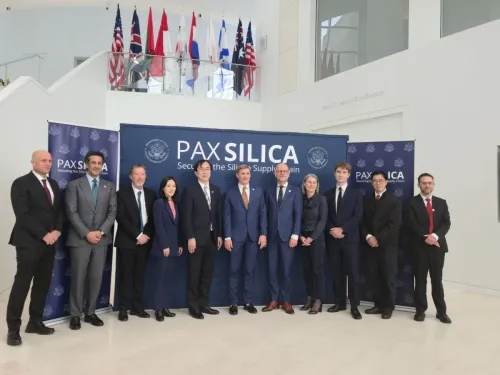
India's Strategic Role in US Efforts to Diminish China's Technology Dominance

Synopsis
The US is strategically aligning with India to reduce China's grip on rare earth minerals and advanced technology, as highlighted in a recent Congressional hearing. This partnership aims to bolster supply chains and enhance economic security.
Key Takeaways
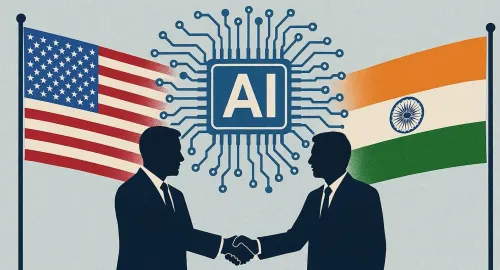
India has joined the US-led Pax Silica coalition aimed at securing supply chains.
Strategic collaboration between the US and India is intended to counter China's dominance in technology.
China currently controls a significant portion of global refining capacity.
The US is focusing on enhancing refining capabilities in allied nations.
Strengthened US-India trade relations signal a robust partnership for future technologies.
On February 25, during a pivotal Congressional hearing on economic security, it was revealed that the United States is strategically positioning India as a crucial ally to diminish China's hold on rare earth elements and advanced technology supply chains, according to a senior official from the State Department.
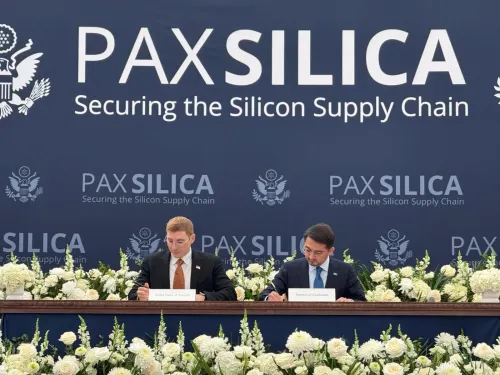
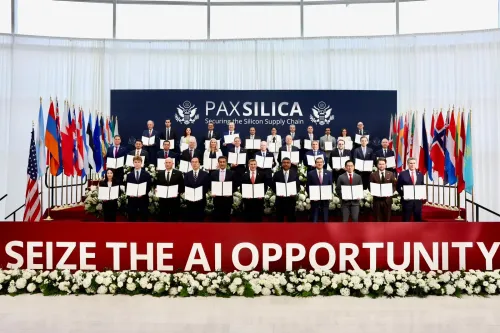
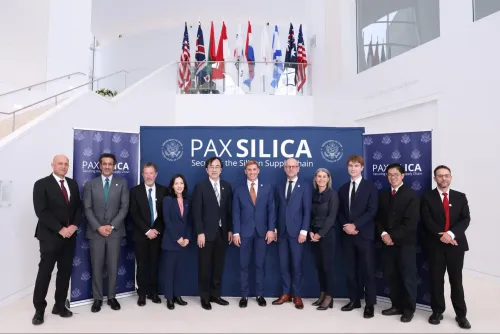
Undersecretary of State for Economic Growth, Energy and Environment, Jacob Helberg, testified before the House Foreign Affairs Committee, announcing that India has officially joined the US-led “Pax Silica” coalition. This initiative is designed to secure supply chains in critical minerals, semiconductors, and artificial intelligence among allied nations.
“We welcomed India into our coalition just last week,” Helberg noted, emphasizing that Pax Silica serves as “an economic security coalition for the AI century, aimed at bolstering the supply chain infrastructure essential for national power.”
Helberg warned lawmakers that control over the industrial foundations of AI will be pivotal for global leadership in the coming decades.
“The nation that dominates the industrial foundations of artificial intelligence will lead this century, while those that do not will rely on those who do,” he stated.
He highlighted India’s strategic strengths, asserting that New Delhi possesses both talent and substantial refining capabilities.
“India is perhaps the only nation that can rival China in terms of the depth of its human capital and skilled workforce,” Helberg claimed. “Additionally, it ranks as the world’s third-largest mineral refiner.”
Currently, China accounts for around 90 percent of global refining capacity, which Helberg described as a “fundamental challenge” that the US is urgently addressing.
He explained that the strategy includes enhancing refining capabilities in allied countries through “brownfield projects” and mobilizing private investments into mining and mineral processing initiatives in nations like India, Australia, and South Korea.
Washington’s approach integrates economic coordination, export controls, and supply chain diversification to counteract what Helberg characterized as China’s strategic exploitation of trade and industrial policies.
“China has openly stated its intentions to decouple from us,” he remarked. “The real question is whether we are comfortable maintaining our dependency on them while they actively seek to separate from us.”
The hearing revealed significant partisan divides regarding US tariff policies, yet there was a shared bipartisan concern over China’s dominance in critical minerals and advanced manufacturing.
Helberg mentioned that 55 countries recently took part in a US-led ministerial focused on critical minerals to explore alternatives to Chinese-controlled supply chains. He also referred to a recent joint statement between the US and India on trade that includes “historic purchases by India from the US concerning energy” and increased cross-border investments.
“I have immense confidence in the trajectory of the US-Indian relationship,” he asserted. “It is incredibly robust.”
For India, these statements signify a growing acknowledgment in Washington of its role in shaping the forthcoming phase of global technological competition. In recent years, the United States and India have strengthened their collaboration through initiatives related to critical and emerging technologies, as well as within frameworks like the Quad, alongside Japan and Australia.
Point of View
The emphasis on India as a key partner by the US highlights a strategic pivot in addressing challenges posed by China's dominance in technology and resources. This collaboration could redefine international supply chains and economic security.
NationPress
19 Sept 2026
Frequently Asked Questions
What is the Pax Silica coalition?
The Pax Silica coalition is a US-led initiative aimed at securing supply chains in critical minerals, semiconductors, and artificial intelligence among allied nations, with India being a recent addition.
Why is India considered a strategic ally for the US?
India possesses significant talent and refining capabilities, making it a crucial ally in reducing China's dominance over global supply chains in technology and critical minerals.
What are the implications of China's control over refining capacity?
China currently controls about 90 percent of the world's refining capacity, which poses a significant challenge for the US and its allies in achieving supply chain security.
How is the US responding to China's trade strategies?
The US is enhancing refining capabilities in allied countries, implementing economic coordination, and diversifying supply chains to address China's strategic use of trade and industrial policies.
What recent developments have occurred in US-India trade relations?
A recent joint statement highlighted historic energy purchases by India from the US, signaling strengthened trade ties and increased cross-border investments.