US Military Operations Have Severely Weakened Iran's Forces

Synopsis
The U.S. military campaign against Iran has dramatically weakened Tehran's armed forces, striking over 6,000 targets and rendering Iranian naval power ineffective. This escalation marks a significant turning point in the ongoing conflict.
Key Takeaways
U.S. military strikes have significantly weakened Iran's armed forces.
Over 6,000 targets have been engaged in the conflict.
Iranian naval power is now largely combat ineffective .
The campaign is part of Operation Epic Fury , focusing on missile infrastructure.
Global energy security is at risk due to tensions in the Strait of Hormuz .
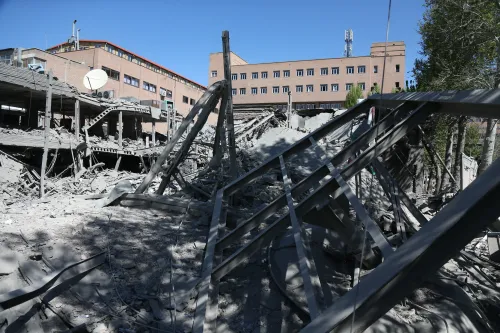
Washington, March 13 (NationPress) On Friday, the United States announced that its military operations against Iran had significantly weakened Tehran’s armed forces. With over 6,000 targets impacted, Iranian naval capabilities have been deemed “combat ineffective” as the conflict now enters its 13th day.
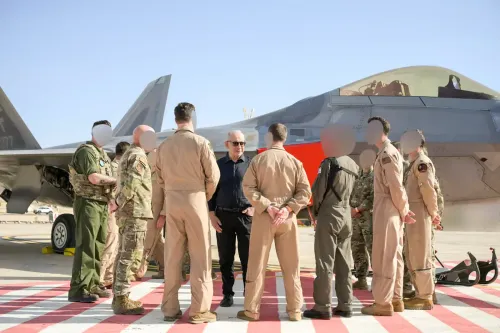
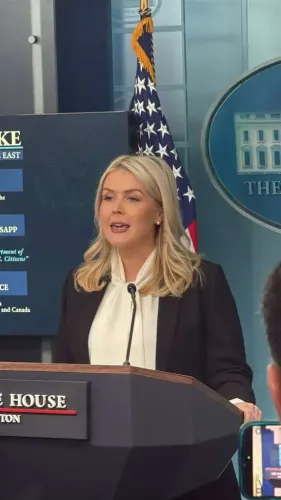
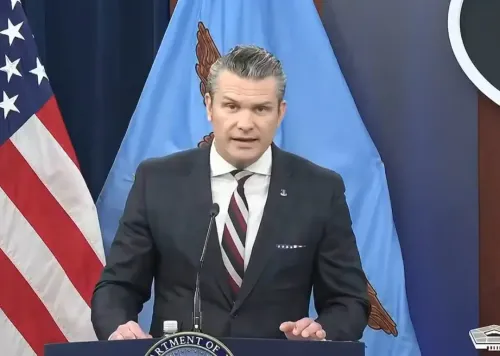
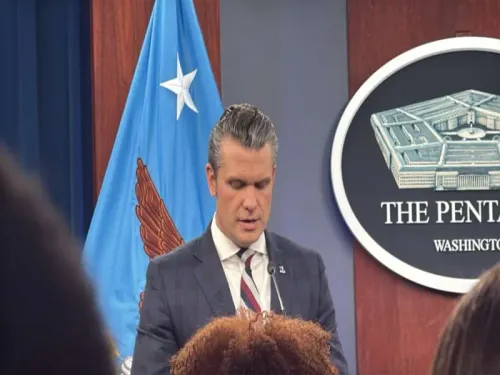
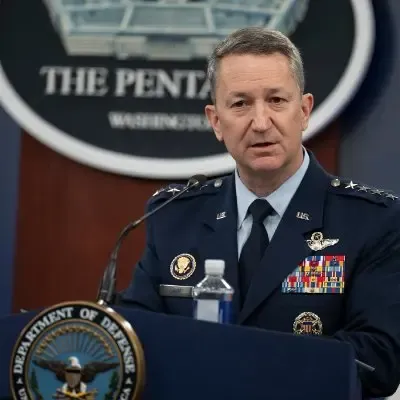
During a Pentagon press briefing, Defense Secretary Pete Hegseth and Chairman of the Joint Chiefs of Staff Gen. Dan Caine reported that U.S. forces were ramping up their efforts through a campaign termed Operation Epic Fury, focusing on Iran’s missile systems, naval resources, and defense manufacturing.
“As we begin the 13th day of Operation Epic Fury, we are continuing to advance towards our military goals,” Caine informed the media.
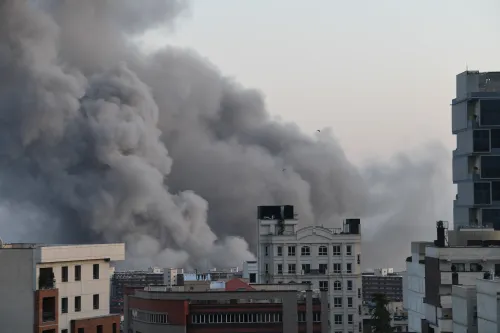
The U.S. military has engaged in a persistent air and missile campaign throughout Iran, targeting military installations, manufacturing facilities, and launch systems that officials claim allow Tehran to pose a threat to American troops, regional allies, and commercial shipping.
“We’ve hit over 6,000 targets, and our strike packages are being deployed every hour,” Caine stated. “Centcom is now consistently over the adversary.”
The Pentagon reports that this military campaign has greatly diminished Iran’s ability to execute military operations.
“As Admiral Cooper mentioned in his update on Wednesday, Iranian combat effectiveness continues to wane due to the ongoing strikes,” Caine remarked.
He pointed out significant damage inflicted on Iran’s naval capabilities.
“In under two weeks, we’ve made the Iranian Navy combat ineffective and are continuing to target naval vessels,” he noted, including ships equipped with anti-ship and anti-aircraft armaments.
U.S. officials have stated that this military operation aims to dismantle Iran’s ability to threaten maritime traffic and project power in the region.
“Our bases or our allies in the area are consistently undermining the Iranian Navy,” Caine added.
American forces are also focused on targeting Iran’s mine-laying capabilities and the infrastructure associated with attacks on commercial shipping.
“We are going after Iran’s mine-laying capacity to prevent assaults on commercial vessels,” he explained.
Despite the Pentagon's reported advancements, Caine warned that Iran still possesses some capability to threaten U.S. forces and international shipping.
“Iran can still pose risks to friendly forces and commercial shipping, and we are committed to this effort,” he stated.
Defense Secretary Hegseth emphasized that the military campaign's objectives have remained unchanged since the conflict began.
“We have defined these objectives clearly and are actively pursuing them,” he mentioned.
He noted that the U.S. is aiming to destroy Iranian missile launchers, cripple its defense industrial base, and weaken its naval forces.
“Our focus is on missile launchers, the defense industrial base, their navy, and limiting their capability to project power, which is crucial in preventing them from acquiring nuclear weapons,” Hegseth said.
The defense secretary highlighted that the administration is intentionally avoiding broader military or political goals that have characterized previous U.S. conflicts in the region.
“We are not engaging in mission creep, expansive missions, or prolonged timelines. Democracy building and nation building are not part of President Trump's intentions,” he stated.
Hegseth remarked that President Trump will ultimately dictate the pace and duration of the military campaign.
“The President has control over the throttle and will determine when we have achieved our objectives,” he stated.
The Pentagon also indicated that the intensity of U.S. airstrikes is continuing to increase.
Caine mentioned that Thursday would mark the most active day of the operation to date.
“Today will be our busiest day,” he confirmed.
Hegseth stated that the operation is escalating across various domains.
“We are enhancing every tool at our disposal—AI, cyber capabilities, space, electronic warfare, counter-UAS—you name it, we are utilizing it,” he said.
The briefing also addressed concerns regarding the safety of global energy routes, particularly the Strait of Hormuz.
Caine stated that Iranian actions have been responsible for disruptions to commercial shipping in this vital waterway.
“The only factor hindering commercial traffic through the Straits at this moment is Iran,” he detailed.
The Pentagon emphasized that the U.S. is prioritizing operations aimed at neutralizing Iran’s ability to threaten maritime traffic.
“Targeting Iran’s mine-laying operations is a top priority for us,” Caine said.
Hegseth mentioned that Washington has long anticipated Iran's potential to exploit the strait during a conflict.
“For years, Iran has threatened shipping in the Strait of Hormuz,” he stated.
“We have plans in place for every conceivable scenario,” he added.
The briefing also touched upon the risks and costs associated with the ongoing military campaign.
Caine confirmed a U.S. KC-135 refueling aircraft crashed over western Iraq during a combat mission.
He noted that the incident was not a result of hostile or friendly fire.
“We are treating this as an ongoing rescue and recovery operation,” Caine mentioned.
He also reported that four airmen had been rescued and updates would be provided as more information comes to light.
“Our service members make tremendous sacrifices to carry out the missions our nation requires of them,” he affirmed.
Caine also highlighted a fire on the aircraft carrier USS Gerald R. Ford, stating that the Pentagon is monitoring the situation and further questions should be directed to the Navy.
Both officials commended U.S. troops involved in the campaign, particularly the artillery units supporting the operation.
Caine noted that American soldiers and Marines had utilized the Precision Strike Missile for the first time in combat during this conflict.
“In just the initial 13 days of this operation, our artillery forces have made history,” he stated.
“They fired the first precision strike missiles ever deployed in combat, reaching deep into enemy territory.”
Caine recounted discussions with soldiers from the 3rd Battalion, 27th Field Artillery Regiment stationed at Fort Bragg in North Carolina.
“One of them had joined the Army only six months ago and had only been in the unit for two months before being deployed,” Caine explained.
Despite their youth, he noted that the troops conducted their missions with professionalism and discipline.
“They expressed calmness, pride, purpose, and clarity,” he stated.
The ongoing confrontation between Washington and Tehran arises amidst longstanding tensions regarding Iran’s nuclear program, its missile capabilities, and its network of regional proxies throughout the Middle East.
The Strait of Hormuz remains a critical chokepoint for global energy, facilitating a substantial portion of daily oil shipments worldwide.
Developments in this conflict are being closely monitored by energy-importing nations, including India, which relies significantly on crude oil from the Gulf region and is sensitive to disruptions in global energy markets.
Point of View
I recognize the serious implications of the U.S. military campaign against Iran. The ongoing conflict raises critical questions about regional stability and international relations, particularly concerning global energy security and the balance of power in the Middle East.
NationPress
30 Sept 2026
Frequently Asked Questions
What is Operation Epic Fury?
Operation Epic Fury is the codename for the U.S. military campaign targeting Iran's missile infrastructure, naval assets, and defense industrial base.
How many targets have been struck in the campaign?
The U.S. military has reported that over 6,000 targets have been struck in the ongoing conflict.
What impact has the campaign had on Iran's military?
The campaign has significantly degraded Iran's military capabilities, rendering its naval forces combat ineffective.
What are the objectives of the U.S. military campaign?
The campaign aims to dismantle Iran’s capacity to threaten maritime traffic and to disable its missile launchers and naval capabilities.
What is the significance of the Strait of Hormuz?
The Strait of Hormuz is a critical chokepoint for global energy, through which a large share of the world's oil shipments pass.