US-Saudi Arabia civil nuclear pact signed, opens door for American firms
Synopsis
Washington and Riyadh have formalised a civil nuclear partnership that could be worth billions over decades — and hands American firms a foothold in Saudi Arabia's emerging nuclear sector. The deal is as much a geopolitical signal as an energy agreement: it arrives as Russia and China compete fiercely for nuclear contracts across the Middle East, and as Saudi Arabia's own nuclear ambitions draw sustained international scrutiny.
Key Takeaways
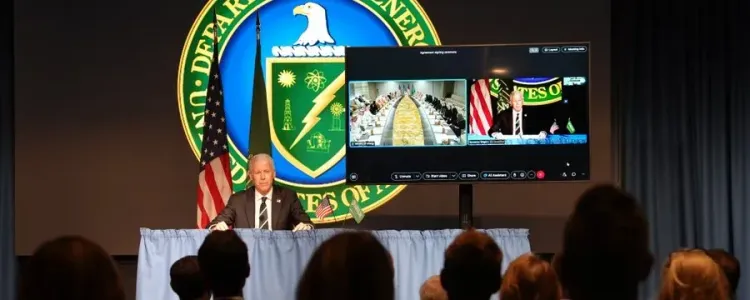
US Energy Secretary Chris Wright and Saudi Energy Minister Prince Abdulaziz bin Salman signed the civil nuclear pact on 23 July .
The deal is a Section 123 agreement under the US Atomic Energy Act of 1954 — a legal prerequisite for significant civilian nuclear cooperation.
The US Department of Energy called it the foundation for a 'decades-long, multi-billion-dollar partnership.' An accompanying bilateral safeguards agreement commits both nations to high standards of nuclear safety and non-proliferation.
The agreement will now go to US Congress for a mandatory review before taking full effect.
The deal advances the Trump administration's push to expand American leadership in the global civil nuclear market.
The United States and Saudi Arabia on Wednesday, 23 July signed a landmark civil nuclear cooperation agreement, formally opening the door for American companies to participate in the Kingdom's planned nuclear energy programme. The deal, known as a Section 123 agreement under the US Atomic Energy Act of 1954, establishes the legal framework for what the US Department of Energy described as a 'decades-long, multi-billion-dollar partnership.'
What Was Signed
US Energy Secretary Chris Wright and Saudi Energy Minister Prince Abdulaziz bin Salman signed two documents: the peaceful nuclear cooperation agreement and an accompanying bilateral safeguards agreement. Together, they set the legal and non-proliferation terms governing nuclear trade, technology transfers, and related cooperation between the two countries.
Under US law, a Section 123 agreement is a prerequisite before Washington can engage in significant civilian nuclear cooperation with any foreign nation. The agreement will now be transmitted to the US Congress for review before it can take full effect.
What the US Said
'These agreements reflect our two nations' shared commitment to strengthening US-Saudi commercial relations, delivering prosperity at home and security to our allies abroad,' Wright said after the signing. He added: 'Rest assured, these agreements uphold the highest standards of nuclear safety and nonproliferation, while relying on the world's best nuclear technology and scientists, designed right here in the United States.'
Wright also credited President Donald Trump, stating: 'Thanks to President Trump, the American nuclear renaissance is underway and will deliver long-term benefits to the American and Saudi people.' The Energy Department said the deal advances the Trump administration's effort to expand US leadership in the global civil nuclear market and promote exports of American nuclear technology.
Strategic and Commercial Significance
The agreement is expected to expand US nuclear technology exports, create high-paying American jobs, and strengthen US energy and national security, according to the Energy Department. It also aims to reinforce global non-proliferation standards and deepen strategic ties with Riyadh.
The deal builds on President Trump's executive order on deploying advanced nuclear reactor technologies for national security, which included provisions promoting American civil nuclear exports. For Saudi Arabia, it represents a significant step toward diversifying an energy mix currently dominated by hydrocarbons.
Non-Proliferation Framework
US officials said the accompanying safeguards agreement commits both countries to high standards of nuclear safety, security, and non-proliferation. Notably, the agreement comes amid longstanding international scrutiny over Saudi Arabia's nuclear ambitions, including past statements by senior Saudi officials about matching any Iranian nuclear capability. The safeguards framework is intended to address those concerns by embedding non-proliferation commitments directly into the cooperation structure.
What Happens Next
The agreement now heads to US Congress for a mandatory review period. Industry observers expect American nuclear technology firms to begin formal engagement with Saudi counterparts once Congressional review concludes. The partnership, if fully realised, could reshape the competitive landscape in the global civil nuclear market, where Russia and China have aggressively expanded their footprint in recent years.
Point of View
But its strategic weight lies elsewhere. By locking in a non-proliferation framework with Riyadh now, Washington is attempting to shape the terms of Saudi Arabia's nuclear future before Riyadh turns to Moscow or Beijing — both of whom have fewer conditions attached to their nuclear export offers. The harder question the agreement does not answer is enforcement: Saudi officials have previously signalled they would pursue enrichment capabilities if Iran did. Whether the safeguards agreement has teeth on that specific point will determine whether this is a durable non-proliferation instrument or a commercially useful but strategically incomplete deal.
NationPress
23 Jul 2026
Frequently Asked Questions
What is the US-Saudi Arabia civil nuclear agreement signed on 23 July?
It is a Section 123 agreement under the US Atomic Energy Act of 1954, signed on 23 July by US Energy Secretary Chris Wright and Saudi Energy Minister Prince Abdulaziz bin Salman. The deal establishes the legal and non-proliferation framework for civilian nuclear cooperation between the two countries, enabling American firms to participate in Saudi Arabia's nuclear energy programme.
What is a Section 123 agreement and why does it matter?
A Section 123 agreement is a mandatory legal prerequisite under US law before Washington can engage in significant civilian nuclear cooperation with another country. It governs nuclear trade, technology transfers, and related cooperation, and must include non-proliferation commitments. Without it, American companies cannot legally supply nuclear technology or fuel to a foreign partner.
What happens next after the agreement is signed?
The agreement will be sent to the US Congress for a mandatory review period. Once Congressional review concludes, American nuclear technology firms are expected to begin formal commercial engagement with Saudi counterparts under the framework established by the deal.
How does this deal benefit the United States?
According to the US Department of Energy, the partnership is expected to expand American nuclear technology exports, create high-paying US jobs, strengthen energy and national security, and deepen strategic ties with Saudi Arabia. It also advances the Trump administration's broader goal of reclaiming US leadership in the global civil nuclear market.
Does the agreement address nuclear proliferation concerns about Saudi Arabia?
The accompanying bilateral safeguards agreement commits both countries to high standards of nuclear safety, security, and non-proliferation. US officials said these standards are embedded in the legal framework of the deal. However, the agreement's effectiveness on proliferation will ultimately depend on enforcement mechanisms, which have not been publicly detailed.