White House: 70M Trump Accounts, $4.5B Deposited Since July 4

Synopsis
The White House announced on October 7, 2026 that Trump Accounts have crossed 70 million enrollments and $4.5 billion in deposits since July 4, with auto-enrollment driving uptake and a $1,000 one-time federal contribution available to claimants.
Key Takeaways
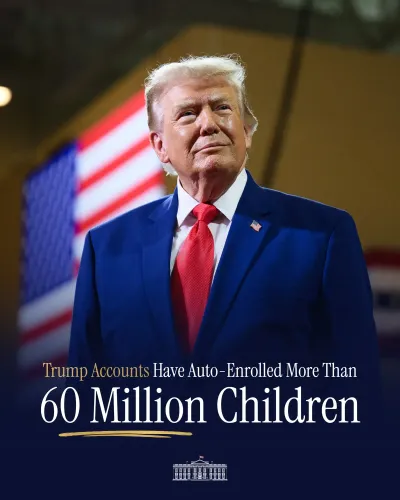
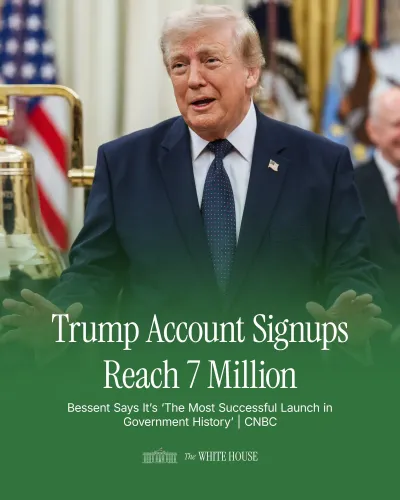
The White House announced Trump Accounts have reached 70 million enrolled accounts as of October 7, 2026 .
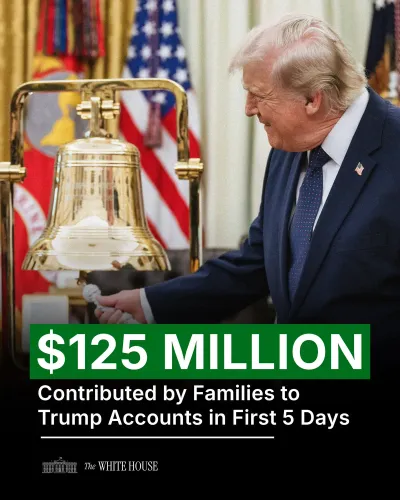
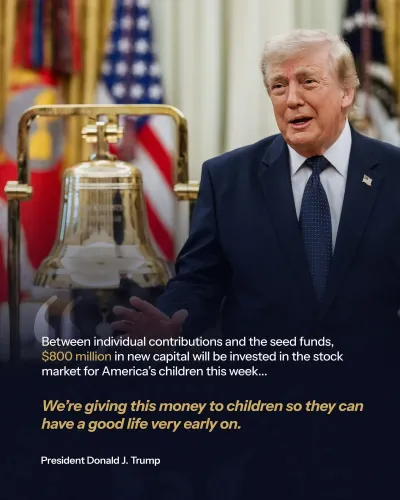
More than $4.5 billion has been deposited into these accounts since the programme launched on July 4, 2026 .
Each eligible American can claim a one-time $1,000 federal contribution by activating their account.
Auto-enrollment is the key mechanism — eligible participants are opted in by default, removing sign-up friction.
The programme is framed as giving 'America's next generation a real stake in the American dream,' targeting broad-based wealth access.
The rapid rollout puts the monthly government outlay at roughly $1.5 billion , setting up a major fiscal debate ahead.
Seventy million accounts. $4.5 billion deposited. The numbers the White House posted on Wednesday, October 7, 2026 are not projections — they are the live scoreboard of a sweeping new federal savings initiative called Trump Accounts, designed to give every American child a government-seeded financial stake from birth.
The official White House account declared, 'THE FUTURE IS FUNDED,' announcing that auto-enrollment has already pulled 70 million accounts into the programme, with more than $4.5 billion deposited since the scheme's symbolic launch date of July 4, 2026. Eligible Americans are being urged to claim their account and unlock a one-time $1,000 federal contribution.
What Trump Accounts actually are
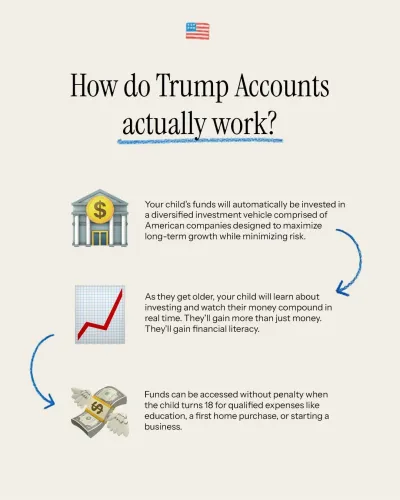
Trump Accounts are federally backed savings or investment accounts seeded with a $1,000 one-time government contribution, aimed at giving American children — particularly those from lower-income households — a foundational financial asset. The auto-enrollment mechanism means eligible newborns or citizens are opted into the programme by default, dramatically lowering the participation barrier that has historically kept wealth-building tools out of reach for millions of families. The framing from the White House positions the scheme firmly in the language of the 'American dream' — the idea that every child, regardless of zip code or family income, should have a real financial footing from day one.70 million accounts in roughly three months
The scale is striking. If the 70 million figure is accurate as of early October 2026, it represents one of the fastest mass-enrollment financial programmes in American history — broader in raw numbers than many major federal benefit rollouts. The $4.5 billion-plus already deposited since July 4th implies a government outlay running at a pace of roughly $1.5 billion per month, a significant fiscal commitment that will invite scrutiny from budget watchdogs and opposition lawmakers alike. Auto-enrollment is the engine here. Rather than requiring families to navigate bureaucratic sign-up processes, eligible participants are enrolled automatically and must actively opt out — a design choice drawn from behavioural economics research that consistently shows default-on systems achieve far higher participation than opt-in equivalents.The $1,000 claim and what comes next
The White House post includes a direct call to action, asking Americans to visit a linked portal and 'claim' their Trump Account to unlock the one-time $1,000 contribution. This suggests at least some portion of the 70 million enrolled accounts may not yet have been formally activated or verified by account holders, and the administration is pushing for full uptake before any claim window closes. For Indian-origin Americans and the broader South Asian diaspora in the United States — a demographic with above-average financial literacy and high household savings rates — the programme could represent a meaningful additional asset for children born or naturalised as US citizens. At $4.5 billion already out the door and tens of millions more accounts potentially pending their $1,000 seed, the fiscal trajectory of Trump Accounts will become a central battleground in the next federal budget debate. The administration has bet big — and the clock on claiming is running.Point of View
000 seed contribution is modest in isolation, but at 70 million accounts it becomes a multi-trillion-dollar liability horizon if compounding returns and future top-ups are baked in. For the White House, the political calculus is straightforward: a tangible, named benefit that every American family can point to is extraordinarily difficult for opponents to campaign against. The real test will come when the Congressional Budget Office scores the full programme cost and deficit hawks on both sides of the aisle are forced to take a position.
NationPress
8 Oct 2026
Frequently Asked Questions
What is a Trump Account and who is eligible?
A Trump Account is a federally backed savings account seeded with a one-time $1,000 government contribution. Auto-enrollment means eligible Americans — particularly newborns and children — are opted in by default, though the exact eligibility criteria have not been detailed in the White House post.
How do I claim my Trump Account and the $1,000 contribution?
The White House directed Americans to a linked portal in its October 7, 2026 post where account holders can claim and activate their Trump Account to unlock the one-time $1,000 federal contribution.
How many Trump Accounts have been opened so far?
According to the White House, 70 million accounts have been enrolled and more than $4.5 billion deposited since the programme launched on July 4, 2026 .
What is auto-enrollment in Trump Accounts?
Auto-enrollment means eligible Americans are automatically signed up for a Trump Account without having to apply, dramatically increasing participation. Account holders can opt out if they choose.
Will Trump Accounts affect the US federal budget or deficit?
With $4.5 billion deposited in roughly three months and 70 million accounts enrolled, the programme's fiscal footprint is significant and is expected to face scrutiny from budget analysts and lawmakers during the next federal budget cycle.