White House Reaffirms America as 'One Nation Under God'
Synopsis
The White House on 27 June 2026 declared America 'ONE NATION UNDER GOD,' invoking language enshrined in the Pledge of Allegiance since 1954 when President Eisenhower signed the phrase into law. The post reignites debate between religious communities and civil liberties groups over faith in American public life.
Key Takeaways
The White House posted on 27 June 2026 that America 'has always been, and always will be, ONE NATION UNDER GOD.' The phrase 'under God' was added to the U.S.
Pledge of Allegiance by Congress in 1954 , signed by President Dwight D.
In 1956 , 'In God We Trust' was designated the official national motto, reinforcing the same religious framing.
The declaration echoes a long pattern of presidential and congressional affirmations of America's religious heritage, particularly during periods of cultural debate.
The post has drawn attention from both religious communities, who welcome it, and civil liberties groups, who have historically contested such government expressions of faith.
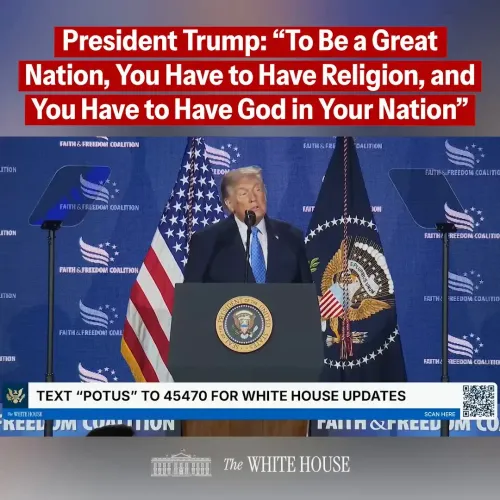
The White House, the official communications account of the Executive Office of the President of the United States, posted a declaration of national religious identity on Friday, 27 June 2026, stating that America 'has always been, and always will be, ONE NATION UNDER GOD.'
Context
The phrase 'one nation under God' is not merely rhetorical — it carries specific legislative weight. In 1954, the United States Congress passed a joint resolution, signed into law by President Dwight D. Eisenhower, that inserted the words 'under God' into the Pledge of Allegiance. The move was a deliberate assertion of American religious identity during the Cold War, distinguishing the United States from officially atheist Soviet ideology.
Two years later, in 1956, Congress also designated 'In God We Trust' as the official national motto of the United States, cementing the language of faith into the country's civic fabric. The White House post on Friday directly echoes both of these mid-20th-century legislative milestones.
Policy Backdrop
Official invocations of America's religious heritage have recurred across presidential administrations and congressional sessions since the 1950s. Such statements have periodically intensified during moments of cultural or political debate over national identity, the role of religion in public life, and the boundaries of church and state.
The post's emphatic capitalisation — 'ONE NATION UNDER GOD' — signals a deliberate rhetorical choice, amplifying the declaration beyond a routine ceremonial affirmation. The specific political or ceremonial occasion prompting the June 2026 post has not been independently confirmed.
Stakeholders and Impact
The statement lands in a landscape where religious communities and civil liberties organisations have long held opposing views on public expressions of faith by government institutions. Religious groups and conservative constituencies typically welcome such affirmations as a validation of America's founding values.
Civil liberties advocates, including organisations that have historically challenged the 'under God' language in the Pledge of Allegiance through the courts, are likely to view the White House declaration as a politically charged statement. The tension between these two camps has produced decades of litigation and public debate in the United States.
What's Next
Responses from Congress, the courts, and advocacy organisations will indicate how broadly the statement is read — as routine presidential expression or as a signal of policy intent on religious freedom and public life. For Indian observers, the post is a reminder of how religious identity continues to shape political communication in the world's oldest democracy, a dynamic that resonates with ongoing debates about nationalism and faith in India as well. The White House's choice to make this declaration publicly and emphatically suggests the theme of national religious identity will remain a live issue in American political discourse in the months ahead.
Point of View
All-caps declaration is a textbook use of civic-religious language to consolidate a political base — a tool American presidents have reached for since the Cold War era. By anchoring the message in a phrase with a specific 1954 legislative history, the post frames religious identity not as opinion but as settled constitutional tradition. For Indian political analysts, the parallel to debates over national identity, majority sentiment, and state expression of faith is striking — both democracies are navigating the boundaries between civic nationalism and religious assertion. The statement is unlikely to shift policy on its own, but its timing and tone will be read as a cultural signal by supporters and critics alike.
NationPress
25 Sept 2026
Frequently Asked Questions
What does 'one nation under God' mean in the U.S. Pledge of Allegiance?
'One nation under God' is a phrase added to the U.S. Pledge of Allegiance in 1954 by Congress and signed by President Dwight D. Eisenhower. It affirms a belief in a single, unified nation guided by religious principles and was introduced during the Cold War to distinguish the United States from atheist Soviet ideology.
Why did the White House post 'one nation under God' in June 2026?
The White House posted the declaration on 27 June 2026 as an affirmation of American national and religious identity. The specific occasion or policy context for the post has not been officially confirmed beyond the statement itself.
When was 'under God' added to the U.S. Pledge of Allegiance?
'Under God' was added to the Pledge of Allegiance in 1954 when Congress passed a joint resolution and President Eisenhower signed it into law, during a period of heightened Cold War tensions.
What is the U.S. national motto and how is it related to this statement?
The U.S. national motto is 'In God We Trust,' adopted by Congress in 1956 — two years after 'under God' was added to the Pledge. Both actions were part of the same mid-20th-century effort to embed religious identity into American civic symbols.
Do civil liberties groups oppose government statements about God in the United States?
Yes, organisations focused on the separation of church and state have historically challenged government expressions of religious faith, including the 'under God' wording in the Pledge of Allegiance, through legal challenges and public advocacy.