White House Declares NASA Is 'Back' Under Trump
Synopsis
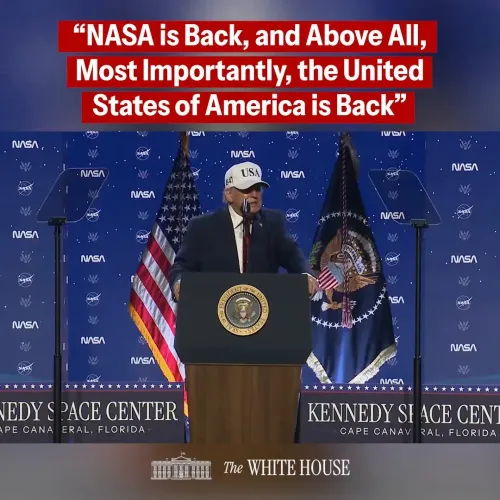
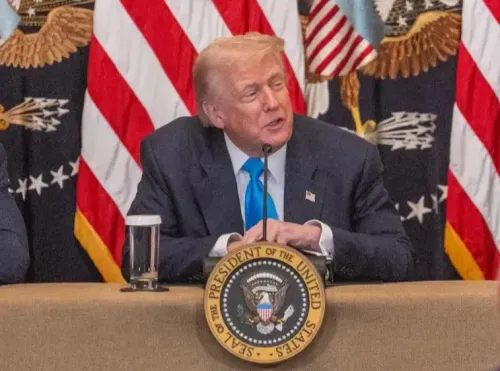
The White House declared on November 9, 2026 that 'NASA is BACK' under the Trump Administration, invoking restored ambition and leadership in a sharp social-media post that signals a renewed push on U.S. space priorities, with Artemis programme milestones the next real test.
Key Takeaways
The White House posted on November 9, 2026 declaring that ambition, momentum, and leadership have returned under the Trump Administration — and that NASA is BACK .
The first Trump administration issued Space Policy Directive-1 in December 2017 , directing NASA to return U.S. astronauts to the Moon, laying the foundation for the Artemis programme .
The declaration signals renewed prioritisation of U.S. space leadership amid intensifying competition, particularly from China .
The Artemis lunar programme and upcoming NASA budget requests will be the tangible test of the administration's declared momentum.
India , as an Artemis Accords signatory with deepening NASA-ISRO ties, has a direct stake in the direction of U.S. space policy.
The rocket emoji said it all. The White House posted a sharp, four-line declaration on Monday, November 9, 2026, announcing that under the Trump Administration, 'ambition is back, momentum is back, leadership is back' — and capping it with a blunt verdict: NASA is BACK.
A rallying cry rooted in space-policy history
The post lands against a backdrop of decades of competing visions for American space leadership. NASA, the U.S. civilian space agency, has been the centrepiece of every administration's ambitions — from the Moon to Mars — but funding cycles, shifting priorities, and the rise of commercial rivals have made 'momentum' a contested claim in Washington for years.
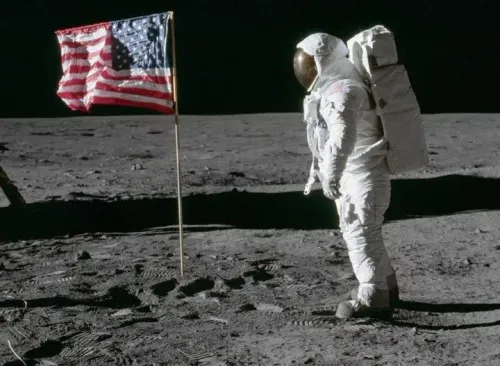
The first Trump administration leaned hard into space policy early: in December 2017, it issued Space Policy Directive-1, formally directing NASA to return American astronauts to the Moon — a directive that laid the groundwork for what later became the Artemis lunar programme. The current post appears to signal a continuation, or intensification, of that posture in the administration's second term.
What 'back' means for Artemis and beyond
The Artemis programme — NASA's flagship effort to land humans on the lunar surface — has been both the crown jewel and the pressure point of U.S. space ambition. Timelines have slipped, budgets have been contested, and international competitors, particularly China, have sharpened their own lunar goals. Against that backdrop, a White House declaration of restored momentum is not merely rhetorical: it signals budget priorities, contractor relationships, and America's posture in a rapidly intensifying space race.
The aerospace contractor ecosystem — from legacy giants to newer commercial partners — will be watching the next NASA budget request closely for hard numbers behind the rallying cry. Artemis programme milestones in the coming fiscal cycle will be the clearest test of whether the declared momentum translates into mission-ready hardware and launch schedules.
The geopolitical undertone
Statements of this kind rarely travel alone. When the White House plants the American flag emoji next to a space agency declaration, the audience extends well beyond domestic aerospace workers. It is a signal to allies in the Artemis Accords framework — which counts India among its signatories — and a pointed message to rivals. For India, whose own space agency ISRO has deepened cooperation with NASA in recent years, the direction of U.S. space leadership carries direct programmatic weight.
Ambition, as any rocket engineer will tell you, is the easy part. The countdown clock — budgets, launches, landings — will tell the real story.
Point of View
The administration is implicitly arguing that NASA lost momentum under a predecessor, a framing that sets up space policy as a partisan differentiator heading into a new fiscal cycle. For India, the signal matters: a re-energised U.S. space posture under the Artemis Accords framework directly shapes the terms of NASA-ISRO collaboration and the broader Indo-Pacific tech partnership. The real test of the declaration will come when the next presidential budget request hits Congress — rhetoric and rocket emojis are easy; appropriations are harder.
NationPress
9 Nov 2026
Frequently Asked Questions
What did the White House say about NASA in November 2026?
The White House posted on November 9, 2026 declaring that 'ambition is back, momentum is back, leadership is back' and that 'NASA is BACK' under the Trump Administration, signalling a renewed emphasis on U.S. space leadership.
What is the Artemis programme and why does it matter?
Artemis is NASA's flagship programme to return American astronauts to the Moon. It was shaped in part by Space Policy Directive-1 issued by the first Trump administration in December 2017, and it remains the central test of U.S. space ambitions amid competition from China.
What was Space Policy Directive-1 signed by Trump?
Space Policy Directive-1, signed in December 2017, formally directed NASA to lead an innovative and sustainable programme of exploration to return U.S. astronauts to the Moon, setting the policy foundation for the Artemis lunar programme.
How does the Trump NASA announcement affect India?
India is a signatory to the Artemis Accords and has been deepening cooperation between ISRO and NASA. A re-energised U.S. space posture directly influences the scope and direction of that bilateral partnership.
What should we watch next after the White House NASA declaration?
The next NASA budget request to Congress and upcoming Artemis programme milestones — including launch schedules and Moon mission timelines — will reveal whether the administration's declared momentum translates into concrete action.