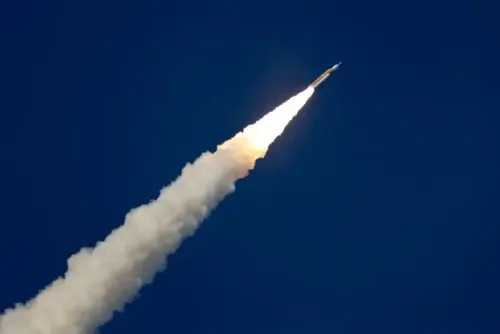
White House Invokes Apollo Legacy, Eyes Future Moon Missions

Synopsis
The White House invoked Apollo 11's 1969 Moon landing on 5 July 2026, declaring American innovation is 'not done yet' — a pointed signal of continued US lunar ambitions under the Artemis programme and amid growing competition in space.
Key Takeaways
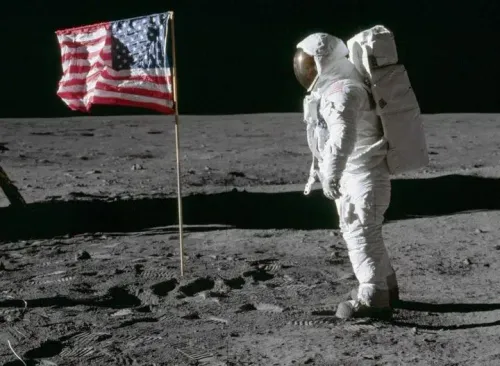
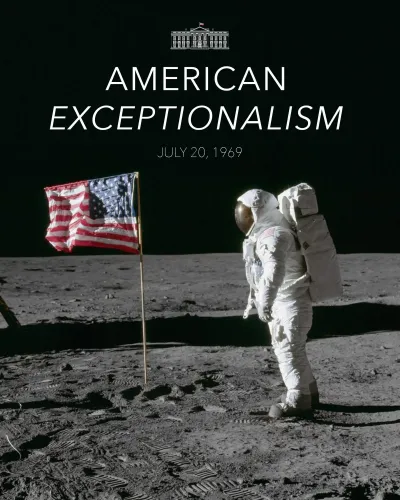
The White House posted on 5 July 2026 that 'American innovation brought mankind to the moon, and we're not done yet.' The statement references the Apollo 11 mission of July 1969 , the first crewed Moon landing in history.
NASA's Artemis program , announced in 2019 , is the current US framework to return astronauts to the lunar surface.
US space policy faces parallel pressure from China and other nations pursuing their own lunar programmes.
Congressional appropriations for NASA and the Artemis flight schedule remain the key near-term indicators of how this political signal translates into action.
The White House posted a pointed declaration on 5 July 2026, invoking America's Apollo-era achievement to signal continued ambitions in space exploration, stating that American innovation brought mankind to the moon — and that the work is not finished.
Context
The post, shared from the official communications account of the Executive Office of the President of the United States, read: 'American innovation brought mankind to the moon, and we're not done yet.' The message was accompanied by two images, underscoring its deliberate, curated character rather than an off-hand remark.
The reference anchors directly to Apollo 11, the July 1969 mission that placed the first humans on the lunar surface, fulfilling a goal set by President John F. Kennedy in 1961 during the height of the Cold War Space Race. That mission remains the defining symbol of American technological ambition on the world stage.
Policy Backdrop
NASA, the National Aeronautics and Space Administration established in 1958, has been pursuing the Artemis program — a formal initiative announced in 2019 — to return US astronauts to the lunar surface and build sustainable exploration infrastructure. The program draws on commercial launch partnerships and international agreements to extend what the Apollo generation began.
US space policy has cycled between crewed lunar focus and other priorities since 1969, but congressional direction and agency planning in the 2010s renewed emphasis on the Moon. That shift has been accelerated by expanded commercial launch capabilities and parallel lunar programmes from China and other spacefaring states, adding a geopolitical dimension to what is also a scientific and technological endeavour.
Stakeholders and Impact
The statement carries direct relevance for the NASA workforce and the broader US aerospace industry, both of which depend on sustained political will and congressional appropriations to advance crewed missions. A White House signal of this kind — brief, symbolic, and publicly amplified — typically precedes or reinforces budget and programme decisions.
For India, the message lands at a moment when the Indian Space Research Organisation (ISRO) is deepening cooperation with NASA under bilateral frameworks, including joint missions and astronaut training agreements. American assertions of lunar leadership shape the environment in which such partnerships are negotiated and funded.
What's Next
The immediate marker to watch is congressional action on NASA appropriations and the schedule for subsequent Artemis flights, including any crewed lunar orbit or landing attempts. The White House statement, while short, signals that the political leadership intends to keep the Moon at the centre of America's public technology narrative.
Whether this translates into specific programme announcements, budget commitments, or diplomatic engagement with partner nations — including India — will become clearer as legislative and agency calendars unfold in the months ahead.
Point of View
Image-backed White House post invoking Apollo is rarely accidental — it is a calibrated assertion of American technological identity at a moment when space has re-emerged as a domain of great-power competition. By tying present ambition to the Apollo legacy, the administration frames the Artemis programme not as a new venture but as the continuation of a proven national story, which is politically durable and internationally legible. For partner nations like India, such signals matter: they indicate that Washington views space leadership as a priority worth defending, which in turn strengthens the case for deeper bilateral cooperation. The real test will be whether rhetorical commitment is matched by appropriations and a credible Artemis flight schedule.
NationPress
3 Oct 2026
Frequently Asked Questions
What did the White House say about the Moon in July 2026?
The White House posted on 5 July 2026 that 'American innovation brought mankind to the moon, and we're not done yet,' signalling continued US commitment to lunar exploration.
What is the Artemis program and how does it relate to Apollo?
The Artemis program is NASA's initiative, announced in 2019, to return US astronauts to the Moon and build sustainable exploration infrastructure, directly extending the legacy of the Apollo missions that first landed humans there in July 1969.
Why is the US focused on the Moon again?
Renewed US lunar focus is driven by congressional direction, expanded commercial launch capabilities, and parallel lunar programmes from China and other states, giving the effort both scientific and geopolitical dimensions.
How does this affect India's space programme?
India's ISRO has deepening cooperation agreements with NASA, so American assertions of lunar leadership and sustained Artemis funding directly shape the environment in which Indo-US space partnerships are negotiated.
What should we watch for next in US space policy?
Key indicators include congressional action on NASA appropriations and the confirmed schedule for upcoming Artemis flights, including any crewed lunar orbit or surface landing attempts.