US-China Moon race now measured in months, says NASA chief Isaacman

Synopsis
NASA Administrator Jared Isaacman has put a clock on the US-China Moon race: months, not years. With the US targeting an Artemis landing by end-2028 and China aiming for before 2030, the gap is razor-thin — and Isaacman's CBS interview is the most direct acknowledgement yet that America is in a genuine, time-bound space race for the first time since Apollo.
Key Takeaways
NASA Administrator Jared Isaacman declared the US-China Moon race is now measured in months, not years on 6 July 2025 .
The US is targeting a crewed lunar landing by end of 2028 under Artemis IV ; China has stated a goal of before 2030 .
Artemis III is planned for next year , with new landing systems to be tested in Earth orbit before the surface mission.
Lunar base infrastructure is set to begin arriving as early as 2027 , including a lunar terrain vehicle .
By the early 2030s , NASA envisions the Moon hosting crews on extended rotations — a precursor to Mars missions .
NASA is assisting Blue Origin with the investigation into the New Glenn rocket's recent launch failure.
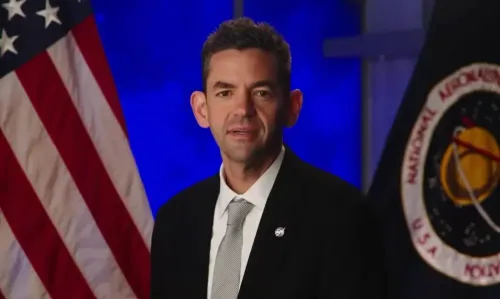
NASA Administrator Jared Isaacman has declared that the United States is locked in a renewed race with China to land astronauts on the Moon, warning that the competition is now a matter of months, not years. Speaking on CBS's Face the Nation on 6 July 2025 — as the US marked the 250th anniversary of its independence — Isaacman said Beijing's intent to reach the Moon is beyond dispute, and Washington must move swiftly to get there first.
Isaacman's Warning on China
'It is not arguably. Like, there -- we are very much in a space race right now, and the Chinese are moving at incredible speeds,' Isaacman said. 'The Chinese will land their taikonauts on the moon. There's no question. The question is, will the United States return before them.'
China has publicly stated its lunar landing goal as before 2030. Isaacman placed the US target at the end of 2028, framing the gap as a sprint rather than a marathon. 'That is months, not years,' he said.
Artemis Timeline and What Comes Next
Isaacman confirmed that Artemis III is planned for next year, to be followed by Artemis IV in 2028, when astronauts are expected to land on the lunar surface after testing new landing systems in Earth orbit. He credited the Trump administration with making lunar exploration a national priority through what he described as a 'historic investment' for the Artemis programme.
'We are going back,' Isaacman said. 'It will be an unbelievable display.' Infrastructure for a lunar base is expected to begin arriving as early as 2027, with equipment — including a lunar terrain vehicle and the beginnings of permanent infrastructure — already in place by the time astronauts land in 2028.
A Permanent Moon Base by the Early 2030s
Beyond the initial crewed landing, NASA's long-term objective is a sustained human presence on the Moon that would serve as a stepping stone for eventual Mars missions. Isaacman projected that by the early 2030s, the Moon would function much like the International Space Station, hosting crews on extended rotations. 'You're going to have crews that are there on pretty extended periods of time, as we learn in that environment and prepare for Mars,' he said.
Private Sector and Blue Origin's Setback
Isaacman also defended the expanding role of commercial companies in America's space programme, arguing that private launch providers have fundamentally transformed the economics of space exploration. He cited an experimental mission to rescue NASA's ageing Swift space telescope as an example of how relatively inexpensive commercial launches can extend the lives of scientific missions that would otherwise require costly replacements.
On the recent launch failure of Blue Origin's New Glenn rocket, Isaacman said NASA is assisting the company with its investigation while keeping work on future lunar missions on track. 'They're going to solve that,' he said. 'NASA's there to help.'
The Artemis Programme in Context
Artemis is NASA's flagship effort to return humans to the Moon for the first time since the Apollo era. Unlike Apollo, Artemis is designed to build a sustained lunar presence through international partnerships and commercial operators — and ultimately to lay the groundwork for crewed Mars missions. This is the most explicit public framing yet by a sitting NASA chief of the US-China lunar competition as a direct, time-bound race.
Point of View
Not years' framing is a deliberate escalation in public rhetoric — and it carries institutional weight coming from a sitting NASA administrator. What mainstream coverage underplays is that the 2028 US target and China's pre-2030 goal are separated by a margin thin enough that a single Artemis delay could flip the outcome. The Apollo comparison is seductive but misleading: this race is not just about a flag on the surface — it is about who establishes the first permanent lunar infrastructure, which will shape resource access and strategic positioning for decades. Blue Origin's New Glenn failure is a quiet but significant subplot; commercial dependency is NASA's greatest force-multiplier and its most visible vulnerability at the same time.
NationPress
5 Oct 2026
Frequently Asked Questions
What did NASA chief Jared Isaacman say about the US-China Moon race?
Isaacman said the US is in a renewed space race with China and that the competition is now measured in months, not years. He made the remarks on CBS's Face the Nation on 6 July 2025, stating that China will land taikonauts on the Moon and the key question is whether the US returns first.
When does NASA plan to land astronauts on the Moon under Artemis?
NASA is targeting a crewed lunar landing by the end of 2028 under Artemis IV, following Artemis III planned for next year. Astronauts will test new landing systems in Earth orbit before the surface mission.
What is China's timeline for landing on the Moon?
China has publicly stated its goal is to land taikonauts on the Moon before 2030. NASA's Isaacman cited this directly when framing the US target of end-2028 as a months-not-years race.
What is NASA's long-term plan for the Moon and Mars?
NASA aims to establish a permanent lunar base with infrastructure arriving from 2027, and envisions the Moon functioning like the International Space Station by the early 2030s, with crews on extended rotations as preparation for eventual Mars missions.
What happened with Blue Origin's New Glenn rocket?
Blue Origin's New Glenn rocket suffered a recent launch failure. NASA Administrator Isaacman said NASA is assisting the company with its investigation while ensuring work on future lunar missions continues, expressing confidence the issue would be resolved.