White House Marks 57 Years Since Apollo 11 Moon Landing
Synopsis
The White House on July 21, 2026, commemorated the 57th anniversary of the Apollo 11 Moon landing, invoking American Exceptionalism and describing the 1969 planting of the U.S. flag on the lunar surface as the greatest achievement in human history. The post echoes a long tradition of invoking Apollo to underline U.S. space leadership.
Key Takeaways
The White House posted a tribute on July 21, 2026 , marking 57 years since the Apollo 11 Moon landing of July 20, 1969 .
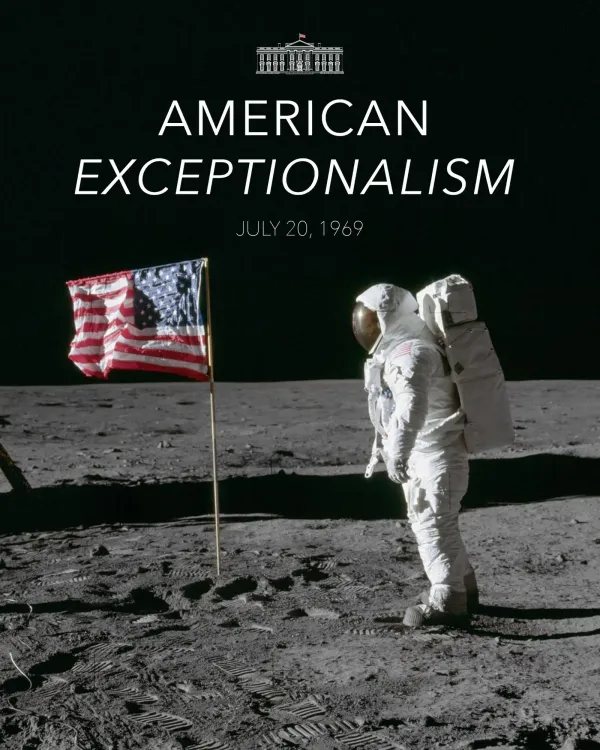
The post described the lunar landing as 'the greatest achievement in human history' and cited it as proof of American Exceptionalism .
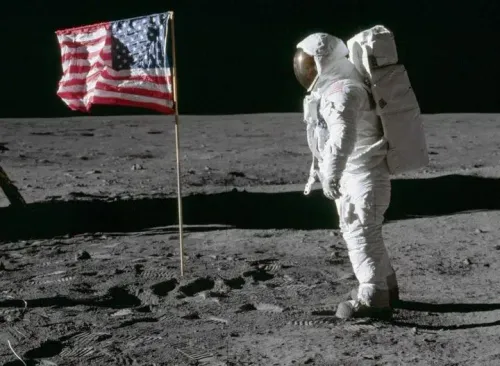
Commander Neil Armstrong was the first human to walk on the Moon; the U.S. flag was planted on the lunar surface during the mission.
Kennedy had set the Moon-landing goal in May 1961 , driven by Cold War competition with the Soviet Union .
NASA 's Artemis program seeks to return humans to the Moon, and White House rhetoric around Apollo anniversaries continues to shape the political case for that investment.
The White House, the official communications account of the Executive Office of the President of the United States, on Tuesday, July 21, 2026, marked the 57th anniversary of the Apollo 11 lunar landing, calling it 'the greatest achievement in human history' and invoking the concept of American Exceptionalism in a post on X.
Context
On July 20, 1969, NASA's Apollo 11 mission achieved what had seemed an almost impossible feat: placing human beings on the surface of the Moon and returning them safely to Earth. Commander Neil Armstrong became the first human to set foot on the lunar surface, famously describing the moment as 'one small step for man, one giant leap for mankind.' The American flag was planted on the Moon's surface, a symbolic act the White House's post echoes 57 years later.
The White House post stated: 'The Stars and Stripes were planted on the lunar surface to commemorate the greatest achievement in human history,' framing the landing as the 'clearest case of American Exceptionalism' made 'extraterrestrially undeniable.'
Policy Backdrop
The road to Apollo 11 began in May 1961, when President John F. Kennedy set a national goal of landing a man on the Moon and returning him safely before the decade's end. The ambition was shaped in large part by Cold War rivalry: the Soviet Union's launch of Sputnik in 1957 and cosmonaut Yuri Gagarin's orbital flight in 1961 had put the United States on the defensive in the Space Race.
The programme was not without tragedy. The Apollo 1 fire in January 1967 claimed three astronauts and forced sweeping safety reforms before the mission could proceed. The eventual success in 1969 was seen as a vindication of sustained national investment in science, engineering, and human exploration.
Stakeholders and Impact
Anniversaries of the Apollo 11 landing carry weight well beyond ceremonial tribute. For the American public and the global scientific community, the event remains a benchmark for what coordinated state investment in technology can achieve. Successive administrations — across party lines — have invoked Apollo to justify continued human spaceflight budgets and to assert U.S. leadership in space exploration.
The framing of the Moon landing as a demonstration of 'American Exceptionalism' is also a recurring rhetorical device in debates over civil space funding, international cooperation frameworks, and the Artemis Accords, which seek to establish norms for a new era of lunar exploration involving allied nations.
What's Next
NASA's Artemis program aims to return humans to the lunar surface for the first time since Apollo 17 in 1972. Congressional funding cycles and partnerships with international space agencies under the Artemis Accords framework will determine the pace and scope of that effort. The White House's anniversary post signals that the political will to invoke space achievement as a marker of national identity remains strong, lending rhetorical momentum to future budget and policy discussions around human spaceflight.
Point of View
Tying historical achievement to present-day assertions of U.S. primacy in space. With NASA's Artemis program navigating funding pressures and international competition from China's lunar ambitions, the anniversary post serves as soft scaffolding for the policy argument that America must lead the next era of human exploration. The pattern suggests that space heritage will remain a live instrument of executive messaging well beyond ceremonial dates.
NationPress
20 Oct 2026
Frequently Asked Questions
When did Apollo 11 land on the Moon?
Apollo 11 landed on the Moon on July 20, 1969 , with commander Neil Armstrong becoming the first human to walk on the lunar surface.
Why is the White House commemorating the Moon landing in 2026?
July 20, 2026 marks the 57th anniversary of the Apollo 11 landing. The White House posted a tribute calling it the 'greatest achievement in human history' and a demonstration of American Exceptionalism.
What is American Exceptionalism in the context of the Moon landing?
'American Exceptionalism' is the idea that the United States holds a unique place in history due to its founding ideals and achievements. The White House used the term to argue that the 1969 Moon landing was the clearest proof of this national character.
What is NASA's Artemis program and how does it relate to Apollo?
NASA 's Artemis program is the agency's effort to return humans to the Moon for the first time since Apollo 17 in 1972 . It is widely framed as the spiritual successor to the Apollo missions and is a key reference point in current U.S. space policy.
Who set the goal of landing on the Moon?
President John F. Kennedy announced in May 1961 that the United States would land a man on the Moon and return him safely before the end of the decade, a goal realised by Apollo 11 in 1969 .