NASA's Artemis II Crew Makes Historic Return from the Moon

Synopsis
NASA's Artemis II crew has made a triumphant return after a groundbreaking 10-day mission around the Moon, marking humanity's first foray into deep space in over 50 years. Discover the milestones and challenges they faced during this historic expedition.
Key Takeaways
NASA's Artemis II mission marked humanity's return to deep space after over 50 years.
The mission was a successful 10-day journey around the Moon.
Notable milestones included the first Black astronaut, first woman, and first Canadian to reach the Moon's vicinity.
Minor technical challenges did not compromise the mission's success.
The Artemis program aims to establish a sustained human presence on the Moon.
Washington, April 11 (NationPress) NASA's Artemis II team successfully returned, landing in the Pacific Ocean near San Diego at 8:07 p.m. Eastern time on Friday. This marked the culmination of a groundbreaking 10-day journey around the Moon, signifying humanity's re-entry into deep space after a hiatus exceeding 50 years.
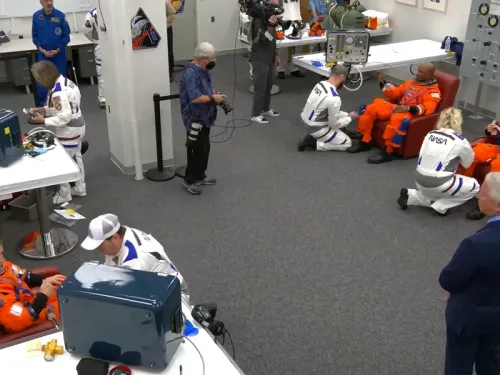
The Orion spacecraft, which transported NASA astronauts Reid Wiseman, Victor Glover, and Christina Koch, along with Canadian astronaut Jeremy Hansen, executed a parachute-assisted descent, as recovery teams prepared for the crew's retrieval, according to NASA's official updates.
“SPLASHDOWN!” NASA announced, confirming the astronauts were “back on Earth” following their mission.
“What a journey,” Wiseman expressed shortly after landing during a live broadcast. “We are stable one. Four green crewmembers.”
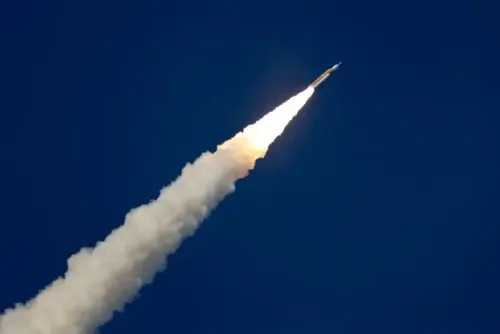
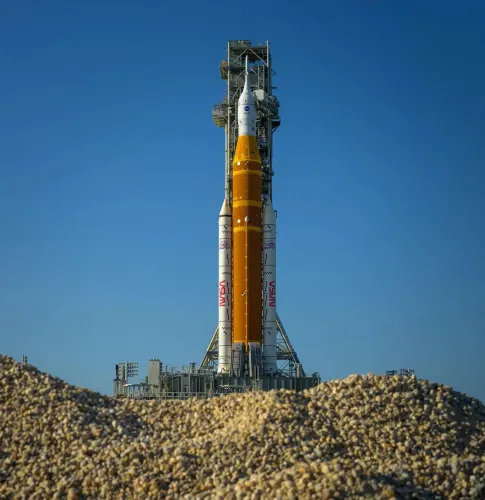
This mission was notable as it represented the inaugural crewed test flight of NASA's Orion spacecraft and Space Launch System rocket, propelling astronauts beyond low Earth orbit, around the Moon, and back.
As reported by Smithsonian Magazine, the crew undertook a nearly 10-day expedition, splashing down off California's coast, marking the first human voyage near the Moon in over half a century, and laying the groundwork for future lunar endeavors.
Throughout the journey, the astronauts ventured as far as 252,756 miles from Earth, surpassing the previous distance record established during the Apollo 13 mission, while examining the Moon’s far side and various lunar features, including ancient basins and craters.
Several milestones were achieved during the flight: Glover became the first Black astronaut to approach the Moon's vicinity, Koch the first woman, and Hansen the first Canadian.
The expedition faced some technical difficulties. Minor issues, including challenges with the spacecraft's toilet system and unusual odors within the cabin, were noted during the mission but did not compromise its success, as highlighted by Smithsonian Magazine.
The re-entry into Earth's atmosphere was particularly challenging. The spacecraft traveled at approximately 25,000 miles per hour and encountered temperatures nearing 5,000 degrees Fahrenheit due to the superheated plasma surrounding the capsule.
According to NASA, the capsule sequentially deployed its drogue and main parachutes before safely landing in the Pacific, where recovery teams swiftly approached by boat and subsequently transported the astronauts via helicopter to the USS John P. Murtha for medical evaluations.
NASA Administrator Jared Isaacman expressed pride in the mission's success. “I couldn't be more proud of the entire workforce, their years of dedication, late nights, and relentless effort that contributed to this remarkable moment,” he stated.
The successful return garnered acclaim from various segments of the US government. The State Department remarked that the mission “has shown the world what is possible,” while former President Donald Trump described the trip as “spectacular” and the landing as “perfect,” expressing his eagerness to welcome the crew at the White House.
The Artemis II mission is a crucial advancement in NASA’s broader lunar agenda, aimed at returning humans to the Moon and establishing a sustained human presence there. The upcoming Artemis III mission is anticipated to test docking capabilities and prepare for a crewed lunar landing later this decade.
Point of View
It is evident that NASA's Artemis II mission represents a significant leap forward for space exploration. The successful return of the crew not only rekindles the spirit of lunar exploration but also showcases the collective efforts of scientists and astronauts in pushing the boundaries of human achievement. This mission is a testament to our enduring quest for knowledge beyond our planet.
NationPress
19 Sept 2026
Frequently Asked Questions
What was the main objective of the Artemis II mission?
The primary objective of the Artemis II mission was to conduct a crewed test flight of NASA's Orion spacecraft and Space Launch System rocket, sending astronauts around the Moon and back, marking humanity's return to deep space.
Who were the astronauts on the Artemis II mission?
The Artemis II crew consisted of NASA astronauts Reid Wiseman, Victor Glover, Christina Koch, and Canadian astronaut Jeremy Hansen.
What milestones were achieved during the mission?
During the mission, Victor Glover became the first Black astronaut to reach the Moon's vicinity, Christina Koch was the first woman, and Jeremy Hansen was the first Canadian to travel near the Moon.
What challenges did the crew face during their journey?
The crew encountered minor technical issues, including problems with the spacecraft's toilet system and unusual odors inside the cabin, but these did not affect the mission's success.
What is the significance of the Artemis II mission for future lunar exploration?
The Artemis II mission is a crucial step in NASA's broader lunar program, aimed at returning humans to the Moon and establishing a sustained presence there, leading to future missions including Artemis III.