White House Launches Trump Accounts for All U.S. Children
Synopsis
The White House has announced Trump Accounts, a free financial savings vehicle open to every child in the United States, positioning it as a market-driven tool to build long-term generational wealth. Key operational details including funding, contribution limits, and rollout timeline are yet to be confirmed by Congress or the Treasury.
Key Takeaways
The White House announced Trump Accounts on 7 July 2026 , a savings vehicle free to set up for every U.S. child .
The stated goal is to 'make America's next generation rich' through long-term wealth accumulation.
The programme follows the Republican policy tradition of using tax-advantaged, market-driven instruments — similar to the expanded 529 plans under the 2017 Tax Cuts and Jobs Act .
Universal child savings proposals have been debated by both parties since the 1990s , reflecting bipartisan interest in early capital accumulation.
Specific details on funding, contribution limits, tax treatment, and rollout timeline remain unconfirmed pending Congressional and Treasury action.
Financial institutions and asset managers are expected to play a central role in administering the accounts if the programme is enacted.
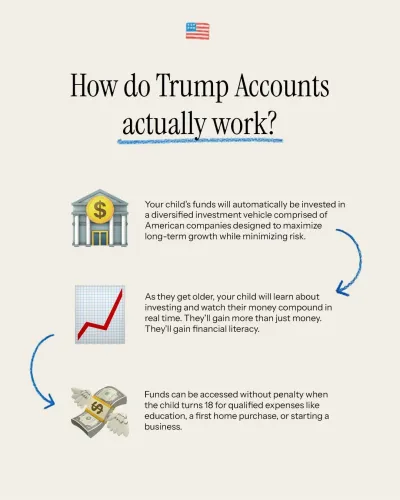
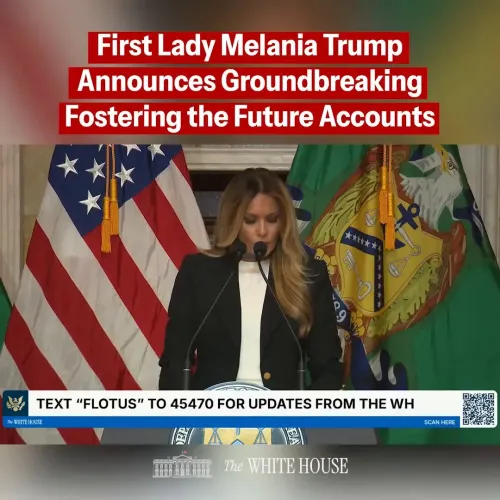
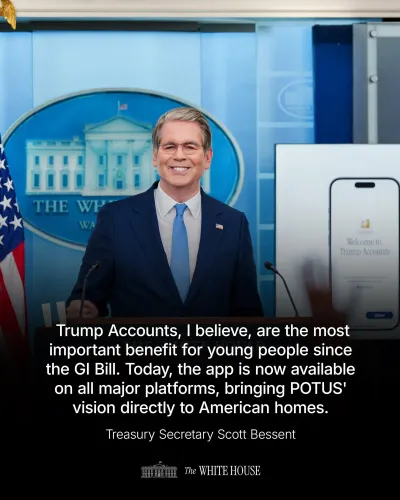
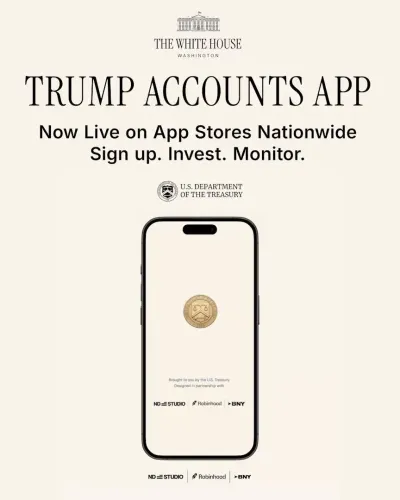
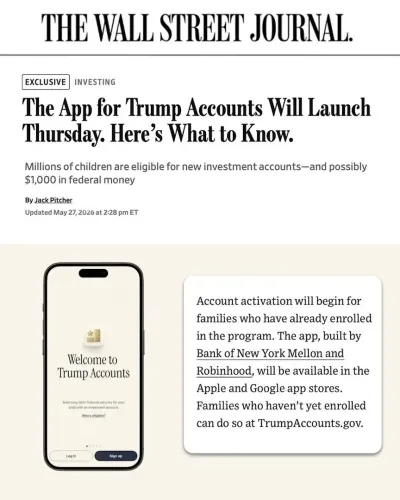
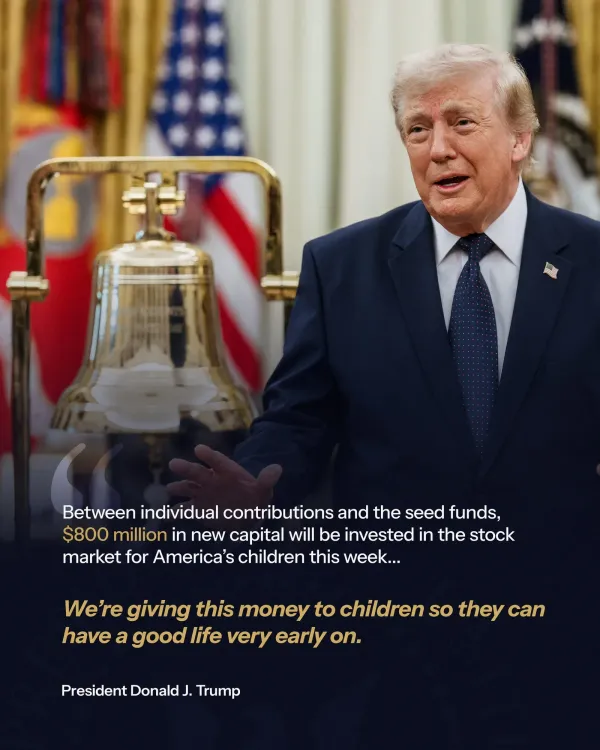
The White House announced on Monday, 7 July 2026, that Trump Accounts — a new financial savings vehicle — will be made available free of charge to every child in the United States, with the stated goal of building long-term wealth for the next generation of Americans.
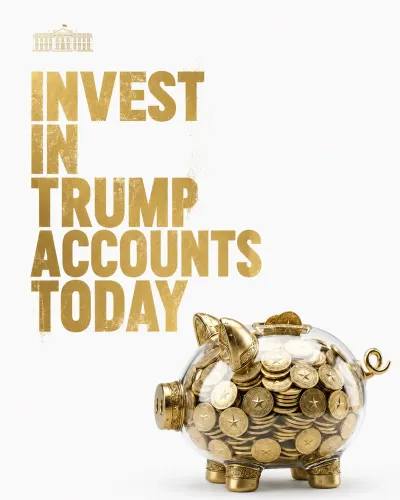
The official White House post declared the scheme 'free to set up and available for ALL U.S. children,' adding that 'Trump Accounts will help make America's next generation rich.' The announcement positions the programme as a universal entitlement rather than a means-tested benefit, signalling a broad-based approach to childhood financial inclusion.
Context
The Trump Accounts initiative fits within a long-standing Republican policy tradition of promoting tax-advantaged, market-driven savings instruments as tools for wealth creation. The 2017 Tax Cuts and Jobs Act, signed during President Donald Trump's first term, had already expanded 529 education savings plans and created Opportunity Zones to channel private capital into underserved communities. The new accounts appear to extend that philosophy directly to individual children from birth. The concept of universal child savings accounts is not new to American policy debate. Proposals for so-called 'baby bonds' and expanded child savings vehicles have circulated across both major parties since the 1990s, reflecting a bipartisan recognition that early capital accumulation can have outsized effects on lifetime economic outcomes.Policy Backdrop
Republican administrations have consistently favoured mechanisms that route wealth-building through private markets rather than direct government transfers. Trump Accounts follow that template: by establishing a savings vehicle at birth, the programme aims to harness decades of compound market growth on behalf of children who might otherwise have no investment exposure. The broader policy rationale mirrors arguments made by economists who study intergenerational wealth gaps — that early, consistent capital accumulation, even in modest amounts, can substantially alter a family's financial trajectory over one or two generations. The White House framing of the accounts as a tool to 'make America's next generation rich' leans into this logic directly.Stakeholders and Impact
The primary beneficiaries are American children and their families, particularly those in lower- and middle-income households who currently have little or no exposure to investment accounts. If implemented at scale, the programme could represent one of the largest expansions of retail investment access in recent U.S. history. Financial institutions, asset managers, and brokerage platforms are also likely stakeholders, as the administration of millions of new accounts would require significant back-end infrastructure. The precise tax treatment, contribution limits, and investment menu of the accounts will shape how attractive the vehicle is to different income groups.What's Next
Critical details — including the funding source, contribution rules, investment options, and rollout timeline — are yet to be publicly confirmed. Congressional action on enabling legislation and guidance from the U.S. Treasury will determine the programme's practical scope. Observers will watch the next federal budget cycle closely for appropriations language and regulatory frameworks that give the accounts legal and operational form. If the programme advances as described, it could reframe the political debate around child poverty and wealth inequality in the United States, shifting the conversation from direct cash transfers toward long-horizon asset-building — a distinction with significant implications for how other governments, including those in the developing world, approach similar challenges.Point of View
The White House insulates the programme from 'welfare' stigma while maximising its political coalition. However, the absence of confirmed funding and legislative detail at the time of announcement is a pattern familiar from earlier Trump-era policy rollouts, where headline ambition has sometimes outpaced regulatory execution. The initiative will be a significant test of whether a Republican Congress can translate a broad wealth-building promise into durable, funded legislation.
NationPress
7 Jul 2026
Frequently Asked Questions
What are Trump Accounts for children?
Trump Accounts are a new savings vehicle announced by the White House in July 2026 , described as free to set up and available to every child in the United States , with the goal of building long-term generational wealth through market-based investment.
Who is eligible for a Trump Account?
According to the White House , Trump Accounts are available to all U.S. children , making it a universal programme rather than one limited to specific income groups or demographics.
How is a Trump Account different from a 529 plan?
A 529 plan is specifically designed for education expenses, while Trump Accounts appear to be aimed at broader wealth accumulation. However, full details on tax treatment and permitted uses have not yet been confirmed by Congress or the U.S. Treasury .
When will Trump Accounts be available?
The White House has not confirmed a specific rollout date. The programme requires enabling legislation and Treasury guidance, which are expected to be addressed in the next federal budget cycle.
What is the funding source for Trump Accounts?
The funding source for Trump Accounts has not been publicly confirmed. Congressional appropriations and regulatory frameworks will determine how the accounts are financed and administered.