White House Demands Congress Pass SAVE America Act Now
Synopsis
The White House on June 5, 2026 issued a sharp public demand for Congress to pass the SAVE America Act, which would require documentary proof of US citizenship for federal voter registration. The bill passed the House in 2024 but has stalled in the Senate amid partisan disagreement over voter eligibility rules.
Key Takeaways
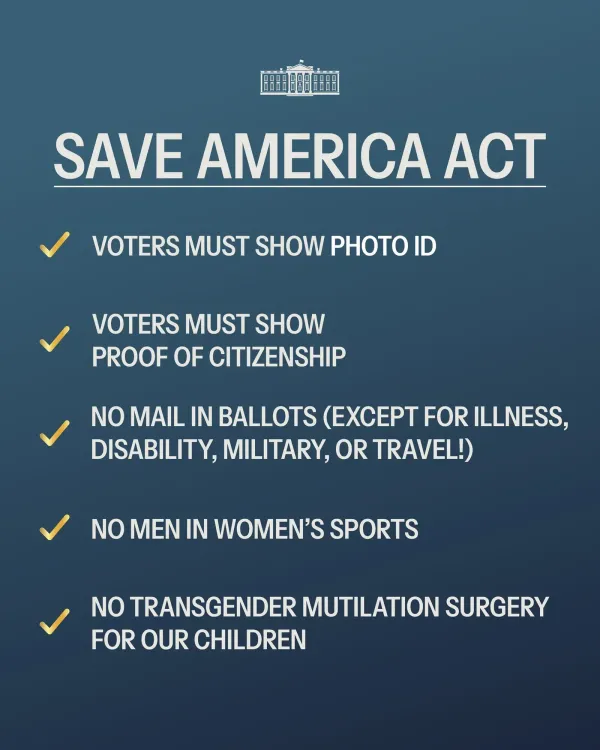
The White House posted a direct public demand on June 5, 2026 , calling on Congress to pass the SAVE America Act 'without delay.' The SAVE Act would mandate documentary proof of US citizenship for federal voter registration.
The bill passed the House of Representatives in July 2024 on a party-line vote but stalled in the Senate .
Supporters argue the law prevents non-citizen voter registration; opponents say it restricts legitimate ballot access.
The Senate 's floor scheduling decisions — whether as a standalone bill or an appropriations rider — will determine the legislation's fate.
Partisan disputes over proof-of-citizenship voter requirements have recurred across multiple Congresses since at least 2019 .
The White House issued an urgent call on Friday, June 5, 2026, demanding that the United States Congress pass the SAVE America Act without further delay, posting bluntly on X: 'NO MORE GAMES. Pass the SAVE America Act without delay!'
Context
The Safeguard American Voter Eligibility (SAVE) Act is a federal legislative proposal that would require documentary proof of United States citizenship as a condition for registering to vote in federal elections. The measure has been a priority for Republican lawmakers who argue that existing registration systems are insufficient to prevent non-citizens from enrolling on voter rolls. The White House's post signals that the executive office is now applying direct public pressure on Congress to act.Policy Backdrop
The SAVE Act first cleared the House of Representatives in July 2024 on a party-line vote, but failed to advance through the Senate, where it stalled without a floor vote. The legislation sits within a long-running partisan dispute over federal voter eligibility rules, with one side emphasising fraud prevention through stricter documentation requirements and the other warning that such mandates create barriers to legitimate voter participation. Similar proof-of-citizenship provisions have surfaced in appropriations riders and standalone bills going back to at least 2019.Stakeholders and Impact
The bill's passage would directly affect election officials across all fifty states, who would be required to implement new documentation verification processes for federal voter registration. Advocacy groups focused on ballot access have argued that large segments of the eligible voting population — particularly low-income citizens, the elderly, and minority communities — may lack the required documents readily at hand. Proponents counter that the requirement mirrors identification standards already in place for other government services and is essential to maintaining the integrity of the electoral roll. The White House's public intervention escalates pressure on Senate leadership to schedule a floor vote.What's Next
All eyes now turn to the Senate, where floor scheduling remains the decisive variable. Lawmakers could take up the SAVE Act as a standalone measure or attach its voter-verification language to a broader appropriations package — a route that has been attempted in previous congressional sessions. The White House's unusually direct language — 'NO MORE GAMES' — suggests the administration views further procedural delay as politically unacceptable and may tie the issue to other legislative priorities moving through Congress.Point of View
Designed to frame Senate inaction as obstruction rather than deliberation. By going directly to the public on social media, the administration bypasses traditional legislative negotiation and applies grassroots pressure on senators in competitive states. The SAVE Act has become a flagship election-integrity symbol for the Republican base, and the timing of this push — well ahead of the next federal election cycle — suggests a calculated effort to either secure a legislative win or build a campaign-ready contrast with opponents. The outcome will test whether executive bully-pulpit tactics can break a Senate deadlock that procedural maneuvering alone has not resolved.
NationPress
21 Oct 2026
Frequently Asked Questions
What is the SAVE America Act?
The SAVE America Act, formally the Safeguard American Voter Eligibility Act, is a federal bill that would require individuals to provide documentary proof of US citizenship when registering to vote in federal elections. It passed the House in July 2024 but has not been voted on in the Senate.
Why is the White House pushing for the SAVE Act now?
The White House posted a public demand on June 5, 2026 calling for Congress to pass the bill 'without delay,' signalling that the administration considers further legislative delay politically unacceptable, though specific timing reasons were not stated in the post.
Did the SAVE Act pass Congress?
The SAVE Act passed the House of Representatives in July 2024 on a party-line vote but did not advance in the Senate, where it has yet to receive a floor vote.
What does proof of citizenship for voter registration mean?
It means a voter registering for federal elections would need to present a document — such as a passport or birth certificate — proving they are a US citizen, going beyond the current requirement of attesting to citizenship on the registration form.
Who opposes the SAVE America Act?
Opponents, generally from the Democratic side, argue the requirement creates barriers for eligible voters who may not have easy access to the required documents, disproportionately affecting low-income, elderly, and minority citizens.