White House Taunts Critics With 'Panicans Got Real Quiet'
Synopsis
The White House posted a pointed, informal message on X on June 5, 2026, using the coined term 'Panicans got real quiet' to taunt critics. The post, accompanied by a linked image, signals administration confidence but does not specify the triggering development, leaving the full context dependent on follow-up communications.
Key Takeaways
The White House posted 'Panicans got real quiet' on X on June 5, 2026 , in an informal, combative tone.
The term 'Panicans' appears to be a coined portmanteau targeting critics or political opponents the administration characterises as alarmist.
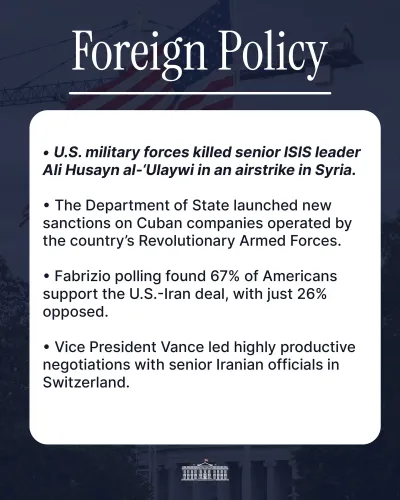
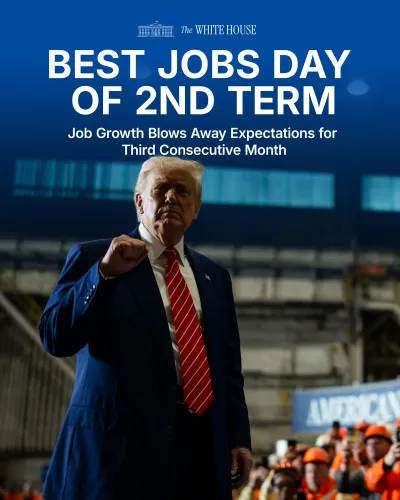
The post included 1 image via a link, which carries the substantive context not stated in the text itself.
No specific policy, data point, or event is named in the post; the trigger remains unspecified publicly.
The messaging style is consistent with a broader pattern of the White House using informal social media language to counter critics after favourable developments.
Follow-up official statements or data releases are expected to clarify the underlying claim of vindication.
The White House, the official communications account of the Executive Office of the President of the United States, posted a pointed, informal message on X on Friday, June 5, 2026, taunting critics with the phrase 'Panicans got real quiet,' accompanied by a watchful-eyes emoji and a linked image.
Context
The post, brief and deliberately provocative, uses the coined term 'Panicans' — an apparent portmanteau targeting those the administration characterises as alarmist critics or political opponents. The watchful-eyes emoji and the attached image signal a triumphalist tone, suggesting the administration believes a recent development has silenced its detractors.
Official White House social media accounts have increasingly adopted informal, combative language to respond to critics and amplify what the administration frames as positive news. This style of direct-to-public messaging bypasses traditional press channels and speaks directly to a partisan audience.
Policy Backdrop
The use of social media for political counter-messaging has become a defining feature of modern executive communications. Across multiple administrations, the White House X account has deployed sharp, colloquial phrasing following economic data releases, legislative milestones, or favourable polling shifts — moments the administration wishes to amplify while simultaneously discrediting critics who had predicted negative outcomes.
The specific trigger for this post — whether an economic indicator, a policy outcome, or another development — is not stated in the post itself. The linked image, which is not reproduced here, is the primary carrier of the underlying message, making the post's full meaning contingent on that visual context.
Stakeholders and Impact
For domestic audiences in the United States, the post is a signal of administration confidence, intended to demoralise critics and energise supporters. The informal register — 'got real quiet' — is calibrated to resonate on social media rather than in formal policy discourse.
For international observers, including in India, where Washington DC's policy signals carry weight on trade, geopolitics, and bilateral relations, the post's vagueness limits immediate analytical value. However, the confrontational tone is consistent with a broader pattern of the current administration using public messaging as a political instrument.
What's Next
Subsequent official statements, press briefings, or data releases from the White House are expected to clarify the specific development the administration is referencing. Observers will watch for follow-up communications that give concrete substance to the implied claim of vindication.
The post's informal framing is unlikely to be the administration's last word on whatever underlying issue prompted it. A more detailed official statement or policy announcement is the logical next step, and that will be the document to watch for substantive policy implications.
Point of View
Coin a dismissive label for opponents, and let the audience fill in the blanks. It is less a policy communication and more a morale signal — directed at supporters as much as at critics. The post fits a broader arc in which executive accounts increasingly function as partisan amplifiers rather than neutral information channels. For analysts tracking US political communication, the interesting question is not what was said, but what development was deemed significant enough to warrant this kind of public gloating.
NationPress
20 Oct 2026
Frequently Asked Questions
What did the White House post on X on June 5 2026?
The White House posted the message 'Panicans got real quiet' on X on June 5, 2026, accompanied by a watchful-eyes emoji and a linked image, in an apparent taunt directed at critics of the administration.
What does 'Panicans' mean in the White House post?
'Panicans' appears to be a term coined by the administration to describe critics or political opponents it characterises as alarmist. The word is not a standard political or dictionary term.
What event triggered the White House 'Panicans' post?
The specific triggering event is not stated in the post itself. The linked image and subsequent official communications are expected to clarify what development the administration is referencing.
Does the White House regularly use informal language on social media?
Yes. Official White House social media accounts have used informal, combative phrasing across multiple administrations, particularly after economic data releases, legislative milestones, or polling shifts the administration views favourably.
Why does the White House use confrontational social media posts?
The strategy is designed to bypass traditional media, speak directly to supporters, demoralise critics, and frame news cycles on the administration's own terms — a tactic that has become a standard feature of modern executive communications.