White House Mocks Critics With 'PANICAN' Post
Synopsis
The White House posted a sharp, all-caps message on June 5, 2026, coining the term 'PANICAN' to mock critics and political opponents, signalling the administration believes a key development has vindicated its position. The specific trigger remains linked to an attached image not yet confirmed.
Key Takeaways
The White House posted 'BAD DAY TO BE A PANICAN' on X on Friday, June 5, 2026 .
The coined term 'PANICAN' appears to target political opponents or critics perceived as needlessly alarmist.
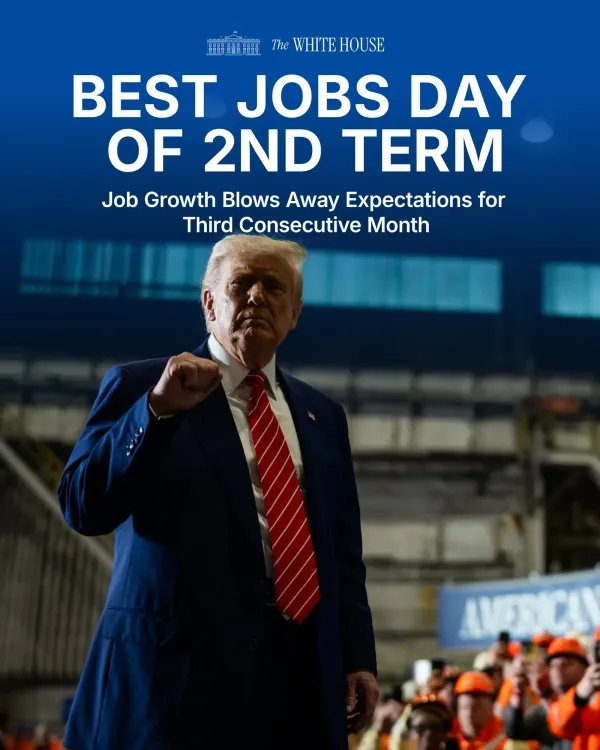
The post included one attached image whose specific content has not been independently verified.
The combative, all-caps style is consistent with the current administration's established social media communication pattern.
No explicit policy, data point, or event was named in the post; follow-up statements are expected to provide context.
The White House, the official communications account of the Executive Office of the President of the United States, posted a sharp, combative message on X on Friday, June 5, 2026, declaring: 'BAD DAY TO BE A PANICAN' — an apparent coined term targeting critics perceived as sounding alarms without cause.
Context
The post, brief and deliberately punchy, uses the neologism 'PANICAN' — a portmanteau seemingly blending 'panic' and a suffix suggesting a person or group — to dismiss critics or political opponents. The all-caps styling is consistent with the administration's established tone of direct, combative social media communication. An image was attached to the post, though its specific content has not been independently confirmed.
The White House did not elaborate on the precise trigger for the message. However, the framing — 'bad day to be' a certain type of person — is a rhetorical device the administration has used previously to signal that a news cycle, data release, or political development has vindicated its position.
Policy Backdrop
White House social media accounts across multiple administrations have increasingly used informal, coined, or meme-adjacent language to shape political narratives. This approach is designed to energise supporters, dominate online discourse, and pre-empt critical coverage by framing opponents as alarmists or bad-faith actors.
The pattern of labelling critics as 'panicans' or equivalent terms fits a broader communication strategy: when economic indicators, legislative outcomes, or polling data move favourably, the administration moves quickly to amplify the moment and embarrass those who predicted otherwise. The specific data point or event the June 5 post references remains tied to the attached media, which the pipeline has not yet resolved.
Stakeholders and Impact
The primary target of the post appears to be political opponents and media commentators who had forecast negative outcomes — whether on economic, legislative, or geopolitical grounds — that the administration now claims have not materialised. Such messaging is aimed squarely at an American domestic audience but carries weight internationally, including in India, where United States economic and political signals are closely tracked by markets, policymakers, and the diaspora.
For Indian observers, the post is a window into the current White House's communications posture: assertive, unfiltered, and willing to use social media as a primary arena for political combat. Investors and analysts watching US policy developments — particularly on trade, tariffs, or bilateral ties — will look for the substantive announcement or data release that prompted the message.
What's Next
The administration is expected to follow up with more detailed statements or data releases that would clarify what specifically prompted the 'PANICAN' post. Subsequent White House communications in the hours and days after June 5, 2026 will be closely watched to identify the policy or economic development the message was anchored to. The post's combative framing suggests the administration believes it holds a significant political or factual advantage on at least one active front.
Point of View
The administration forces critics onto the defensive. This tactic — using social media to declare victory before the full story is public — has become a signature of modern executive communications. For Indian audiences tracking US policy, the post is less about its specific trigger and more about the administration's confidence that an upcoming data point or announcement will embarrass its critics. The broader arc here is a White House that treats its own social media feed as a primary policy communication tool, bypassing traditional channels entirely.
NationPress
19 Sept 2026
Frequently Asked Questions
What does 'PANICAN' mean in the White House post?
'PANICAN' is a coined term used by the White House, apparently blending 'panic' and a suffix denoting a type of person, to mock critics or political opponents who the administration believes made needlessly alarmist predictions.
Why did the White House post 'BAD DAY TO BE A PANICAN'?
The post signals that the administration believes a recent development — likely a data release or political outcome — has vindicated its position and embarrassed critics, though the specific trigger was not named in the post itself.
When did the White House make this post?
The post was made on Friday, June 5, 2026 , at 13:55 UTC, on the official White House account on X.
Is this kind of messaging normal for the White House?
Yes, White House social media accounts across multiple administrations have used informal or combative language to frame political debates, but the current administration has been particularly direct and meme-adjacent in its social media tone.
What should Indians watch for after this White House post?
Indian markets, policymakers, and diaspora observers should watch for subsequent White House statements or US data releases in the days after June 5, 2026, which are likely to reveal the specific development that prompted the 'PANICAN' post.