Are Young Americans Turning Against Trump and His 'Big Beautiful Bill'?
Synopsis
A new Yale Youth Poll reveals a significant shift in young Americans' political views, showing growing disapproval for Donald Trump and his policies. With a desire for change and a critical eye on traditional structures, young voters are reshaping the political landscape ahead of the 2028 elections.
Key Takeaways
Young voters show a marked decline in support for Trump .
The One Big Beautiful Bill Act is viewed negatively.
Young Americans prefer Democratic candidates .
There is a strong desire for political change .
Younger voters are more ideologically polarized.
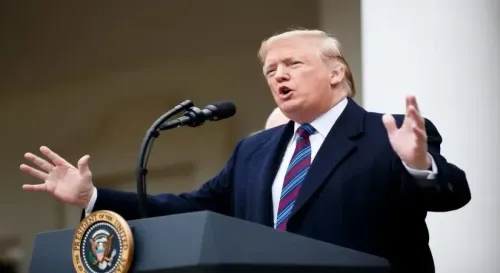
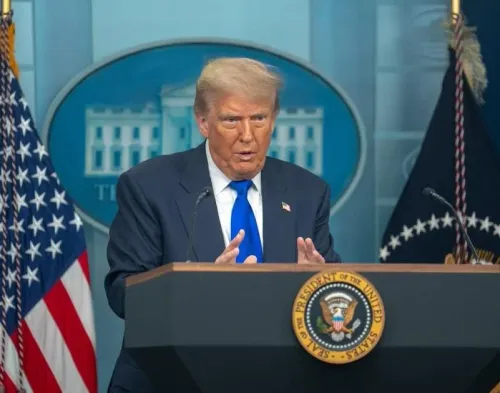
Washington, Dec 9 (NationPress) Young voters in America have drastically shifted their support away from President Donald Trump and express significant doubts about his signature legislation, the One Big Beautiful Bill Act (OBBBA). This trend occurs alongside their increasing inclination towards traditional views on gender roles and a more critical stance on Israel compared to older generations, as outlined in a recent Yale Youth Poll released on Monday.
A notable highlight from the poll is the significant decline in Trump’s popularity among younger voters. The survey reveals that Vice President Kamala Harris secured the 2024 votes from respondents aged 18-22, 23-29, and 30-34 by margins of 3, 8, and 12 percentage points, respectively.
These demographics now express disapproval of President Trump’s performance by margins of 30, 34, and 36 points. This represents a drastic change from the spring 2025 survey, which indicated that voters aged 18-21 had a slight approval rating for Trump, while those aged 22-29 showed marginal disapproval.
The Democratic Party holds a commanding lead in the congressional generic ballot among younger Americans, with advantages of 15, 16, and 20 percentage points among those aged 18-22, 23-29, and 30-34, respectively. In contrast, Republicans have a 7-point lead among voters aged 45-64, with those aged 65 and older showing divided opinions.
There is a prevailing sense of frustration with the current state of the nation, highlighted by the polls.
Only 4 percent of respondents believe that “no real changes are needed” in America, while 46 percent advocate for “a return to basic stability,” and another 46 percent seek “a major change and a shock to the system.” Young voters are particularly inclined towards advocating for “major change.”
However, opinions are nearly split on which party represents change, with 29 percent supporting the Democratic Party, 29 percent endorsing the Republican Party, 22 percent rejecting both, and 13 percent supporting both.
The youngest demographic is also exhibiting increased ideological polarization. The poll indicates that 47 percent of 18-22-year-olds and 45 percent of 23-29-year-olds identify as liberal, a higher percentage than that of older age groups. Conversely, 40 percent of 18-22-year-olds and 38 percent of 23-29-year-olds identify as conservative, resulting in fewer moderates among young Americans.
In the 2028 election landscape, Republican voters show strong support for Vice President JD Vance, who garners 51 percent support in a primary field without Trump. He is followed by Donald Trump Jr. (8 percent), Florida Governor Ron DeSantis (6 percent), Nikki Haley (5 percent), and Marco Rubio (5 percent). Vance enjoys a substantial lead across all age demographics, and in terms of electability, Republicans rate DeSantis (79 percent) and Vance (75 percent) as the most viable candidates for the general election.
However, if President Trump were to hypothetically run again, he would receive 50 percent support, with Vance trailing at 19 percent and all other candidates below 5 percent.
Among Democratic voters, California Governor Gavin Newsom leads the 2028 primary with 25 percent support, followed by Kamala Harris (18 percent), Alexandria Ocasio-Cortez (16 percent), and Pete Buttigieg (14 percent), with all other candidates receiving less than 5 percent.
Strategically, Republicans and Democrats show different approaches for upcoming elections. A majority of Republican respondents (55 percent) believe the GOP should focus on “energizing and turning out their base,” whereas 25 percent prefer the party to moderate and 20 percent advocate maintaining the 2024 strategy.
Conversely, 49 percent of Democrats feel their party should moderate, 45 percent prioritize base turnout, and merely 6 percent want to replicate the 2024 strategy. The Yale team describes this as “a noticeable shift” from its spring poll, where 59 percent of Democrats favored a leftward move and 39 percent supported centrist strategies. Notably, younger Democrats under 35 primarily favor base emphasis, while older Democrats lean towards moderation.
The One Big Beautiful Bill Act, strongly linked to Trump in voters’ minds, is highly unpopular. When asked what comes to mind regarding OBBBA, respondents frequently mention “Trump” and “tax,” alongside other terms like “rich,” “cuts,” “taxes,” and several negative descriptors such as “stupid,” “bad,” “terrible,” “horrible,” and “corruption.”
When inquired about which groups would benefit the most, 33 percent of voters identify billionaires, while 20 percent believe individuals earning over $200,000 a year would benefit. Only 16 percent collectively feel that the middle class, working class, or the poor would gain the most.
Point of View
It is crucial to recognize the shifting sentiments among young voters. Their growing skepticism towards established political figures like Donald Trump and their desire for substantial change indicate a transformative period in American politics, one that could significantly influence the future electoral landscape.
NationPress
21 Sept 2026
Frequently Asked Questions
What is the main finding of the Yale Youth Poll?
The poll indicates a significant decline in support for President Trump among young voters and a strong desire for change in the political landscape.
How do young Americans feel about the One Big Beautiful Bill Act?
Young Americans have shown deep skepticism towards the One Big Beautiful Bill Act, associating it negatively with Trump.
What are the political preferences of younger voters?
Younger voters tend to favor Democratic candidates, with a strong inclination towards liberal ideologies.
Who do young voters support for the 2028 elections?
Currently, Vice President JD Vance leads among Republican voters, while Gavin Newsom is ahead among Democratic voters.
What do young voters want in terms of political change?
A majority of young voters are calling for major changes, indicating dissatisfaction with the current political climate.