Article 370 abrogation at 7: Railways, tourism, investment reshape J&K
Synopsis
Seven years after Article 370 was abrogated, Jammu and Kashmir's story is no longer just political — it is increasingly economic. Record tourist arrivals, a completed 272-km rail link to the Valley, investments more than doubling to ₹18,000 crore, and a GSDP growth projection of 5.82% signal a structural shift. The real test is whether these headline numbers translate into ground-level opportunity.
Key Takeaways
J&K's real GSDP is estimated to grow 5.82 per cent in 2025-26 , with nominal GSDP projected at ₹2.86 lakh crore .
The 272-km USBRL rail link connected the Kashmir Valley to India's national railway network for the first time in June 2025 ; the Vande Bharat service carried 44,727 passengers in its first ten days.
Tourist arrivals crossed 2.3 crore in 2024 — a historic high — driven by improved rail, road, and air connectivity.
Investment inflows rose to approximately ₹18,000 crore between 2016-17 and 2025-26 , more than double the ₹8,000 crore recorded in preceding decades.
More than 41,000 government jobs were created between 2019 and May 2026 ; over 9.81 lakh people benefited from self-employment schemes in the last four years.
The 2026-27 Budget allocates ₹25,236 crore in capital expenditure and projects GSDP at ₹3,15,822 crore , a 9.5 per cent rise over revised 2025-26 estimates.
Seven years after the abrogation of Article 370, Jammu and Kashmir is being assessed less through the prism of political and security challenges and more through measurable shifts in infrastructure, connectivity, tourism, and investment, according to a recent report. The transformation, the report argues, is the cumulative result of multiple converging growth drivers rather than any single project or policy intervention.
Economic Indicators Signal Broadening Growth
According to the Jammu and Kashmir Economic Survey 2025-26, the Union Territory's real Gross State Domestic Product (GSDP) is estimated to grow by 5.82 per cent during 2025-26, with nominal GSDP projected at around ₹2.86 lakh crore. Per capita income is estimated at ₹1,68,243.
The services sector remains the largest contributor to gross state value added, accounting for 61.02 per cent. Notably, the report highlights that economic growth is no longer concentrated in a single sector — agriculture, horticulture, tourism, manufacturing, construction, and energy are all emerging as meaningful contributors to activity and employment.
The 2026-27 Budget projects GSDP at ₹3,15,822 crore at current prices, a 9.5 per cent increase over revised estimates for 2025-26. Capital expenditure has been budgeted at ₹25,236 crore, signalling a continued emphasis on infrastructure creation.
Railway Connectivity: A Historic First
One of the most consequential developments cited in the report is the completion of the 272-km Udhampur-Srinagar-Baramulla Rail Link (USBRL) in June 2025, which connected the Kashmir Valley directly with India's national railway network for the first time. The project includes landmark engineering achievements — the Chenab Rail Bridge and the Anji Bridge — both of which have drawn international attention.
The railway's role expanded further in 2026. In April, the Jammu-Srinagar Vande Bharat service was extended to Jammu Tawi and its capacity was increased from 8 to 20 coaches, with regular operations beginning on 2 May. According to data cited in the report, the service carried 44,727 passengers in its first ten days, including tourists, pilgrims, traders, and local residents.
Beyond passenger movement, the rail link is also facilitating goods transport. Kashmir's apple produce is reportedly reaching national markets more efficiently, while essential commodities — food grains, fertilisers, cement, salt, and milk — are moving into the Valley with greater ease.
Roads, Tunnels, and Aviation Infrastructure
Road and tunnel projects are complementing the railway push. The Jammu Semi Ring Road and Srinagar Semi Ring Road are both progressing, according to the report. A significant milestone was reached in June 2026 when the main tunnel of the Zojila Tunnel project recorded a breakthrough. Once complete, the tunnel is expected to provide year-round connectivity between Jammu and Kashmir and Ladakh, reducing weather-related disruptions that have historically cut off the region for months at a stretch.
Aviation infrastructure is also being scaled up. In February 2026, the Union Cabinet approved construction of a new Civil Enclave at Srinagar International Airport at an estimated cost of ₹1,677 crore. The proposed terminal, spread across 71,500 square metres, is designed to handle up to 2,900 passengers during peak hours and approximately 10 million passengers annually.
Tourism at Record Levels, Investment More Than Doubles
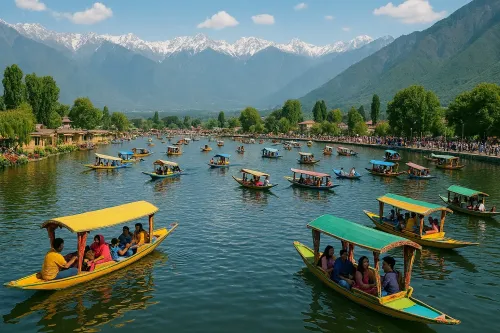
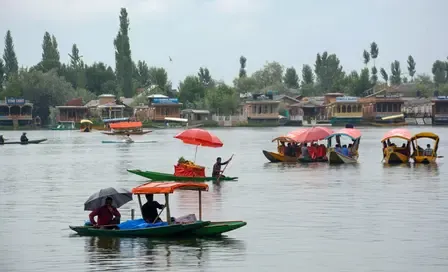
Tourism has emerged as one of the clearest economic signals of the changing landscape. Government data cited in the report show that Jammu and Kashmir recorded more than 2.3 crore tourist arrivals in 2024 — the highest in its history. The report attributes this surge to improved rail, road, and air connectivity, as well as the development of tourism destinations beyond traditional centres. Increased visitor spending has generated economic activity across hospitality, transport, food services, handicrafts, and local businesses.
Investment inflows have also accelerated. According to figures cited in the report, Jammu and Kashmir attracted approximately ₹18,000 crore in investments between 2016-17 and 2025-26, compared with around ₹8,000 crore during the preceding decades. The Union Territory also achieved a 'Top Achiever' ranking in the national Ease of Doing Business assessment, according to the Economic Survey 2025-26.
Jobs, Hydropower, and the Road Ahead
On employment, government data show that more than 41,000 government jobs were created between 2019 and May 2026. Over 9.81 lakh people reportedly benefited from self-employment opportunities under various government-backed schemes during the previous four years. Mission YUVA, described in the report as a flagship initiative, aims to establish 1.37 lakh enterprises and generate approximately 4.25 lakh jobs over five years through skill development and entrepreneurship support.
The power sector is also gaining strategic weight. The 2026-27 Budget estimates ₹7,100 crore in non-tax revenue from the power sector — nearly 64 per cent of the government's own non-tax revenue. The J&K Hydro Power Policy 2025 is expected to provide a framework for attracting fresh investment into the sector.
Whether the pace of these developments is sustained — and whether the gains reach the most marginalised communities in the Union Territory — will determine the longer-term arc of Jammu and Kashmir's economic integration with the rest of India.
Point of View
But they require scrutiny on at least two fronts. First, GSDP growth and investment figures for a Union Territory administered by the Centre carry an inherent political incentive to present progress favourably — independent verification of these numbers is limited. Second, the jobs data conflates government employment with self-employment beneficiaries, a category that can include one-time scheme recipients rather than sustained livelihoods. The connectivity gains — particularly the USBRL completion — are verifiable and genuinely historic. But the gap between infrastructure milestones and inclusive economic outcomes for ordinary Kashmiris remains the story that aggregate indicators cannot fully tell.
NationPress
21 Sept 2026
Frequently Asked Questions
What is the current economic growth rate of Jammu and Kashmir?
According to the Jammu and Kashmir Economic Survey 2025-26, the Union Territory's real GSDP is estimated to grow by 5.82 per cent in 2025-26, with nominal GSDP projected at around ₹2.86 lakh crore and per capita income estimated at ₹1,68,243.
When was the Kashmir Valley connected to India's national railway network?
The Kashmir Valley was connected to India's national railway network for the first time in June 2025, with the completion of the 272-km Udhampur-Srinagar-Baramulla Rail Link (USBRL). The Jammu-Srinagar Vande Bharat service subsequently expanded to 20 coaches and began regular operations on 2 May 2026.
How many tourists visited Jammu and Kashmir in 2024?
Jammu and Kashmir recorded more than 2.3 crore tourist arrivals in 2024, the highest in the region's history, according to government data cited in the report. The growth is attributed to improved rail, road, and air connectivity, as well as the development of new tourism destinations.
How much investment has Jammu and Kashmir attracted since 2016-17?
Jammu and Kashmir attracted approximately ₹18,000 crore in investments between 2016-17 and 2025-26, more than double the roughly ₹8,000 crore recorded in the preceding decades, according to figures cited in the report. The Union Territory also achieved a 'Top Achiever' ranking in India's national Ease of Doing Business assessment.
What is the Zojila Tunnel and why does it matter for J&K?
The Zojila Tunnel is a major infrastructure project that recorded a main-tunnel breakthrough in June 2026. Once completed, it will provide year-round road connectivity between Jammu and Kashmir and Ladakh, eliminating the months-long weather-related closures that have historically disrupted trade, tourism, and mobility in the region.