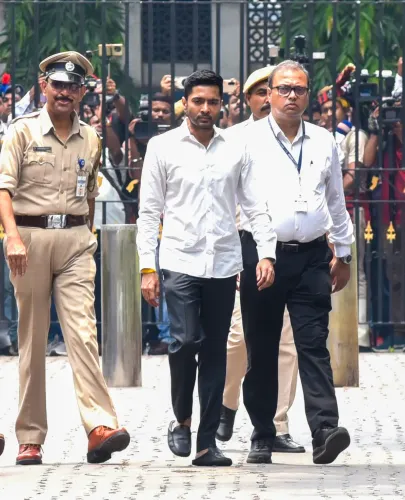
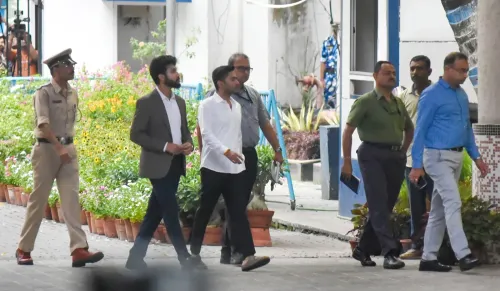
Abhishek Banerjee appears at Bengal CID office minutes before court deadline

Synopsis
After dodging CID summons three times, Trinamool Congress General Secretary Abhishek Banerjee flew back from New Delhi to Kolkata and walked into Bhabani Bhavan with just five minutes to spare — only after a court warned that further non-compliance would not be tolerated. He has a 21-day arrest shield, but the investigation is now firmly in motion.
Key Takeaways
Abhishek Banerjee arrived at the West Bengal CID headquarters, Bhabani Bhavan , at 5:55 p.m. on 11 June — five minutes before the court deadline.
A vacation bench of Justice Kaushik Chanda had directed his appearance by 6 p.m. , citing three prior instances of evading summons.
The court granted Banerjee interim protection from arrest for 21 days while directing full cooperation with investigators.
Banerjee flew back from New Delhi after the order was issued, landing in Kolkata at around 4 p.m.
The court also authorised the CID to carry out raid and search operations as part of the investigation.
Trinamool Congress General Secretary and Lok Sabha member Abhishek Banerjee arrived at the headquarters of the Criminal Investigation Department (CID) of the West Bengal Police on Thursday, 11 June, to face questioning in the legislators' signature mismatch case. He entered Bhabani Bhavan in South Kolkata at 5:55 p.m. — just five minutes before the court-mandated deadline.
Court Order That Triggered the Appearance
A single-judge vacation bench of Justice Kaushik Chanda of the Calcutta High Court directed Banerjee to present himself at the CID office by 6 p.m. on Thursday. The bench noted that Banerjee had already evaded summons in the matter on three previous occasions and made clear that further non-compliance would not be tolerated.
The court simultaneously granted Banerjee an interim protection from coercive police action, including arrest, for the next 21 days. The bench also directed him to fully cooperate with CID investigators and authorised the agency to conduct raid and search operations if necessary.
Rush Back From New Delhi
When the court order was pronounced, Banerjee was in New Delhi. He immediately flew back to Kolkata, landing at Kolkata Airport at around 4 p.m. He briefly stopped at his residence on Kalighat Road before proceeding to Bhabani Bhavan, the CID headquarters located roughly a kilometre away. On arrival, he signed the visitors' register at the building's entrance but declined to answer questions from waiting journalists.
The Signature Mismatch Case
The case centres on an alleged mismatch in signatures of Trinamool Congress (TMC) legislators. The precise nature of the forgery or discrepancy has not been detailed in official statements, but the CID has been pursuing the investigation with court backing. Banerjee, who is also the nephew of former West Bengal Chief Minister Mamata Banerjee, is among those being questioned in connection with the matter.
This is the first time Banerjee has appeared before the CID in this case, following three earlier instances where he did not respond to summons. The court's firm directive and the accompanying 21-day arrest protection mark a significant procedural development, signalling that the investigation is entering a more active phase.
What Happens Next
With the interim protection from arrest in place for 21 days, the CID will proceed with its questioning. The court's authorisation for raids and searches broadens the agency's investigative scope. Legal observers note that the next hearing will be closely watched to determine whether Banerjee's cooperation satisfies the court's conditions or whether further judicial intervention becomes necessary.
Point of View
But it also hands the CID a defined window to build its case. What matters now is whether the questioning yields substantive leads or becomes a procedural formality that the investigation quietly outlasts. Bengal's political establishment has a long history of such cases stalling at the threshold of accountability.
NationPress
29 Jul 2026
Frequently Asked Questions
Why was Abhishek Banerjee summoned by the West Bengal CID?
Abhishek Banerjee was summoned in connection with the legislators' signature mismatch case, which involves an alleged discrepancy in the signatures of Trinamool Congress MLAs. The CID has been investigating the matter and had issued summons to Banerjee on three prior occasions before the court intervened.
What did the Calcutta High Court order on 11 June?
A single-judge vacation bench of Justice Kaushik Chanda directed Abhishek Banerjee to appear at the CID's Bhabani Bhavan office by 6 p.m. on Thursday, 11 June. The court also granted him a 21-day interim protection from arrest and authorised the CID to conduct raids and searches if required.
Is Abhishek Banerjee at risk of arrest in this case?
Not immediately. The court has granted him interim protection from coercive police action, including arrest, for 21 days from 11 June. However, he has been directed to cooperate fully with investigators during this period.
Who is Abhishek Banerjee?
Abhishek Banerjee is the General Secretary of the Trinamool Congress and a Lok Sabha member. He is also the nephew of former West Bengal Chief Minister Mamata Banerjee, making him one of the most prominent figures in the party's leadership.
What is the legislators' signature mismatch case?
The case involves an alleged mismatch or forgery in the signatures of Trinamool Congress legislators. The West Bengal CID is investigating the matter, and the Calcutta High Court has been overseeing compliance with its investigative directives.