How Did NSE Sustainability Recognize Adani Power's ESG Performance?

Synopsis
Adani Power has received recognition from NSE Sustainability Ratings for its remarkable ESG performance, achieving a score of 65 in the 'Aspiring' category. This highlights the company's commitment to sustainable practices and community development, setting a new benchmark in the energy sector.
Key Takeaways
Adani Power achieves a score of 65 in NSE Sustainability Ratings.
Recognized in the “Aspiring” category for ESG performance.
Focuses on sustainable growth and responsible business practices.
Utilizes advanced emission management technologies .
Commits to community development and workforce well-being.
Ahmedabad, Dec 16 (NationPress) In a testament to its steadfast dedication to environmental, social and governance (ESG) principles, Adani Power Ltd announced on Tuesday that NSE Sustainability Ratings and Analytics Limited, a subsidiary of NSE Indices Ltd and part of the National Stock Exchange of India (NSE) group, has evaluated the company based on publicly accessible information and awarded it a score of 65, categorizing it in the “Aspiring” group.
Adani Power stands out among all major thermal, mixed fuel, and integrated energy companies in this evaluation, showcasing its strategic emphasis on sustainable growth through responsible business practices.
The company’s ongoing commitment to a variety of ESG initiatives and its operational excellence is measured against the best industry benchmarks.
As India’s largest private power producer, Adani Power has adopted advanced emission management technologies, such as ‘Ultra Super Critical’ boilers, to minimize its carbon footprint and has invested in ongoing monitoring and remediation systems.
Moreover, alongside energy efficiency efforts, Adani Power has prioritized water conservation by implementing a zero liquid discharge system, which ensures a minimal impact on local water resources.
The Adani Group company has also broadened its community development initiatives, focusing on education, healthcare, and skill development for local communities.
Programs such as scholarship initiatives for underprivileged students, health camps, and livelihood improvement projects illustrate Adani Power's commitment to inclusive growth.
The company also strongly emphasizes the well-being of its workforce, safety training, and the promotion of diversity and inclusion across its operations.
In terms of governance, Adani Power surpasses the minimum standards required by regulations.
The proportion of independent directors on the Nomination and Remuneration Committee exceeds compliance requirements.
Similarly, the representation of independent directors on the Audit Committee is above statutory guidelines, and the composition of the Risk Management Committee exceeds the necessary threshold.
Additionally, the company has adopted rigorous ESG standards for suppliers and contractors, ensuring responsible practices throughout its supply chain.
Through these efforts, Adani Power consistently sets new standards for responsible and sustainable business in the energy sector.
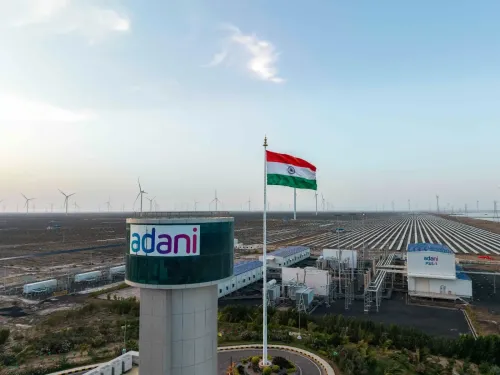
Currently, Adani Power boasts an installed thermal power capacity of 18,110 MW, distributed across 12 power plants located in Gujarat, Maharashtra, Karnataka, Rajasthan, Chhattisgarh, Madhya Pradesh, Jharkhand, and Tamil Nadu, along with a 40 MW solar power facility in Gujarat.
Point of View
I believe that Adani Power's recent recognition by NSE Sustainability Ratings highlights a significant shift towards responsible corporate practices in India. Their commitment to ESG principles is not only commendable but sets a benchmark for the energy sector, demonstrating that sustainable growth is achievable and essential.
NationPress
15 Sept 2026
Frequently Asked Questions
What is the significance of Adani Power's ESG score?
Adani Power's ESG score of 65 signifies its commitment to sustainable practices and responsible business operations, positioning it favorably among major energy companies.
How does Adani Power contribute to community development?
Adani Power is actively involved in community development through scholarship programs, health camps, and skill-building initiatives aimed at uplifting underprivileged communities.
What technologies does Adani Power use to manage emissions?
The company utilizes advanced emission management technologies, including ‘Ultra Super Critical’ boilers, to significantly reduce its carbon footprint.
How does Adani Power ensure water conservation?
Adani Power has adopted a zero liquid discharge system to minimize its impact on local water resources, ensuring sustainable water management.
What are Adani Power's governance practices?
The company exceeds regulatory requirements for independent director representation in its committees, ensuring strong governance standards.