Afghanistan FM seeks US investment, sanctions rollback five years after NATO exit
Synopsis
Afghanistan's Foreign Minister is asking Washington to invest in its mines, reopen its embassy, and lift sanctions — while ruling out any military return. With over $1 trillion in untapped minerals and China already moving in, the US faces a strategic clock it may not have noticed is ticking.
Key Takeaways
Afghan FM Amir Khan Muttaqi has urged US investment in mining, infrastructure, agriculture, and trade, as well as a rollback of sanctions, five years after NATO 's withdrawal.
An estimated $145 billion was appropriated for Afghanistan's reconstruction by June 2021 , of which $88.6 billion went to security alone, according to a SIGAR report.
Afghanistan holds at least $1 trillion in mineral reserves, including lithium, cobalt, and copper; since 2021, Kabul has announced over $7 billion in mining deals with China and Iran .
Key projects including the CASA-1000 power corridor and the TAPI gas pipeline remain stalled or severely delayed.
Afghanistan's GDP grew 180 per cent between 2000 and 2019 , but growth was underpinned by foreign aid averaging nearly 60 per cent of GDP.
Muttaqi has ruled out any return of US military forces or American control of Bagram Air Base .
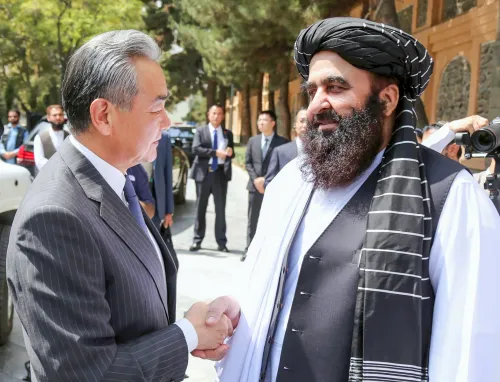
Five years after the withdrawal of United States-led NATO troops from Afghanistan, the country's Foreign Minister Amir Khan Muttaqi has formally sought Washington's investment in mining, infrastructure, agriculture, and trade — while simultaneously calling for an end to economic sanctions that have crippled the war-ravaged nation's recovery. Muttaqi made the appeal in an interview with the Financial Times, signalling Kabul's intent to reframe its relationship with the West on economic rather than military terms.
The Scale of Unfinished Business
Two decades of International Security Assistance Force (ISAF) presence through mid-2021 saw an estimated $145 billion appropriated for reconstruction and related activities in Afghanistan by June 2021, according to a report by the United States Special Inspector General for Afghanistan Reconstruction (SIGAR). Of this, $88.6 billion went towards security, $36.3 billion for governance and development, $4.2 billion in humanitarian assistance, and $15.9 billion as programme administration costs.
Yet, as the SIGAR report noted, the critical question was not merely how much was spent, but 'how these resources were used and how effective they were' — an accountability gap that analysts say remains unresolved. Administrative corruption was flagged as a major challenge throughout that period.
Stalled Projects and Broken Promises
Among the most significant casualties of the post-2021 transition is the CASA-1000 (Central Asia-South Asia power project), a $1.2 billion initiative designed to transmit surplus electricity from Tajikistan and Kyrgyzstan to Pakistan via Afghanistan. Launched in 2013, work on the Afghan section was suspended in September 2021.
The TAPI pipeline — the Turkmenistan-Afghanistan-Pakistan-India gas corridor intended to transport 33 billion cubic metres of natural gas annually from Turkmenistan's Galkynysh gas field — has similarly stalled. Construction of the Afghan section, officially launched in 2018, reportedly remained limited. In the transport sector, the Khaf-Herat railway, inaugurated in 2019, still awaits full integration into the regional rail network.
A Trillion-Dollar Resource Paradox
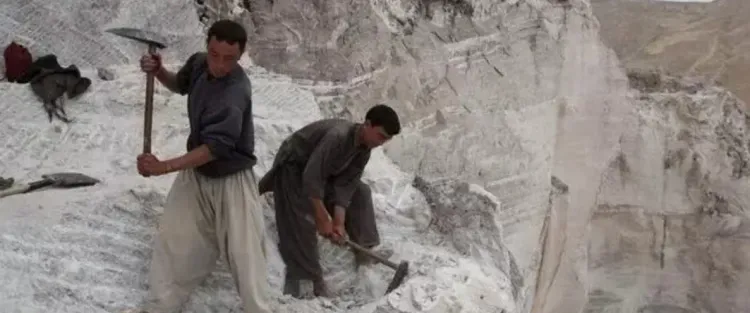
Despite the dysfunction, Afghanistan sits atop one of the world's most underexploited mineral endowments. According to assessments by US geologists and the former Afghan government, the country holds at least $1 trillion worth of mineral reserves, including copper, iron ore, niobium, cobalt, gold, and lithium. Since 2021, Kabul has reportedly announced more than $7 billion in mining investments involving countries including China and Iran.
Sanctions, along with political and human rights concerns, remain among the principal obstacles to attracting US capital, according to reports. This creates a paradox: the very resources that could stabilise Afghanistan are being developed by geopolitical rivals of Washington, partly because US firms are legally barred from engaging.
What Muttaqi Is Asking For
Muttaqi's ask is threefold: US investment, the reopening of the US Embassy in Kabul, and the withdrawal of sanctions. He has framed this as a forward-looking proposition, urging Washington to look beyond the last two decades of conflict toward future economic cooperation. However, he also stated that any return of American military forces to Afghanistan — including retaking control of Bagram Air Base — would be unacceptable.
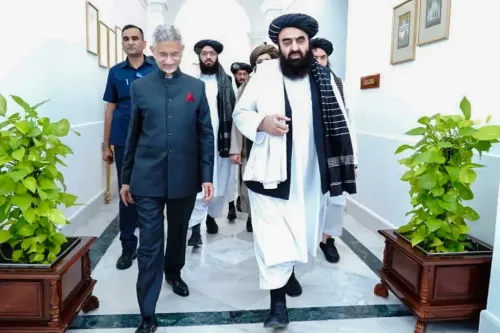
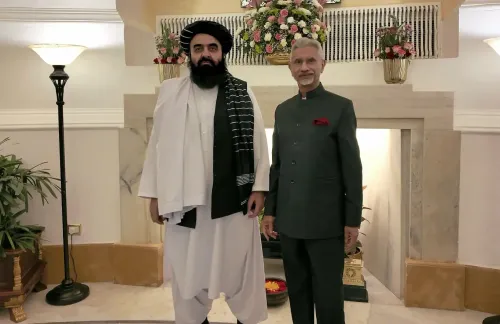
Muttaqi, who operates under UN travel restrictions applicable to Taliban officials, has visited several countries with UN permission, including India, where a Taliban representative is stationed at the embassy in New Delhi without formal diplomatic recognition of the Kabul regime.
Growth That Depended on Aid
The economic picture under the previous administration was more complex than often portrayed. According to the World Bank, Afghanistan's economy grew at an average of more than 7 per cent annually from 2000 to 2019, with GDP rising by 180 per cent over that period. However, this growth was heavily aid-dependent — foreign assistance averaged nearly 60 per cent of GDP across the period and stood at around 45 per cent in 2019.
An Afghan economic analyst cited instability over the last two decades as the single most significant factor preventing key projects from reaching fruition. Experts have argued that poor resource management meant funds were not effectively directed to productive sectors. 'Security, effective governance, sustainable infrastructure, regional cooperation, and stronger domestic production and exports are also essential,' one report concluded.
Whether Washington recalibrates its posture toward Kabul — and on what conditions — will shape not just Afghanistan's economic trajectory but the broader contest for influence over one of Asia's most strategically located mineral frontiers.
Point of View
Which is not how Washington typically operates. The deeper irony is that $145 billion in reconstruction spending produced an economy so aid-dependent it collapsed within weeks of the troop withdrawal — a failure of institutional design that neither side has publicly reckoned with. Meanwhile, China is quietly locking up Afghan mining concessions, which means every month Washington delays a policy recalibration is a month Beijing consolidates its position on a critical mineral frontier. The human rights question is real, but so is the geopolitical cost of inaction.
NationPress
17 Oct 2026
Frequently Asked Questions
What is Afghanistan's Foreign Minister Amir Khan Muttaqi asking the US for?
Muttaqi has urged the US to invest in Afghanistan's mining, infrastructure, agriculture, and trade sectors, reopen the US Embassy in Kabul, and withdraw economic sanctions. He made these remarks in an interview with the Financial Times, framing the appeal as a forward-looking economic partnership rather than a continuation of the post-9/11 military relationship.
How much did the US and its allies spend on Afghanistan's reconstruction?
According to a SIGAR report cited in Tolo News, approximately $145 billion was appropriated for reconstruction and related activities in Afghanistan by June 2021. This included $88.6 billion for security, $36.3 billion for governance and development, $4.2 billion in humanitarian assistance, and $15.9 billion in programme administration costs.
What are Afghanistan's mineral resources worth?
According to assessments by US geologists and the former Afghan government, Afghanistan holds at least $1 trillion in mineral reserves, including copper, iron ore, niobium, cobalt, gold, and lithium. Since 2021, Kabul has reportedly announced over $7 billion in mining investments involving China and Iran.
Which major infrastructure projects in Afghanistan remain stalled?
Two of the most significant are the CASA-1000 power project — a $1.2 billion initiative to transmit electricity from Central Asia to Pakistan via Afghanistan, suspended in September 2021 — and the TAPI pipeline, which was to carry 33 billion cubic metres of gas annually from Turkmenistan through Afghanistan to Pakistan and India, with construction of the Afghan section reportedly limited despite an official 2018 launch.
Why are sanctions a barrier to US investment in Afghanistan?
Economic sanctions imposed on the Taliban-led government, combined with political and human rights concerns, legally and reputationally restrict US firms from engaging with Afghanistan. This has effectively ceded early-mover advantage in the country's mineral sector to China and Iran, according to reports.