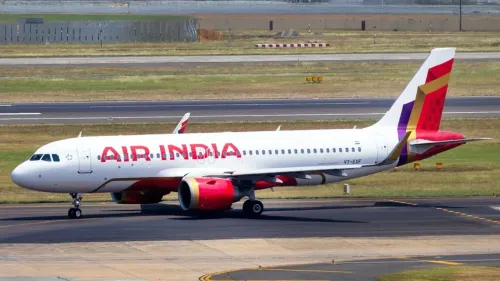
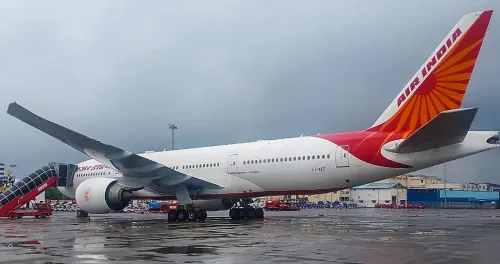
Air India posts $2.8 bn loss in FY26, drags Singapore Airlines profit down 57%
Synopsis
Air India's $2.80 billion loss in FY26 is not just an airline story — it has wiped out more than half of Singapore Airlines' annual profit. With Pakistan's airspace shut, Middle East routes disrupted, and jet fuel costs rising, Air India's Tata-era turnaround is under its severest test yet.
Key Takeaways
Air India posted a loss of $2.80 billion (SGD 3.56 billion) for the financial year ended March 2026 .
Singapore Airlines Group net profit fell 57.4 per cent to SGD 1.184 billion , down from SGD 2.778 billion in 2024-25, largely due to Air India losses.
SIA holds a 25.1 per cent stake in Air India and accounted for a full year of losses versus only four months the prior year.
Closure of Pakistan's airspace and the Middle East conflict forced Air India to cancel several international flights, disrupting its revival plans.
India's international air traffic fell 20 per cent in April month-on-month to 28.3 lakh passengers ; domestic traffic dropped 4 per cent to 140.8 lakh .
SIA Group reaffirmed its commitment to the Air India investment as part of its long-term multi-hub strategy.
Air India recorded a net loss of $2.80 billion (SGD 3.56 billion) for the financial year ended March 2026, according to the annual report of Singapore Airlines (SIA) Group released on Thursday, 14 May. The staggering loss has eroded the bottomline of SIA Group, which holds a 25.1 per cent stake in the Tata-owned carrier.
Impact on Singapore Airlines
Singapore Airlines Group reported a 57.4 per cent decline in net profit to SGD 1.184 billion for the financial year ended March 2026, down from SGD 2.778 billion in 2024-25. The airline attributed the sharp fall primarily to accounting for its full share of Air India's losses — a swing of SGD 846 million — compared with only four months of shared losses in the previous year, following the completion of the Air India-Vistara merger in November 2024.
Notably, SIA Group's 2024-25 profit had also been boosted by a one-time, non-cash accounting gain of SGD 1.098 billion recognised upon the merger's completion — a tailwind absent this year.
Why Air India Is Bleeding
Air India's revival trajectory has been disrupted by a confluence of external shocks. The closure of Pakistan's airspace forced the carrier to cancel several international flights in recent months, adding to route inefficiencies and operational costs. Simultaneously, the ongoing Middle East conflict has sharply curtailed international traffic, while a surge in jet fuel prices has inflated operating expenses, compounding pressure on an already loss-making airline.
India's international air passenger count fell to 28.3 lakh in April — a 20 per cent drop compared to March — while domestic traffic declined to 140.8 lakh passengers, representing a 4 per cent fall both year-on-year and month-on-month, according to data from the Ministry of Civil Aviation.
Singapore Airlines Stays Committed
Despite the losses, SIA Group reaffirmed its commitment to the Air India investment, describing it as a core component of its long-term multi-hub strategy. 'This strategic investment provides the Group with a direct stake in one of the world's largest and fastest-growing aviation markets, complementing its Singapore hub and strengthening its long-term growth,' the airline said in a press statement.
The group's position signals confidence in India's aviation growth story even as near-term headwinds persist.
What Comes Next
Air India's turnaround — a central pillar of the Tata Group's aviation ambitions since acquiring the carrier — now faces a more difficult timeline. With geopolitical disruptions showing no immediate signs of easing and fuel costs elevated, analysts will watch whether the airline can stabilise international operations and rebuild load factors before the next financial year. SIA Group's next quarterly update will be closely scrutinised for any revision to its Air India outlook.
Point of View
But the more revealing number is SIA Group's profit collapse — a 57 per cent fall driven almost entirely by its Air India exposure. The geopolitical disruptions (Pakistan airspace, Middle East conflict) are real but also convenient; the deeper question is whether Air India's cost structure and network strategy can generate a path to profitability independent of external shocks. SIA's public reaffirmation of its stake reads as a holding position, not a vote of confidence. The clock is ticking on what was supposed to be one of Indian aviation's great turnaround stories.
NationPress
26 Sept 2026
Frequently Asked Questions
How much loss did Air India report for FY26?
Air India posted a loss of $2.80 billion (SGD 3.56 billion) for the financial year ended March 2026, according to Singapore Airlines Group's annual report released on 14 May. This is the full-year loss figure disclosed through SIA's stake accounting.
Why did Singapore Airlines' profit fall so sharply in FY26?
Singapore Airlines Group's net profit fell 57.4 per cent to SGD 1.184 billion primarily because it accounted for a full year of Air India's losses — a swing of SGD 846 million — compared to only four months the previous year. The prior year's profit was also elevated by a one-time SGD 1.098 billion non-cash accounting gain from the Air India-Vistara merger.
What caused Air India's heavy losses in FY26?
Air India's losses were driven by multiple headwinds: the closure of Pakistan's airspace forced cancellation of several international flights, the Middle East conflict sharply reduced international traffic, and rising jet fuel prices increased operating costs. Together, these factors severely disrupted the airline's turnaround plans.
Is Singapore Airlines planning to exit its Air India investment?
No. Singapore Airlines Group has reaffirmed its commitment to its 25.1 per cent stake in Air India, calling it a core component of its long-term multi-hub strategy. The group stated the investment gives it direct exposure to one of the world's largest and fastest-growing aviation markets.
How has India's air traffic been affected recently?
India's domestic air traffic fell to 140.8 lakh passengers in April 2026 — a 4 per cent decline both year-on-year and month-on-month. International traffic saw a sharper 20 per cent drop compared to March, falling to 28.3 lakh passengers, according to Ministry of Civil Aviation data.