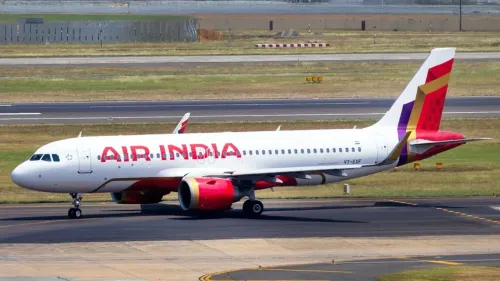
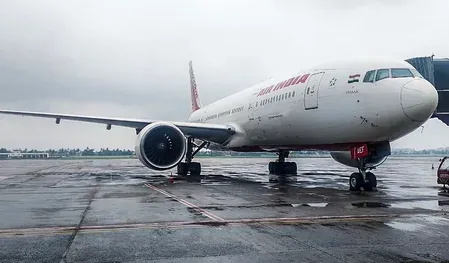
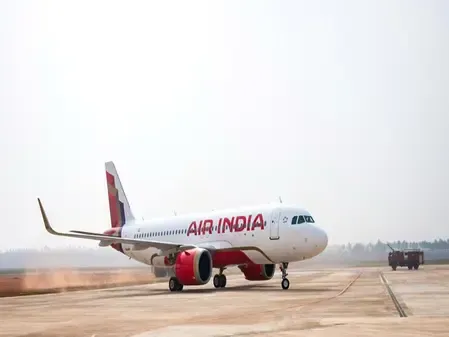
Singapore Airlines backs Air India recovery despite losses and ₹ pressure
Synopsis
Singapore Airlines has ruled out writing down its Air India stake and insists the loss-making carrier is making real progress — but its refusal to comment on a reported $1.1 billion capital request signals that the financial pressure on Air India's transformation is far from resolved.
Key Takeaways
Singapore Airlines holds a 25.1% stake in Air India and calls it central to its long-term multi-hub strategy.
SIA completed a formal impairment review and concluded no write-down of its Air India investment is required.
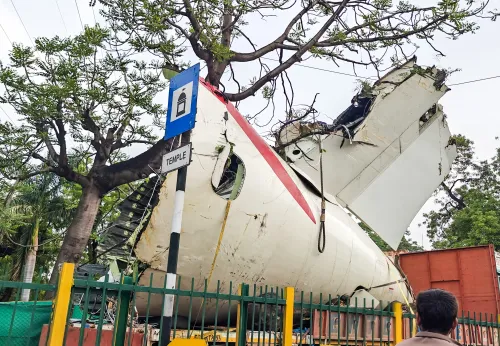
Air India faces headwinds including rupee depreciation , supply chain disruptions, Pakistan airspace closure , and the June 2025 crash that killed 260 people .
SIA declined to comment on reports of a $1.1 billion capital infusion request made by Air India in October 2025 .
SIA's CEO sits on Air India's board as a non-executive, non-independent director.
SIA's AGM is scheduled for 24 July ; the Air India update was part of pre-AGM shareholder disclosures.
Singapore Airlines (SIA) has declared it sees 'tangible progress' in Air India's ongoing transformation, reaffirming that its 25.1% stake in the Tata Group-owned carrier remains central to its long-term multi-hub strategy. The remarks came ahead of SIA's annual general meeting (AGM) scheduled for 24 July, as the airline addressed shareholder and investor queries filed with the Singapore Exchange.
Impairment Assessment and Investment Stance
SIA confirmed it had undertaken a formal impairment assessment after identifying indicators that warranted a review of its Air India holding. The airline concluded that no write-down was necessary, citing India's strong aviation growth potential as a key justification. According to the Singapore Exchange filing, SIA's board will 'carefully evaluate' any future capital requests from Air India after weighing the group's own capital requirements and Air India's business strategy.
Notably, SIA declined to comment on reports that Air India had sought a $1.1 billion capital infusion in October 2025 — a silence that is likely to sustain investor speculation about the carrier's funding trajectory.
Challenges Weighing on Air India
SIA acknowledged that Air India continues to grapple with several well-publicised headwinds. These include the depreciation of the Indian rupee, persistent supply chain disruptions, the closure of Pakistan's airspace, and the June 2025 plane crash that claimed 260 lives. The airspace closure has forced longer routings on key international sectors, adding to fuel and operating costs at a time when the airline is already loss-making.
This comes amid a broader period of turbulence for Indian aviation, where capacity constraints and fleet delivery delays — partly linked to global engine supply issues — have squeezed multiple carriers simultaneously.
Progress Recorded Across Key Metrics
Despite these pressures, SIA said Air India has recorded measurable improvements across customer experience, fleet and network expansion, operational performance, and ground and in-flight service standards. The Singapore carrier did not provide specific metrics to substantiate these claims, but the framing suggests the transformation programme — launched after the Tata Group acquired Air India in early 2022 — is advancing on internal benchmarks.
SIA's Chief Executive Officer serves as a non-executive and non-independent director on Air India's board, a governance arrangement that allows SIA to provide strategic guidance and industry expertise without operational control.
What the AGM Agenda Signals
Beyond the Air India question, SIA's AGM agenda reportedly covered Air India's future funding needs, geopolitical risks, digital services, and customer experience improvements — a broad sweep that reflects how central the India bet has become to SIA's international growth thesis. India is projected to become the world's third-largest aviation market within this decade, making Air India's recovery a strategically significant outcome for SIA shareholders.
Whether SIA will be called upon to inject fresh capital — and on what terms — is likely to remain the dominant question for investors as Air India's transformation enters a more capital-intensive phase.
Point of View
But it is also a carefully worded one — the airline is not committing fresh capital and pointedly refused to address the reported $1.1 billion ask. That silence is telling. Air India's transformation is real but expensive, and the Tata Group cannot absorb indefinite losses alone. The Pakistan airspace closure and the June 2025 crash have compounded structural cost pressures at the worst possible time. SIA's multi-hub framing is strategically sound — India's aviation upside is undeniable — but the gap between 'tangible progress' and profitability is where the real story will be written over the next 18 months.
NationPress
21 Oct 2026
Frequently Asked Questions
What did Singapore Airlines say about its Air India stake?
Singapore Airlines reaffirmed that its 25.1% stake in Air India remains a core part of its long-term multi-hub strategy, citing India's strong aviation growth potential. The airline also concluded a formal impairment assessment and determined no write-down of the investment was necessary.
What challenges is Air India currently facing?
Air India is dealing with rupee depreciation, global supply chain disruptions, the closure of Pakistan's airspace, and the aftermath of a June 2025 plane crash that killed 260 people. These factors have added significant cost and reputational pressure to the carrier's ongoing transformation.
Did Singapore Airlines comment on Air India's $1.1 billion capital request?
No. SIA declined to comment on reports that Air India sought a $1.1 billion capital infusion in October 2025. The airline said its board would carefully evaluate any future funding requests from Air India after considering the group's own capital needs.
What progress has Air India made under Tata Group ownership?
According to Singapore Airlines, Air India has made measurable improvements in customer experience, fleet and network expansion, operational performance, and ground and in-flight services since the Tata Group acquired it in early 2022. Specific performance metrics were not disclosed.
What is Singapore Airlines' role in Air India's governance?
SIA's Chief Executive Officer serves as a non-executive and non-independent director on Air India's board. This gives SIA a strategic oversight role — including the ability to provide industry expertise — without direct operational control of the airline.