Has Air Quality in Delhi-NCR Plummeted to 'Very Poor' Levels?
Click to start listening
Synopsis
The air quality in Delhi-NCR has sharply declined, entering the 'very poor' category due to severe pollution, cold wave conditions, and fog. With AQI levels soaring across the region, health experts urge vulnerable populations to limit outdoor activities. The impact on flight operations adds to the challenges faced by residents during this adverse weather.
Key Takeaways
- AQI levels in Delhi-NCR have reached 'very poor' status.
- Cold wave conditions are exacerbating the situation.
- Health experts advise vulnerable groups to limit outdoor activities.
- Flight operations are impacted due to dense fog.
- Immediate action is needed to combat rising pollution levels.
New Delhi, Jan 16 (NationPress) The air quality in Delhi-NCR significantly declined on Friday morning, with numerous areas registering Air Quality Index (AQI) values categorized as “very poor”, as per the latest data from the Central Pollution Control Board (CPCB).
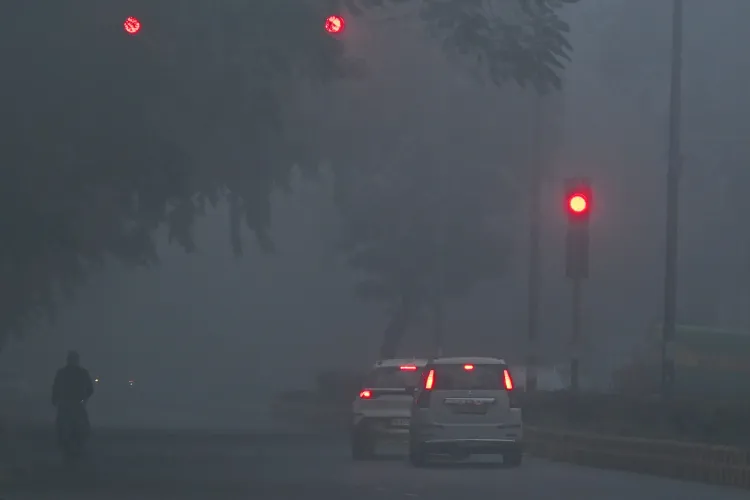
This escalation in pollution coincides with cold wave conditions and dense fog enveloping the city, heightening health and travel concerns.
By 7 a.m., Anand Vihar noted an AQI of 354, firmly placing it in the “very poor” classification. Other pollution hotspots reported similarly concerning levels, including Ashok Vihar at 367, ITO at 362, RK Puram at 374, and Patparganj at 372.
Wazirpur and Chandni Chowk recorded AQI figures of 374 and 370, respectively, while Dwarka Sector 8 registered 369. An AQI measurement between 301 and 400 is categorized as “very poor” and can lead to respiratory issues with prolonged exposure.
The AQI classification indicates that values between 0–50 are considered ‘good’, 51-100 ‘satisfactory’, 101-200 ‘moderate’, 201-300 ‘poor’, 301-400 ‘very poor’, and 401-500 ‘severe’.
The recent surge in pollution is occurring alongside cold wave conditions prevailing in the national capital. The India Meteorological Department (IMD) reported that Delhi is experiencing temperatures significantly below the seasonal average for mid-January, with some areas reporting lows near 3 degrees Celsius and others around 5.4 degrees Celsius.
The IMD has issued warnings about the likelihood of cold wave conditions in isolated areas across Delhi, Haryana, and Chandigarh, while cold day conditions are expected to persist in certain pockets of the region. Dense fog during early morning hours has also reduced visibility in numerous areas.
Weather officials indicated that the sky is anticipated to be primarily clear during the day, transitioning to partly cloudy in the evening.
The adverse weather has also affected flight operations at Delhi’s Indira Gandhi International Airport. An advisory released on X stated that flights were operating under CAT III conditions due to dense fog, potentially leading to delays. Passengers were urged to check with their respective airlines for updated flight information, while airport personnel assured that ground staff are present across terminals to assist travelers.
Health experts have recommended that residents, particularly children, the elderly, and individuals with respiratory issues, limit outdoor activities until air quality improves.
Point of View
We must acknowledge the critical situation affecting the health of Delhi-NCR residents due to deteriorating air quality. This event underscores the pressing need for effective pollution control measures and heightened public awareness, especially among vulnerable populations. Our reporting aims to inform and empower citizens to take necessary precautions.
NationPress
16/01/2026
Frequently Asked Questions
What is AQI and why is it important?
AQI stands for Air Quality Index, which measures air pollution levels. It is crucial because it indicates the level of health risk associated with air quality.
What are the health effects of 'very poor' air quality?
Exposure to 'very poor' air quality can lead to respiratory issues, cardiovascular problems, and other health complications, especially for sensitive groups.
What precautions should residents take during cold wave conditions?
Residents should limit outdoor activities, especially vulnerable populations like children and the elderly, and stay indoors as much as possible.
How does fog affect travel in Delhi?
Dense fog reduces visibility, which can lead to delays in flight operations and increased travel times on the road.
What actions can be taken to improve air quality?
Reducing vehicle emissions, promoting public transportation, and enhancing green spaces can significantly improve air quality.