Akhilesh Yadav Calls for Revolution, Targets BJP's Roots
Synopsis
Samajwadi Party president Akhilesh Yadav posted a sharp Urdu-Hindi verse on 6 June 2026 calling youth to revolution and demanding the structural roots of BJP rule be uprooted — not just its branches — as UP's 2027 election battle begins to take shape.
Key Takeaways
Akhilesh Yadav posted a four-line Urdu-Hindi verse on 6 June 2026 declaring that 'change is knocking at the door' and that youth have launched a revolution.
He argued that true freedom and justice require uprooting the 'trunk and termite roots' of injustice, not merely removing a branch — a direct critique of BJP governance.
The closing line inverts the BJP's 'One Nation' slogan: 'एक देश-एक आवाज़ मतलब इंक़लाब' ('One nation, one voice means revolution').
The post is tagged #BJP_बनाम_CJP , signalling a targeted political contrast beyond routine opposition rhetoric.
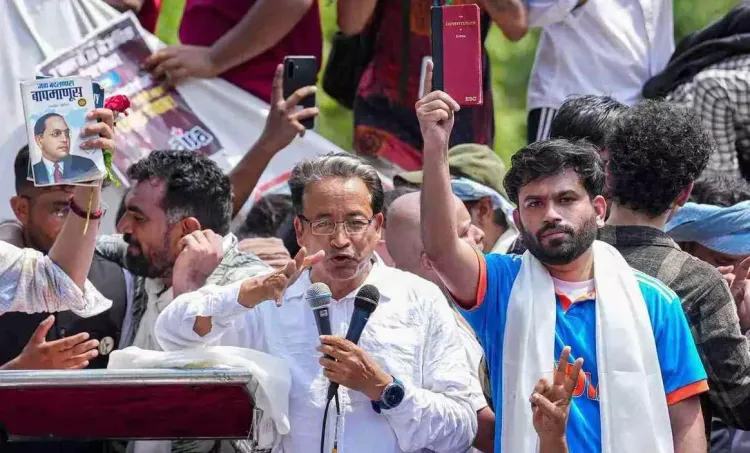
The messaging is widely seen as early mobilisation ahead of the 2027 Uttar Pradesh assembly elections , with youth as the primary audience.
Samajwadi Party president Akhilesh Yadav on Saturday, 6 June 2026 posted a pointed Urdu-Hindi verse on X, calling for a systemic overhaul of what he termed 'arrogant rulers' and warning that superficial change would never deliver true freedom, progress, or justice.
Context
The post opens with a four-line couplet: 'गुरूरमंद हुक्मरानों तक पहुँचे ये आवाज़ / सुनो दरवाज़े पर खटखटा रहा है बदलाव' — 'Let this voice reach the arrogant rulers / Listen, change is knocking at the door.' Yadav then declares that cracks have appeared in fortresses and their foundations are crumbling, and that the youth have now launched a revolution.
The prose section that follows is equally direct. Yadav writes that liberation from 'poisonous conspiracies' will not come as long as only a branch is pointed at and only that branch is removed. He argues that real freedom, progress, and justice will arrive only when the actual trunk of the crime and its termite-eaten roots — hidden deep underground — are uprooted entirely.
Policy Backdrop
The metaphor of branch-versus-root is a recurring device in Samajwadi Party rhetoric, used to argue that the Bharatiya Janata Party's governance addresses symptoms while leaving structural inequities — unemployment, centralisation, communal polarisation — intact. Akhilesh Yadav deployed similar framing during the 2022 Uttar Pradesh assembly elections and the 2024 Lok Sabha campaign, consistently positioning SP as the party of grassroots transformation against what it calls top-down BJP rule.
The hashtag #BJP_बनाम_CJP ('BJP versus CJP') appended to the post signals that the attack is directed at a specific political contrast, though the precise context of that hashtag was not independently verifiable at the time of publication.
Stakeholders and Impact
The post is aimed squarely at Uttar Pradesh's youth, a demographic that constitutes a decisive vote bank in India's most populous state. Yadav's line — 'the youth have now launched a revolution' — is a direct mobilisation signal ahead of the 2027 UP assembly elections, for which political positioning is already intensifying.
Opposition leaders across the INDIA bloc have increasingly used social media poetry and verse to build emotional resonance with Hindi-heartland voters, a tradition with deep roots in socialist and Lohiaite politics. Yadav's post fits that pattern, using the Urdu literary form to frame electoral politics as a moral struggle rather than a policy debate.
The closing line — 'एक देश-एक आवाज़ मतलब इंक़लाब' ('One nation, one voice means revolution') — also inverts the BJP's own 'One Nation' slogans, recasting unity as bottom-up revolt rather than top-down uniformity.
What's Next
BJP spokespersons are likely to respond to the 'revolution' framing, which the ruling party has previously characterised as destabilising language. Watch for follow-up coordination among INDIA bloc partners who may amplify the post as part of a broader pre-2027 campaign narrative.
With Uttar Pradesh assembly elections roughly a year away, Yadav's increasingly pointed rhetoric suggests SP is moving from routine opposition to an active offensive posture — one that places structural critique of BJP governance at the centre of its messaging.
Point of View
Using the Urdu literary tradition to reframe the 2027 UP contest as a civilisational reckoning rather than a routine vote. The branch-versus-root metaphor is a deliberate escalation: it implicitly tells voters that even removing BJP from office is insufficient unless deeper structural change follows. By inverting 'One Nation' into a rallying cry for revolution, SP is attempting to claim the language of national unity for the opposition — a rhetorical gambit that will likely force BJP to respond and thus keep SP's framing in the news cycle.
NationPress
24 Oct 2026
Frequently Asked Questions
What did Akhilesh Yadav post on 6 June 2026?
Akhilesh Yadav posted a verse in Urdu-Hindi calling for revolution against what he termed arrogant rulers, arguing that real freedom will come only when the structural roots of injustice — not just surface branches — are uprooted.
What does Akhilesh Yadav mean by 'branch versus root' in his post?
He uses the metaphor to argue that removing individual BJP leaders or policies is insufficient; the underlying systemic causes of injustice and centralisation must be eliminated for genuine change to occur.
What is the hashtag #BJP_बनाम_CJP about?
The hashtag translates to 'BJP versus CJP' and signals a targeted political contrast in Yadav's post, though the precise event or entity referred to by 'CJP' in this context had not been independently verified at the time of publication.
Is this post related to the 2027 UP elections?
Political analysts read the post as early mobilisation messaging ahead of the 2027 Uttar Pradesh assembly elections, particularly targeting the youth vote bank that is decisive in India's most populous state.
What is Samajwadi Party's political position against BJP?
The Samajwadi Party, founded in 1992 and led by Akhilesh Yadav, consistently positions itself as a champion of social justice, federalism, and youth employment against what it characterises as BJP's centralised and exclusionary governance model.