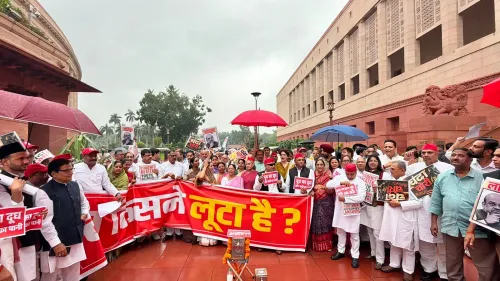
Akhilesh invokes Ram Rajya to target 'donation thieves'
Synopsis
Samajwadi Party president Akhilesh Yadav posted a pointed Hindi verse on 20 October 2026, recasting 'Ram Rajya' as a governance test — targeting welfare thieves and political arrogance while demanding a genuinely equitable order in Uttar Pradesh.
Key Takeaways
Akhilesh Yadav posted a four-line Hindi verse on 20 October 2026 on the theme of Ram Rajya and equitable governance.
The verse targets 'daan-chor' — those who steal donations or welfare funds — framing them as demons to be defeated.
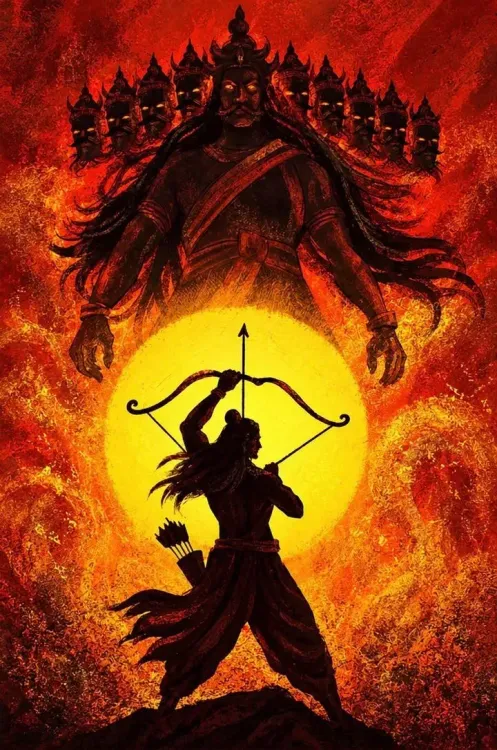
It invokes the Ramayana image of Ram striking Ravana's navel to call for an arrow aimed at the 'arrogant' in power.
The closing demand for 'samatapoorn Ramrajya' (equitable Ram Rajya) repositions a cultural symbol as a social-justice benchmark.
The Samajwadi Party , founded in 1992, has consistently used social-equity framing as a counterpoint to majoritarian politics in Uttar Pradesh .
A four-line verse posted by Samajwadi Party president Akhilesh Yadav on Tuesday, 20 October 2026 repurposes the idea of 'Ram Rajya' as a political challenge — not a temple ritual, but a governance standard that exposes what he calls the arrogance and corruption of those in power.
What the verse says — and what it demands
Written in Hindi verse, Akhilesh's post reads: 'Prabhu Ram wahi jo sabmein ramaayein / Daan-chor ke daanav maar giraayein / Dambhi ki naabhi par teer chalaayein / Samatapoorn Ramrajya jo laayein' — translated: 'The true Lord Ram is one who dwells in all / Who strikes down the demon of those who steal donations / Who aims the arrow at the navel of the arrogant / And who ushers in an equitable Ram Rajya.'
The imagery is layered and deliberate. The phrase 'daan-chor' (those who steal donations or welfare funds) squarely targets corruption in public schemes. The reference to striking the 'navel of the arrogant' — a direct echo of the Ramayana episode where Ram defeats Ravana by piercing his navel — frames political opponents as the demon-king. And 'samatapoorn Ramrajya' (equitable Ram Rajya) is the poem's punchline: a just, egalitarian order as the only legitimate endpoint.
SP's long game with Ram Rajya as a governance yardstick
The Samajwadi Party, founded in 1992 on socialist and social-justice principles, has consistently argued that the ruling establishment appropriates cultural symbols without delivering on their underlying promise of equity. Invoking Ram Rajya as a standard of governance — rather than a cultural marker — is a calculated counter-move: it accepts the symbolic terrain while redirecting its moral weight toward welfare delivery and anti-corruption accountability.
Opposition parties across India have periodically deployed this rhetorical device, but Akhilesh's verse sharpens it into a pointed critique with three specific charges: theft of welfare funds, arrogance in power, and the absence of genuine equality in governance. In the political context of Uttar Pradesh, where welfare scheme implementation and beneficiary targeting are live electoral flashpoints, the language lands with precision.
The arrow aimed at the arrogant
The closing couplet is the sharpest edge. 'Equitable Ram Rajya' as a benchmark implicitly asks: if those in power claim Ram's legacy, why do donation-thieves still operate? Why does arrogance go unpunished? It is a rhetorical trap — and a campaign frame — dressed in devotional metre.
As Uttar Pradesh political actors parse every signal ahead of future electoral cycles, a verse this compact and this loaded rarely stays as just a poem.
Point of View
He occupies it and weaponises its moral logic against them. The specific charge of welfare-fund theft ('daan-chor') roots abstract devotional imagery in concrete governance failure — a move that plays well in Uttar Pradesh, where scheme-delivery and beneficiary exclusion are live political grievances. For the Samajwadi Party, positioning itself as the true custodian of an equitable Ram Rajya is both a cultural claim and an electoral pitch. The sharper the verse, the wider the audience it reaches without requiring a press conference.
NationPress
20 Oct 2026
Frequently Asked Questions
What did Akhilesh Yadav post on 20 October 2026?
Akhilesh Yadav posted a four-line Hindi verse redefining Ram Rajya as a standard of equitable governance — calling for the defeat of welfare thieves ('daan-chor') and the arrogant in power, and demanding a truly equal social order.
What does 'daan-chor' mean in Akhilesh's poem?
'Daan-chor' literally means 'those who steal donations or charitable funds' and in the political context refers to corruption in welfare and public-distribution schemes.
What is 'samatapoorn Ramrajya' and why is it politically significant?
'Samatapoorn Ramrajya' means 'equitable Ram Rajya' — a just, egalitarian order inspired by the ideal reign of Lord Ram. Politically, it allows the Samajwadi Party to engage the cultural symbol of Ram Rajya while redirecting its meaning toward social justice and anti-corruption rather than religious identity.
What is the Samajwadi Party's stance on Ram Rajya?
The Samajwadi Party, founded in 1992 on socialist principles, argues that genuine Ram Rajya means equity and welfare for all — and uses the concept to contrast its own platform with what it characterises as governance failures under rival parties in Uttar Pradesh.
How does Akhilesh Yadav use Ramayana imagery in this post?
The verse references the Ramayana episode in which Ram defeats Ravana by striking his navel — Akhilesh uses this image metaphorically, directing it at 'the arrogant' in power as a call for accountability.