Akhilesh: PDA gets place in BJP, not respect
Synopsis
Samajwadi Party president Akhilesh Yadav declared on 20 August 2026 that the BJP offers the PDA coalition position without respect, and urged PDA communities to unite — setting aside personal gain — to build a permanent government rooted in love, compassion and belonging.
Key Takeaways
Akhilesh Yadav on 20 August 2026 said the BJP gives the PDA communities a place ( sthan ) but never genuine respect ( sammaan ).
He called for PDA members to sacrifice personal interest and unite, arguing this would bring a PDA government 'forever.' Yadav reframed the PDA acronym as standing for 'Prem, Daya, Apnapan' — love, compassion, belonging — as its core emotional principle.
The Samajwadi Party first deployed the PDA coalition as its central electoral strategy in the 2022 Uttar Pradesh assembly elections .
The post signals intensifying SP groundwork ahead of the 2027 Uttar Pradesh assembly elections .
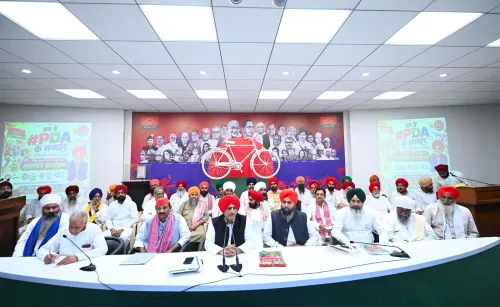
The sharpest divide in Uttar Pradesh politics is not always between parties — sometimes it is between a seat at the table and genuine dignity. Samajwadi Party president Akhilesh Yadav pressed that distinction hard on Thursday, 20 August 2026, arguing that the BJP offers the PDA — the Pichhda-Dalit-Alpsankhyak coalition — position but never respect.
Posting in Hindi, Yadav wrote: 'Bhajpa mein PDA sthan toh pa sakta hai lekin sammaan nahin' — 'In the BJP, the PDA can find a place, but not respect.' The message was direct and the target unmistakable.
Unity as the path to permanent power
Yadav went further than a simple attack on the BJP. He turned the post into a call to arms for the PDA coalition itself. If every member of PDA society set aside personal interest and self-gain and came together, he argued, a PDA government would arrive — and stay — sadaiv ke liye ('forever'). The implicit warning: fragmentation, driven by individual ambition, is the real enemy of the coalition's political ambitions.
The framing matters. By centering personal sacrifice over partisan loyalty, Yadav is addressing the chronic fracture lines that have historically prevented backward-class, Dalit and minority voters from consolidating into a durable bloc. The Samajwadi Party first deployed PDA as its core electoral architecture in the 2022 Uttar Pradesh assembly elections, and has since sought to deepen it as a social identity, not merely a vote-bank calculation.
'Prem, Daya, Apnapan' — the emotional reframe
The most striking move in the post was definitional. Yadav redrew the acronym itself: PDA, he said, stands not only for its constituent communities but for a foundational emotional principle — 'Prem, Daya, Apnapan': love, compassion, belonging. Under a true PDA government, he wrote, no person from any community would be 'victimised, saddened, or humiliated.'
This is a deliberate rhetorical pivot — from caste arithmetic to moral aspiration. The contrast with the BJP's model of governance is implied rather than stated: positions handed out without dignity produce exactly those three conditions Yadav lists. It is the pad-versus-sammaan ('position versus respect') frame that opposition leaders in Uttar Pradesh have used repeatedly, but rarely packaged with this degree of emotional architecture.
With the 2027 Uttar Pradesh assembly elections approaching, the consolidation — or collapse — of the PDA coalition will be among the defining contests in Indian state politics. Yadav is signalling, loudly, that the SP intends to own that ground.
Point of View
He is addressing both an external opponent and an internal discipline problem simultaneously. The rebranding of PDA as 'Prem, Daya, Apnapan' attempts to give the coalition a moral vocabulary that transcends caste arithmetic — a harder identity to fracture than a purely transactional alliance. With 2027 on the horizon, whether that emotional reframe can survive candidate-selection disputes and community-level rivalries is the real test.
NationPress
20 Aug 2026
Frequently Asked Questions
What is PDA in UP politics?
PDA stands for Pichhda-Dalit-Alpsankhyak — a social coalition of backward classes, Dalits and minorities that the Samajwadi Party has built as its core electoral grouping in Uttar Pradesh, first prominently deployed in the 2022 state assembly elections.
What did Akhilesh Yadav say about BJP and PDA?
On 20 August 2026, Akhilesh Yadav said that in the BJP, PDA communities can find a 'place' but never genuine 'respect,' arguing that only a united PDA under the Samajwadi Party would end the humiliation of these communities.
What does Akhilesh Yadav mean by 'Prem, Daya, Apnapan'?
Yadav reinterpreted the PDA acronym to stand for 'Prem, Daya, Apnapan' — love, compassion, belonging — framing it as the emotional and moral foundation of the coalition, beyond its original caste-community definition.
Why is PDA unity important for the 2027 UP elections?
The 2027 Uttar Pradesh assembly elections are the next major electoral test for the Samajwadi Party. Consolidating backward-class, Dalit and minority votes into a durable bloc is the SP's primary path to power, making internal PDA unity its most critical strategic challenge.
What is the 'pad versus sammaan' debate in Uttar Pradesh politics?
The 'pad versus sammaan' — position versus respect — debate refers to the opposition argument that the BJP accommodates OBC, Dalit and minority leaders in token roles without giving them real political dignity or policy influence, a critique Akhilesh Yadav has repeatedly used.