Akhilesh Yadav questions E20 fuel policy amid vehicle damage claims
Synopsis
Samajwadi Party chief Akhilesh Yadav has called out the BJP government over E20 ethanol-blended petrol, citing a contradiction between official assurances and advisor warnings, and describing the policy as a double financial burden — higher fuel costs plus steeper vehicle maintenance — on ordinary consumers.
Key Takeaways
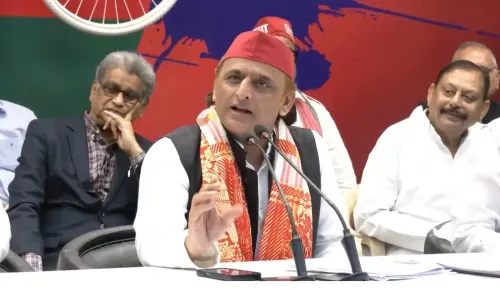
Akhilesh Yadav posted on 19 August 2026 questioning who is telling the truth about E20 fuel — the government or its own advisors.
He cited reports of vehicle breakdowns attributed to E20, with owners having to tow their bikes and cars.
Yadav described E20 as a 'double-edged sword' hitting consumers with both higher petrol prices and costlier maintenance .
He challenged the BJP government — which he says routinely commissions surveys — to instead directly consult citizens affected by the policy.
India's Ethanol Blended Petrol Programme had its E20 target advanced to 2025 under a 2021 central government decision.
Vehicle compatibility, particularly for older and carburettor-based engines, has been a persistent concern raised against higher ethanol blends.
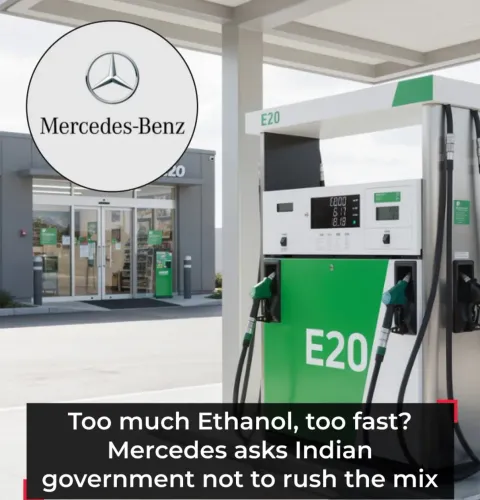
A fuel that was supposed to clean India's air and cut its oil import bill is now, according to Samajwadi Party president Akhilesh Yadav, breaking down the very vehicles it was meant to power — and the government, he says, has no straight answer. On Wednesday, 19 August 2026, Yadav fired a pointed salvo on X, demanding clarity on who is telling the truth about E20, India's 20% ethanol-blended petrol.
Government says 'all is fine'; advisors say otherwise
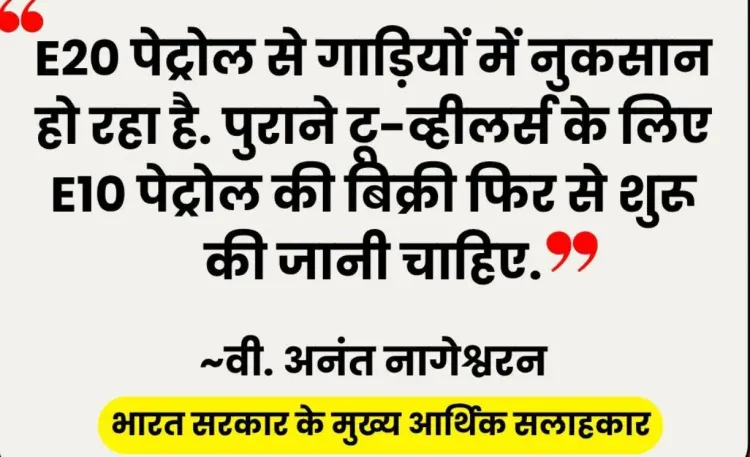
Yadav's post frames a direct contradiction at the heart of India's ethanol policy. 'एक तरफ़ तो सरकार कह रही है E20 में सब ठीक है' ('On one side the government says everything is fine with E20'), he writes, while unnamed advisors are reportedly cautioning that the blend is harmful to vehicles. Bike riders and car owners whose vehicles have had to be towed, he argues, are the ones living this contradiction — not the policymakers.
Yadav directed his sharpest line at the BJP-led central government's habit of commissioning surveys: if you survey everything else, he asks, why not talk directly to the ordinary citizens already bearing E20's consequences to find out what the truth is?
The double burden Yadav says consumers are carrying
The SP chief described E20 as a 'दुधारी तलवार' — a double-edged sword — landing two blows on the same household budget: costlier petrol and higher vehicle maintenance costs. It is a framing designed to resonate with the tens of millions of two-wheeler and small-car owners who fill up frequently and cannot absorb unexpected repair bills.
The criticism lands inside a well-established opposition argument. India's Ethanol Blended Petrol Programme, which the central government accelerated in 2021 by pulling the E20 target forward to 2025, has drawn recurring fire over vehicle compatibility. Older engines, carburettor-based two-wheelers, and vehicles not factory-tuned for higher ethanol content have been flagged — by engineers and consumer groups — as potentially vulnerable to fuel-system corrosion and efficiency loss. The government's counter has consistently been that E20-compliant vehicles are widely available and that the blend cuts crude imports while supporting sugarcane and grain farmers.
Why Uttar Pradesh is the political centre of this debate
Akhilesh Yadav's base in Uttar Pradesh — India's most populous state and a massive two-wheeler market — gives this critique its electoral sharpness. A state where millions depend on motorcycles for daily commutes and livelihoods feels any fuel-related disruption acutely. By tying the E20 debate to both pump prices and workshop bills, Yadav is speaking to a voter segment the Samajwadi Party has long cultivated: the urban working class and the rural commuter.
The government has not yet responded publicly to the specific claims in Yadav's post. What consumers, mechanics, and opposition politicians are now watching for: an independent assessment of E20's real-world impact on older vehicle stock, and whether the blending timeline or any consumer-relief mechanism will be revisited.
The pump price and the repair bill have become one political argument — and until the government answers it with data, not assurances, that argument will only get louder.
Point of View
He forces the BJP onto the defensive on a subject — fuel costs — where the ruling party is perennially vulnerable. The 'double burden' framing is particularly potent because it combines an unavoidable recurring expense (petrol) with an unpredictable shock expense (repairs), making the policy feel punitive rather than progressive. If independent data on vehicle damage accumulates, this narrative could harden into a significant liability for the government ahead of state elections.
NationPress
3 Oct 2026
Frequently Asked Questions
What is E20 fuel and why is it controversial in India?
E20 is petrol blended with 20% ethanol under India's Ethanol Blended Petrol Programme, aimed at reducing crude oil imports and supporting farmers. It is controversial because older vehicles not designed for high ethanol content may suffer fuel-system damage, reduced efficiency, and higher maintenance costs.
What did Akhilesh Yadav say about E20 fuel?
On 19 August 2026 , Akhilesh Yadav posted on X that the BJP government and its own advisors are giving contradictory signals about E20's safety, while ordinary citizens are already dealing with vehicle breakdowns. He called E20 a 'double-edged sword' — making petrol costlier and raising maintenance bills.
Is E20 fuel harmful to vehicles?
The Indian government maintains that E20 is safe for E20-compliant vehicles. However, older engines and carburettor-based two-wheelers may be susceptible to fuel-system corrosion and efficiency loss with higher ethanol blends, a concern flagged by engineers and consumer groups.
When did India set the E20 ethanol blending target?
In 2021 , the central government advanced the target for 20% ethanol blending in petrol to 2025 , accelerating the original timeline under the Ethanol Blended Petrol Programme.
Why is E20 a political issue in Uttar Pradesh?
Uttar Pradesh is India's most populous state with a massive two-wheeler-dependent population. Any increase in fuel costs or vehicle repair bills hits daily commuters and rural workers hard, making E20's real-world impact a potent political issue for the Samajwadi Party's core voter base.