Akhilesh thanks Rahul Gandhi, reaffirms PDA as social justice movement
Synopsis
Samajwadi Party president Akhilesh Yadav thanked Rahul Gandhi for birthday greetings on 1 July 2026 and reaffirmed PDA as a movement for the rights and dignity of 95% of India's historically oppressed communities, ahead of the 2027 Uttar Pradesh assembly elections.
Key Takeaways
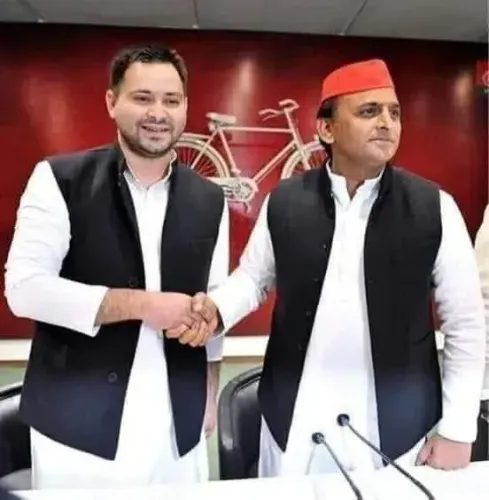
Akhilesh Yadav publicly thanked Rahul Gandhi for birthday wishes on 1 July 2026 , signalling ongoing SP–Congress cordiality.
He redefined PDA as Peedit, Dukhi, Apmanit ('Aggrieved, Sorrowful, Humiliated') — communities oppressed by a dominant 5 per cent for generations.
He also framed PDA's moral foundation as Prem, Daya, Apnapan ('Love, Compassion, Belonging'), making it open to all with 'humanity in their hearts.' Akhilesh called for unmasking those who 'covertly benefit communal forces,' sharpening the party's anti-majoritarian message.
The post positions PDA as a movement for 95 per cent of India's population — OBCs, Dalits, and minorities — ahead of the 2027 UP assembly elections .
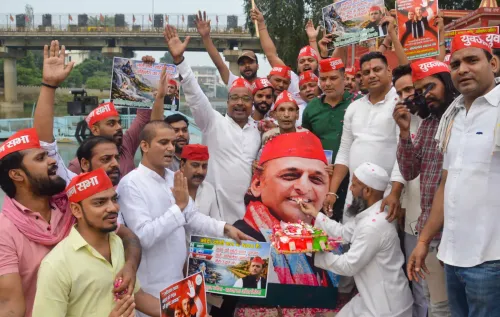
Samajwadi Party president Akhilesh Yadav on Wednesday, 1 July 2026, publicly thanked Congress leader Rahul Gandhi for birthday greetings and used the occasion to restate his PDA framework as a movement for the rights and dignity of 95 per cent of India's population — describing it as far above electoral politics.
Context
In his post, Akhilesh wrote — 'जन्मदिन की बधाई देने के लिए श्री राहुल गांधी जी को बहुत-बहुत धन्यवाद!' ['Many thanks to Rahul Gandhi ji for the birthday wishes!'] — before pivoting to a substantive articulation of the PDA cause. He welcomed all those willing to join in bringing about 'सामाजिक न्याय का राज' ['the rule of social justice'], signalling that the birthday exchange carried political weight beyond personal courtesy.
Akhilesh called on supporters to repeatedly renew their pledge of unity and to 'unmask those who covertly benefit communal forces' — a pointed reference, without naming anyone, to what the Samajwadi Party characterises as majoritarian politics.
Policy Backdrop
PDA — originally standing for Pichhda (Backward), Dalit, Alpsankhyak (Minority) — was the electoral formula Akhilesh Yadav deployed in the 2022 Uttar Pradesh assembly elections. In his 1 July post, he offered an expanded philosophical definition: PDA now stands for 'Peedit, Dukhi, Apmanit' ['Aggrieved, Sorrowful, Humiliated'] — communities he says have been oppressed for generations by 5 per cent of traditionally dominant groups.
He further described the moral core of PDA as 'Prem, Daya, Apnapan' ['Love, Compassion, Belonging'], framing the coalition not as a vote-bank strategy but as a humanitarian movement open to anyone with 'a heart full of mercy and humanity.' This layered wordplay — three distinct expansions of the same acronym — is characteristic of the Samajwadi Party's communication strategy around the PDA brand.
The Samajwadi Party joined the INDIA opposition alliance in June 2023, alongside Congress and other regional parties, to build a unified front against the BJP. The Akhilesh–Rahul exchange on 1 July publicly reinforces that inter-party relationship ahead of the 2027 Uttar Pradesh assembly elections.
Stakeholders and Impact
The communities explicitly addressed by PDA — OBCs, Dalits, and religious minorities — together constitute the overwhelming majority of Uttar Pradesh's electorate. Akhilesh's framing of their shared condition as centuries-old suffering under a dominant 5 per cent is designed to bridge caste and community fault lines that have historically fragmented opposition votes in the state.
The public acknowledgment of Rahul Gandhi's birthday greeting also signals continuity in the SP–Congress relationship at the leadership level, which carries significance for any future seat-sharing negotiations in Uttar Pradesh and nationally.
What's Next
With the 2027 Uttar Pradesh assembly elections on the horizon, the Samajwadi Party is expected to intensify its PDA outreach across backward, Dalit, and minority communities. The language of this post — emphasising dignity, unity, and unmasking hidden communal beneficiaries — suggests the party will sharpen its ideological contrast with the ruling BJP well before the campaign season formally begins. Coordination between Akhilesh Yadav and Rahul Gandhi on alliance strategy and candidate lists will be closely watched as the election cycle approaches.
Point of View
He is attempting to transform what began as an electoral formula into a durable social identity that transcends election cycles. The explicit call to unmask 'covert benefactors of communal forces' suggests the party intends to make indirect complicity with majoritarianism a central campaign charge — a framing that could put pressure on smaller parties in the opposition space to declare their alignments clearly.
NationPress
2 Jul 2026
Frequently Asked Questions
What is PDA in Akhilesh Yadav's politics?
PDA stands for multiple things in Akhilesh Yadav's political framework: originally Pichhda (Backward), Dalit, Alpsankhyak (Minority) as an electoral coalition, and more recently reframed as Peedit-Dukhi-Apmanit ('Aggrieved, Sorrowful, Humiliated') to describe historically marginalised communities, and Prem-Daya-Apnapan ('Love, Compassion, Belonging') as its moral foundation.
Why did Akhilesh Yadav thank Rahul Gandhi on 1 July 2026?
Akhilesh Yadav thanked Rahul Gandhi for sending him birthday wishes, using the public exchange to also reaffirm the shared social justice goals of the SP–Congress opposition partnership.
What does Akhilesh Yadav mean by 95% and 5% in his PDA speeches?
Akhilesh Yadav uses '95 per cent' to refer to OBCs, Dalits, minorities, and other historically marginalised groups, and '5 per cent' to refer to traditionally dominant upper-caste groups he says have exercised disproportionate social and political power for generations.
What is the SP–Congress alliance status ahead of 2027 UP elections?
The Samajwadi Party and Congress are part of the broader INDIA opposition bloc formed in June 2023. Public exchanges between Akhilesh Yadav and Rahul Gandhi, such as the 1 July 2026 birthday acknowledgment, indicate the leadership relationship remains active, though formal seat-sharing details for 2027 have not been announced.
Who does Akhilesh Yadav say can join the PDA movement?
In his 1 July 2026 post, Akhilesh Yadav said anyone with 'a heart full of mercy and humanity' is part of PDA, framing it as a broad humanitarian movement rather than a caste- or community-specific political coalition.