Akhilesh Yadav calls BJP a 'electoral gang', alleges three-tier poll fraud

Synopsis
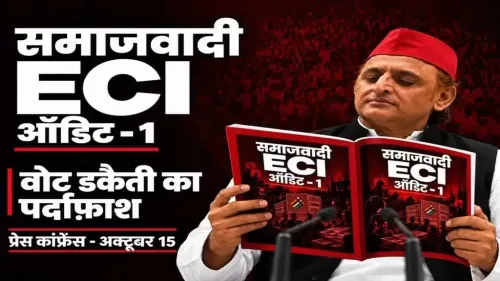
Samajwadi Party president Akhilesh Yadav has accused BJP, the Election Commission and district administration of running a three-tier electoral fraud — covering voter lists, polling-day suppression and result manipulation — calling BJP a 'chunavi giroH' or electoral gang.
Key Takeaways
Akhilesh Yadav posted on 27 October 2026 accusing a BJP-Election Commission-administration 'triguT' of coordinated poll fraud.
He outlined three stages: pre-election voter-list manipulation, polling-day fake voting and voter suppression, and counting/result manipulation.
Yadav explicitly named the Election Commission as an active participant, not just a passive body.
The Samajwadi Party has raised similar allegations since the 2019 Lok Sabha and 2022 UP assembly elections.
Such opposition allegations against BJP and election authorities have become a recurring pattern across multiple states since 2014 .
Any formal SP petition to the Election Commission would escalate this charge from political rhetoric to an institutional challenge.
A three-stage conspiracy to steal elections — that is the charge Samajwadi Party president Akhilesh Yadav has levelled at the Bharatiya Janata Party, laying out what he describes as a coordinated fraud run jointly by the BJP, the Election Commission of India, and the district administration.
Posting on Tuesday, 27 October 2026, Yadav framed his accusation with unusual precision, calling the alleged arrangement a 'त्रिगुट' — a three-pronged combine — executing a 'त्रिस्तरीय पाठ्यक्रम', or three-tier curriculum, of electoral malpractice. 'BJP is an chunavi giroH — an electoral gang,' he wrote in the closing line, using language designed to land as a political indictment rather than a complaint.
The three-stage fraud framework Akhilesh is alleging
Yadav breaks the alleged manipulation into three distinct phases. First, pre-election tampering with voter lists. Second, on polling day, deploying party loyalists to cast fraudulent votes while using voter-list mismatches and administrative muscle to block opposition supporters from the booth. Third, manipulation at the counting stage and in the final declaration of results.
The framework is notable for its explicitness. Rather than a broad charge of rigging, it maps a sequence — preparation, execution, confirmation — implying that each stage is designed to lock in the next, leaving no corrective window for opponents.
A pattern SP has long been building
This is not the first time Akhilesh Yadav and the Samajwadi Party have raised these concerns. During the 2019 Lok Sabha elections, the party publicly questioned voter list integrity. After the 2022 Uttar Pradesh assembly elections, Yadav and his allies disputed both the counting process and the declared results. The cumulative effect of those repeated allegations has shaped a consistent SP counter-narrative ahead of every major poll cycle in Uttar Pradesh, India's most populous and electorally decisive state.
Across the broader Indian opposition, similar charges — focusing on voter rolls, Electronic Voting Machines, and the role of local administrations — have surfaced repeatedly since 2014, from state after state. What distinguishes today's post is the explicit naming of the Election Commission of India as an active participant, not merely a passive or negligent regulator. That framing carries significant political weight and will add pressure on the Commission to respond.
Why this moment, and what comes next
With Uttar Pradesh perpetually in pre-election mode given its scale and political centrality, the timing of such a detailed public indictment matters. Any formal complaint or petition by the Samajwadi Party with the Election Commission — translating this social-media charge into a legal record — would escalate the stakes considerably and force an institutional response.
For now, Yadav has set the frame: not a flawed system, but a designed one. The question that follows every such charge in Indian politics is whether it remains campaign rhetoric or becomes the basis for a documented legal challenge.
Point of View
He raises the political cost for the Commission to remain silent, a pressure tactic that fits a broader opposition strategy of institutionalising dissent before votes are cast. Historically, such charges in Indian politics tend to gain traction when they are followed by formal complaints; without that step, they risk being absorbed as routine opposition noise. The durability of this 'chunavi giroH' framing will depend entirely on whether the Samajwadi Party translates it into documented accountability proceedings.
NationPress
27 Oct 2026
Frequently Asked Questions
What did Akhilesh Yadav accuse BJP of on 27 October 2026?
Akhilesh Yadav accused BJP, the Election Commission and the district administration of running a three-stage electoral fraud covering voter-list manipulation before elections, fake voting and voter suppression on polling day, and result manipulation during counting. He called BJP a 'chunavi giroH' — an electoral gang.
What does 'chunavi giroH' mean?
'Chunavi giroH' is a Hindi phrase meaning 'electoral gang', used by Akhilesh Yadav to characterise BJP as an organised criminal enterprise in the context of elections rather than a legitimate political party.
Has Samajwadi Party raised election fraud allegations before?
Yes. The Samajwadi Party raised similar concerns about voter list integrity during the 2019 Lok Sabha elections and publicly disputed the counting process and results after the 2022 Uttar Pradesh assembly elections.
Why did Akhilesh Yadav name the Election Commission of India?
By naming the Election Commission as an active participant in alleged fraud — rather than a neutral regulator — Yadav escalates the political charge and puts institutional pressure on the Commission to publicly respond to the allegations.
What could happen next after this allegation?
The key development to watch is whether the Samajwadi Party files a formal complaint or legal petition with the Election Commission. That step would convert a political social-media charge into an institutional challenge requiring an official response.