Akhilesh Yadav Alleges BJP 'Criminology' in Temple Donation Scams

Synopsis
Samajwadi Party president Akhilesh Yadav on 14 July 2026 accused the BJP of running a systematic racket of fraud through temple trusts — involving fake receipts, inflated land deals, and misappropriation of devotee donations — and pledged a grassroots campaign to expose it.
Key Takeaways
Akhilesh Yadav posted on 14 July 2026 detailing what he called the BJP's 'criminology' — an alleged multi-step scheme to defraud temple donation systems.
He alleged devotees were covertly solicited for cash, precious metals, and gems, with receipts withheld or fabricated using fake printed slips.
The post claimed trust-linked insiders acquired land cheaply near religious sites, then resold it to the trust at many times the price, pocketing the difference.
Yadav alleged CCTV footage and other evidence was destroyed to cover up the fraud, and that investigations were assigned to individuals themselves facing fraud charges.
The Samajwadi Party announced plans to take the campaign to villages, panchayats, and town squares across Uttar Pradesh to mobilise public opinion against the BJP.
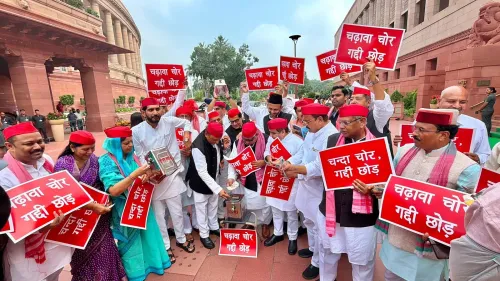
The post was hashtagged #CC_to_CC , referencing the phrase 'chadhava-chanda-daan chori' — theft of religious offerings and donations.
Samajwadi Party president Akhilesh Yadav on Tuesday, 14 July 2026, launched a sharp multi-point attack on the Bharatiya Janata Party, alleging a systematic racket of fraud and embezzlement within temple trusts and religious donation networks, which he termed the BJP's 'criminology' (criminology — a framework of organised wrongdoing).
Context
In a lengthy post on X, Akhilesh Yadav laid out what he called a step-by-step 'kuchakra' (vicious cycle) of alleged financial crimes carried out through religious institutions. He described a chain of alleged malpractices — from covertly soliciting donations in cash, precious metals, and gems from devotees worldwide, to issuing fake receipts, manipulating counts of offerings, and diverting funds through unregistered offices.
The post, hashtagged #CC_to_CC — a reference to the phrase 'chadhava-chanda-daan chori' (theft of offerings, donations, and charity) — alleged that when such schemes are exposed, the accused resort to returning stolen goods temporarily, offering insincere apologies, and using disinformation to deflect scrutiny. Yadav concluded by pledging that 'true patriots' would expose this 'criminology' at every village, panchayat, street, and crossroads across the country.
Policy Backdrop
Allegations of financial irregularities at temple trusts and religious endowments have recurred in Uttar Pradesh politics since the BJP came to power in the state in 2017, following its defeat of the Samajwadi Party. The ruling party oversaw changes in the composition of several temple boards and religious bodies, and successive state governments have issued periodic directives for auditing gold, silver, and cash offerings at major shrines.
Control over temple administration and high-profile religious infrastructure has become an electorally sensitive issue in Uttar Pradesh, with opposition parties — particularly the Samajwadi Party — repeatedly questioning the transparency of trust accounts and land transactions near religious sites. These exchanges have intensified ahead of each assembly and Lok Sabha election cycle since 2017.
Stakeholders and Impact
The most directly affected stakeholders are temple devotees and ordinary donors whose offerings flow into religious trust accounts. Yadav's post specifically alleged that devotees were being emotionally exploited through their faith, with donations solicited globally through intermediaries and receipts withheld or forged.
Religious trusts and their appointed administrators face the political heat of these allegations, as do local BJP functionaries named implicitly in the post's reference to 'associates' and 'reliable people' placed within trust structures. The post also alleged that land near religious sites was acquired cheaply by insiders and then repurchased at inflated prices using trust funds — a pattern that, if substantiated, would implicate both trust officials and local real-estate networks.
Yadav further alleged that when investigations are ordered, they are assigned to individuals who themselves face charges of fraud — a pointed reference to what the Samajwadi Party describes as compromised accountability within the current administration. He used the phrase 'phungi ko phaansi, shaakh ko maafi' ('hang the twig, spare the branch') to describe selective action against small-time operatives while shielding senior figures.
What's Next
The Samajwadi Party has signalled it intends to carry this campaign beyond social media, with Yadav stating that the alleged 'criminology' would be publicly read out and explained at the grassroots level — in villages, panchayats, lanes, and town squares. This suggests a structured ground campaign targeting BJP's religious-mobilisation narrative ahead of future electoral contests in Uttar Pradesh.
The immediate question is whether state authorities or any central body will initiate fresh audits of temple trust accounts in response to the political pressure, or whether the BJP will mount a formal rebuttal. Legislative questions on trust finances and any enforcement actions by the Uttar Pradesh government in the weeks ahead will be closely watched as a gauge of how seriously the administration treats the opposition's charges.
Point of View
The Samajwadi Party is trying to build a cohesive counter-narrative that can be deployed at the grassroots level. The pledge to read out this 'criminology' at village crossroads signals a ground-campaign strategy that mirrors the BJP's own booth-level outreach model. Whether this gains traction will depend heavily on whether any concrete evidence of the alleged practices surfaces through official audits or legal proceedings in the weeks ahead.
NationPress
12 Oct 2026
Frequently Asked Questions
What did Akhilesh Yadav allege about BJP and temple donations?
Akhilesh Yadav alleged on 14 July 2026 that BJP-linked individuals ran a systematic racket involving covert solicitation of donations from devotees globally, issuance of fake receipts, manipulation of offering counts, inflated land deals using trust funds, and destruction of CCTV evidence — all under the cover of temple trust management.
What does #CC_to_CC mean in Akhilesh Yadav's post?
The hashtag #CC_to_CC stands for 'chadhava-chanda-daan chori', a Hindi phrase meaning 'theft of offerings, donations, and charity', which Akhilesh Yadav used as the central theme of his allegations against the BJP regarding temple trust fraud.
Which temple trusts is Akhilesh Yadav talking about?
Yadav's post did not name specific temples or trusts; it described a general alleged pattern of malpractice within religious endowments and trust bodies, implicitly targeting BJP-administered institutions in Uttar Pradesh.
What is the BJP's response to Akhilesh Yadav's temple donation fraud allegations?
As of the time of this report, no formal response from the BJP to Yadav's 14 July 2026 post had been made public.
What action is the Samajwadi Party planning after Akhilesh Yadav's post?
Akhilesh Yadav stated that Samajwadi Party workers and supporters would take the alleged 'criminology' directly to villages, panchayats, streets, and town squares across the country to expose the BJP and call for its social and political boycott.