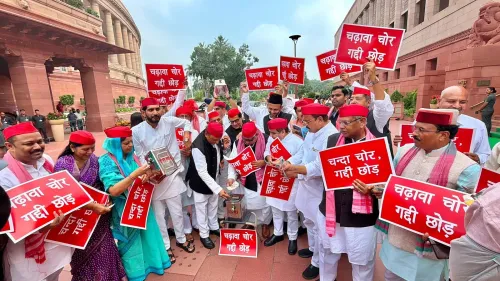
Akhilesh Yadav: Ayodhya will be BJP's Kurukshetra

Synopsis
SP president Akhilesh Yadav has accused BJP functionaries of being behind an alleged theft of offerings and a consecrated stone at Ayodhya, saying the fallout has hurt pilgrim numbers, shattered faith, and damaged local livelihoods — and demanded a credible daily-briefing probe into Ayodhya and Mathura both.
Key Takeaways
Akhilesh Yadav declared Ayodhya will be a 'Kurukshetra' — a field of political reckoning — for the BJP .
An alleged incident of theft of donations, offerings, and a consecrated shila at Ayodhya has reportedly reduced pilgrim footfall, according to Yadav.
Yadav says local traders and residents in Ayodhya are suffering income losses as a direct consequence of the incident and the government's handling of it.
He alleged that those responsible — BJP members and associates — have 'gone underground,' creating fear among locals who are now reluctant to visit the temple.
Yadav demanded daily briefings on the investigation's progress, saying the public has 'not an iota of trust' in the SIT under the BJP government.
He also called for a high-level credible inquiry into a separate reported irregularity incident in Mathura .
Samajwadi Party president Akhilesh Yadav on Thursday, 18 June 2026, declared that Ayodhya would prove to be a 'Kurukshetra' — a field of reckoning — for what he called the 'great sinners' of the Bharatiya Janata Party, citing an alleged incident of theft of offerings, donations, and a consecrated stone (shila) at the temple town that he says has shaken pilgrims' faith and damaged local livelihoods.
Context
In a lengthy post on X, Akhilesh Yadav alleged that a reported incident of 'donation, offering, and shila (consecrated stone) theft' at Ayodhya has had a measurable negative impact on the number of devotees visiting the temple complex. He stated that 'people's faith has been fractured' and that the fallout is being borne directly by local traders and ordinary residents whose incomes depend on pilgrim footfall.
Yadav asked pointedly: 'Why should the public pay the price for the government's mistake?' He alleged that those responsible — whom he identified as BJP functionaries and their associates — had 'gone underground as usual' after the incident, deepening public suspicion and tension in the region.
Policy Backdrop
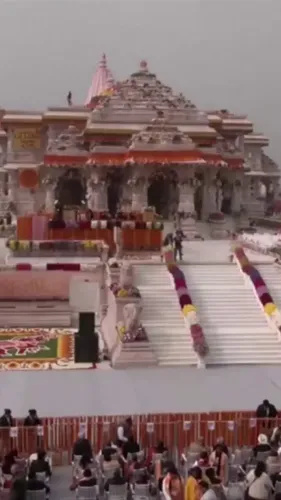
The Ram Temple at Ayodhya was inaugurated on 22 January 2024 under the oversight of the Shri Ram Janmabhoomi Teerth Kshetra Trust, constituted by the central government. The temple complex — and the trust managing it — has since been a high-profile symbol of the BJP's political and cultural project, making any allegations of financial irregularity at the site politically charged.
Yadav also flagged a separate report of alleged irregularities from Mathura, another major Hindu pilgrimage city in Uttar Pradesh, calling for a 'high-level, credible inquiry' there as well. He argued that a Special Investigation Team (SIT) probe lacks public confidence given what he characterised as 'all-round mega-corruption' under the BJP government, and demanded daily briefings on the status of any investigation.
Stakeholders and Impact
Local traders, hoteliers, and service providers in Ayodhya — whose businesses are directly tied to pilgrim arrivals — stand at the centre of the economic concern Yadav raised. The SP chief said residents are now afraid to visit the temple themselves, fearing they could be 'entrapped in the name of investigation,' a claim that reflects a broader atmosphere of uncertainty he described as pervading the area.
Pilgrims and devotees form the other key stakeholder group. Yadav described 'an unknown fear spreading among devotees,' and called the alleged contamination of the sanctity of this 'holy Sanatani pilgrimage' a direct consequence of BJP's governance. The Shri Ram Janmabhoomi Teerth Kshetra Trust and the Uttar Pradesh state government, both linked to the BJP, are the implicit institutional targets of the criticism.
What's Next
Yadav's intervention signals that the Samajwadi Party intends to keep the Ayodhya governance question alive as a political issue in the run-up to future electoral cycles in Uttar Pradesh. His demand for daily investigation briefings and a credible high-level probe into the Mathura irregularities sets a public accountability benchmark that the state government will be under pressure to respond to.
Official pilgrim-arrival data and local trade figures from the Ayodhya district administration, if released, will be closely watched as a measure of whether the reported faith deficit has translated into a quantifiable economic decline — and could shape the next phase of this political debate.
Point of View
Framing alleged financial irregularities not as an isolated incident but as evidence of systemic corruption under the ruling party. By invoking the Mahabharata metaphor of Kurukshetra, he signals that the SP intends to fight the next UP electoral cycle on the terrain of institutional accountability at religious sites, not just caste arithmetic. The demand for daily SIT briefings and the extension of scrutiny to Mathura — another pilgrimage city with its own politically sensitive temple-mosque disputes — suggests a deliberate effort to broaden the narrative into a pattern rather than a single event. Whether this gains traction will depend heavily on whether official data on pilgrim footfall and local trade corroborates the economic harm Yadav alleges.
NationPress
18 Sept 2026
Frequently Asked Questions
What is the Ayodhya donation theft controversy Akhilesh Yadav is referring to?
Akhilesh Yadav has alleged that an incident involving the theft of donations, offerings, and a consecrated stone ( shila ) occurred at the Ayodhya temple complex. The specific details of the incident are under investigation; Yadav claims it has damaged pilgrim faith and hurt local businesses.
What is the Shri Ram Janmabhoomi Teerth Kshetra Trust?
The Shri Ram Janmabhoomi Teerth Kshetra Trust is the body constituted by the central government to oversee the construction and management of the Ram Temple at Ayodhya . The temple was inaugurated on 22 January 2024 .
Why does Akhilesh Yadav say the SIT cannot be trusted?
Yadav argued that given what he described as 'all-round mega-corruption' under the BJP government in Uttar Pradesh , the public has 'not an iota of trust' in an SIT constituted under that government, and therefore demanded daily public briefings on the probe's progress.
What did Akhilesh Yadav say about Mathura?
Yadav described a separate report of alleged irregularities from Mathura as 'extremely serious' and called for a 'high-level, credible inquiry' into that matter as well, suggesting a pattern of governance failures at major pilgrimage sites in Uttar Pradesh .
What does 'Kurukshetra' mean in the context of Akhilesh Yadav's post?
Yadav used 'Kurukshetra' — the battlefield of the Mahabharata — as a metaphor to assert that Ayodhya , the city where BJP's political rise began through the Ram Janmabhoomi movement, will now become the site of the party's political downfall due to its alleged misgovernance.