Manmohan Singh's 'commit suicide' remark shocked me: ex-CEC SY Quraishi
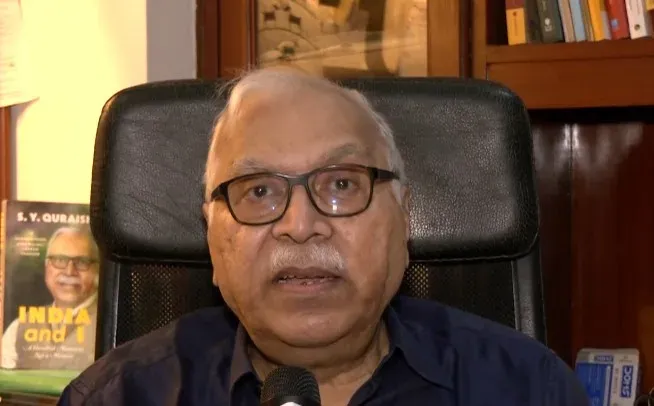
Synopsis
Former CEC SY Quraishi's memoir drops a remarkable revelation: Dr Manmohan Singh once told him he would 'commit suicide' over a misunderstanding tied to the Election Commission's censure of Salman Khurshid. The disclosure, part of a wide-ranging book, offers a rare window into the emotional weight Singh placed on institutional integrity — and on his own reputation as its guardian.
Key Takeaways
Quraishi reveals in his new book that Dr Manmohan Singh told him he would 'commit suicide' after a misunderstanding over the Election Commission's censure of Salman Khurshid .
The censure arose from Khurshid's campaign announcement to raise the minority quota from 4.5 per cent to 9 per cent during Uttar Pradesh Assembly elections , which the Commission ruled a Model Code violation.
Quraishi spent 15–20 minutes calming Singh, clarifying his remarks were aimed at other politicians, not the Prime Minister personally.
On EVMs , Quraishi recalls the BJP was the 'biggest critic' during his tenure; he introduced VVPAT after talks with Chandrababu Naidu , with lakhs of slips tallying with machine counts.
Quraishi declined a PMO posting , citing concerns about being treated as a 'Muslim officer' rather than on merit — a concern later confirmed by a senior PMO official.
The book also covers meetings with RSS chief Mohan Bhagwat and former Bangladeshi PM Sheikh Hasina , whom Quraishi last met shortly before her ouster.
Former Chief Election Commissioner S.Y. Quraishi has disclosed a deeply personal and unexpected exchange with the late former Prime Minister Dr Manmohan Singh in his new memoir, 'India and I: A Hundred Memories, Not a Memoir' — recounting how Singh told him he would 'commit suicide' after a misunderstanding arose over the Election Commission's censure of then Union Minister Salman Khurshid for violating the Model Code of Conduct during the Uttar Pradesh Assembly elections. Quraishi described the remark as a 'bombshell' that left him 'totally shell-shocked', requiring 15–20 minutes to calm the former Prime Minister down.
The Salman Khurshid Censure That Triggered the Crisis
The episode traces back to the Uttar Pradesh Assembly elections, during which Salman Khurshid — then serving as Law Minister — announced while campaigning for his wife that the minority quota would be raised from 4.5 per cent to 9 per cent. The Bharatiya Janata Party (BJP) filed a formal complaint; the Election Commission heard lawyers from both sides before concluding that Khurshid had violated the Model Code. The Commission issued a censure — the maximum permissible action under the Code, carrying no financial penalty but equivalent in gravity to a conviction, with no judicial appeal.
Following the censure, Quraishi says he learned through common friends that certain Congress leaders were publicly criticising him and the Commission, calling them 'arrogant' and 'arbitrary'. He conveyed his concern to Harish Khare, then media adviser to the Prime Minister, stating that if such 'loose talk' continued, the Commission would be compelled to make it public.
The Bombshell Meeting at 7 PM
The following day, Dr Manmohan Singh called Quraishi and requested an urgent meeting, sounding 'almost in panic'. The two met at Singh's official residence at 7 pm. According to Quraishi, Singh was waiting at the door and personally escorted him in. Once seated, Singh said: 'Mr. Quraishi, Harish told me what transpired between you and him yesterday, and if this is what you think about me, I'll commit suicide.'
Quraishi writes that he was 'not prepared for this' and spent the next 15–20 minutes reassuring the Prime Minister. He clarified that his remarks had been directed at ministers and political leaders indulging in irresponsible talk — not at Singh personally, whom he described as a 'strong supporter of the Election Commission' on record. Quraishi said Singh's distress reflected his 'innate goodness', his deep respect for democratic institutions, and his refusal to allow baseless aspersions to be cast on the poll body.
On EVMs, VVPAT, and Electoral Integrity
Quraishi also addressed the Electronic Voting Machine (EVM) controversy, noting that opposition to EVMs was 'at its peak' during his tenure. He recalled that the BJP had been the 'biggest critic', publishing a book titled 'Democracy at Risk' authored by G.V.L. Narasimha Rao with a foreword by L.K. Advani. Upon taking charge as CEC in 2010, Quraishi convened a meeting of all political parties, led on the opposition side by Chandrababu Naidu.
Naidu's core concern, Quraishi said, was not that EVMs had been manipulated but that the process lacked transparency — a voter could not visually verify that their vote had registered correctly. This led to the introduction of the Voter Verifiable Paper Audit Trail (VVPAT), which prints a paper slip confirming the voter's choice on a screen before sealing it in a box. Quraishi said lakhs of VVPAT slips were compared with machine tallies and all matched, restoring credibility to the system. He acknowledged that fresh questions about how many VVPAT slips should be counted remain open and urged the Commission to continue engaging with parties to find a solution.
The PMO Posting He Refused — and Why
In another candid disclosure, Quraishi reveals that he declined a posting to the Prime Minister's Office (PMO) while serving as Joint Secretary in the Ministry of Youth Affairs. He says he was enjoying a uniquely field-oriented role — simultaneously heading the Nehru Yuva Kendra Sangathan with 3 lakh youth clubs and directing the National Service Scheme (NSS) across 300 universities — and had no desire to become 'anonymous' in a backroom role.
More pointedly, Quraishi says he was wary of being posted to the PMO, Home Ministry, or Defence Ministry as a 'Muslim officer' placed under extra scrutiny. 'I would rather be a king in the Panchayati Raj Department than be a suspect in these three Ministries,' he writes. He was later validated in this view by a senior PMO official who confirmed that a request for Quraishi by name had earlier been turned down on the grounds that the office 'already had a Muslim officer'.
Other Revelations: RSS, Sheikh Hasina, and Money Power
Quraishi also describes a meeting with Rashtriya Swayamsevak Sangh (RSS) chief Mohan Bhagwat, which he says he sought along with a group of friends to raise concerns about lynchings, hate speech, and bulldozer actions. Bhagwat reportedly received them promptly and agreed that dialogue was the best path forward; Quraishi says two or three follow-up meetings have since taken place.
On his two meetings with former Bangladeshi Prime Minister Sheikh Hasina — one in 2014 and one shortly before her ouster — Quraishi notes that by the second meeting she appeared 'a little tired' and expressed concern that 'foreign powers' were attempting a regime change, which he says 'is exactly what happened'. He also details the Election Commission's efforts to combat money power during elections, including identifying 40 modus operandi of electoral spending abuse and establishing a dedicated Expenditure Monitoring Division that began seizing funds running into hundreds of crores.
Quraishi's memoir, wide-ranging in its sweep from civil service anecdotes to electoral reform, is likely to fuel fresh debate on institutional independence, the EVM question, and the personal integrity of leaders who shaped India's democratic record.
Frequently Asked Questions
Why did Manmohan Singh say he would 'commit suicide' to SY Quraishi?
Dr Manmohan Singh made the remark after learning that Quraishi had told the Prime Minister's media adviser that certain Congress leaders were publicly criticising the Election Commission following its censure of Minister Salman Khurshid. Singh apparently believed Quraishi was questioning his personal commitment to the poll body, which distressed him deeply. Quraishi spent 15–20 minutes reassuring him that the remarks were directed at other politicians, not at Singh.
What was the Salman Khurshid Model Code of Conduct case about?
During the Uttar Pradesh Assembly elections, then Law Minister Salman Khurshid announced while campaigning for his wife that the minority quota would be raised from 4.5 per cent to 9 per cent. The BJP filed a complaint, and after hearing lawyers from both sides, the Election Commission censured Khurshid for violating the Model Code of Conduct — the maximum action available under the Code, with no financial penalty but no judicial appeal either.
What is SY Quraishi's new book about?
'India and I: A Hundred Memories, Not a Memoir' covers Quraishi's life from childhood and civil service days through his tenure as Chief Election Commissioner. It includes accounts of the EVM-VVPAT debate, his refusal of a PMO posting, a meeting with RSS chief Mohan Bhagwat, and two meetings with former Bangladeshi Prime Minister Sheikh Hasina, among other episodes.
How did SY Quraishi resolve the EVM credibility crisis during his tenure?
After convening a meeting of all political parties in 2010, Quraishi worked with opposition leaders — including Chandrababu Naidu — to introduce the Voter Verifiable Paper Audit Trail (VVPAT), which allows voters to visually confirm their choice before a paper slip is sealed in a box. Lakhs of VVPAT slips were subsequently compared with machine tallies and all matched, which Quraishi says re-established EVM credibility.
Why did SY Quraishi decline the PMO posting?
Quraishi says he was reluctant to leave a field-oriented role he found fulfilling, but more significantly, he was unwilling to be posted to the PMO, Home Ministry, or Defence Ministry as a 'Muslim officer' placed under extra scrutiny. He later learned that a prior request for him by name had been declined because the PMO already had a Muslim officer — a fact he said validated his instinct.