Did Akhilesh Yadav Meet Naveen Patnaik to Form an 'Anti-BJP' Coalition?
Click to start listening
Synopsis
In a significant meeting in Bhubaneswar, SP President Akhilesh Yadav and BJD leader Naveen Patnaik discussed strategies to challenge the BJP. Their dialogue touched on healthcare reform, electoral integrity, and political accountability. Yadav's calls for a united front against the BJP highlight the shifting dynamics of Indian politics as leaders seek to address pressing public concerns.
Key Takeaways
- Akhilesh Yadav and Naveen Patnaik met to explore collaboration against the BJP.
- The focus was on universal healthcare and electoral integrity.
- Yadav criticized the Ayushman Bharat scheme for limiting access to care.
- Concerns were raised about voter removal from electoral rolls.
- Economic issues impacting farmers were also discussed.
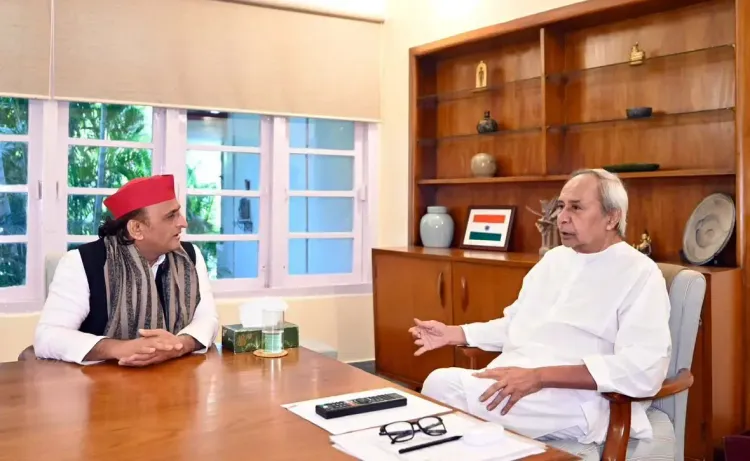
Bhubaneswar, Jan 17 (NationPress) The President of the Samajwadi Party (SP), Akhilesh Yadav, met with BJD leader Naveen Patnaik on Saturday, characterizing their gathering as informal.
Nonetheless, this meeting has ignited discussions regarding the potential development of a unified strategy aimed at contesting the Bharatiya Janata Party (BJP) through democratic means and collective public backing.
Akhilesh, while addressing journalists in Bhubaneswar on Saturday, referred to Patnaik as a senior and esteemed leader committed to the upliftment of the underprivileged. Their discussion, which took place on Friday, revolved around various political matters.
“Two former chief ministers convened to express their concerns and resolved to dethrone the BJP,” stated the SP chief, without providing further details about their dialogue.
He proposed a vision for comprehensive healthcare, asserting that a “healthy India” should be viewed as a national objective rather than just a phrase.
The ex-Chief Minister critiqued the Ayushman Bharat insurance policy, claiming that treatment caps and card-based restrictions hinder impoverished families from accessing necessary healthcare. He insisted that serious illnesses like cancer, liver, or kidney ailments should be treated at government hospitals without any fiscal limitations.
“Our position as a socialist party is unequivocal. Any individual in need of medical assistance should receive free treatment for all conditions. We oppose the card system, as no healthcare issue can be adequately addressed through it,” the former Uttar Pradesh Chief Minister asserted.
He also proposed leveraging artificial intelligence and telemedicine to enhance healthcare access in rural regions where medical services are scarce.
The SP leader accused the central government of misusing its agencies, such as the Enforcement Directorate (ED), Central Bureau of Investigation (CBI), and the Income Tax Department, to target opposition leaders and independent journalists.
He further alleged that communal discord was being manipulated for political advantage, sharing his experiences in Uttar Pradesh concerning violence driven by political agendas.
Highlighting concerns over electoral “transparency,” the SP chief claimed that about three crore voters were removed from the electoral lists during recent revisions in Uttar Pradesh.
He announced plans to approach the Supreme Court to validate the accuracy of the Election Commission's voter rolls.
“We intend to seek the Supreme Court's intervention to ascertain whether the voter list created by the Election Commission is legitimate or if the one compiled by the State Election Commission holds true,” stated the SP leader.
Additionally, he expressed doubts about electronic voting machines (EVMs), pointing out that countries like Germany and Japan do not utilize them in their electoral processes.
On economic matters, the SP leader questioned the government's assertion of doubling farmers' incomes, citing the increasing costs of fertilizers, pesticides, and electricity.
Moreover, he called for stringent environmental impact assessments for industries, emphasizing that industrial growth should not jeopardize public health.
Point of View
It is crucial to recognize the implications of the meeting between Akhilesh Yadav and Naveen Patnaik. With political alliances and strategies continuously evolving, this interaction highlights the need for unity among opposition parties to address critical issues affecting the nation. The focus on healthcare and electoral reforms represents a significant step towards engaging with the electorate's needs, emphasizing the importance of collaborative governance.
NationPress
17/01/2026
Frequently Asked Questions
What was the purpose of Akhilesh Yadav's meeting with Naveen Patnaik?
The meeting aimed to discuss potential strategies to challenge the BJP and shared political concerns.
What healthcare reforms did Akhilesh Yadav propose?
He advocated for universal healthcare and criticized the Ayushman Bharat scheme for its limitations on treatment access.
What concerns were raised regarding electoral integrity?
Yadav claimed that around three crore voters were removed from the electoral rolls during revisions in Uttar Pradesh and intends to approach the Supreme Court for validation.
What did Yadav say about electronic voting machines?
He expressed skepticism regarding EVMs, noting that countries like Germany and Japan do not use them for elections.
What economic issues did Yadav address?
He questioned the government's claims about doubling farmers' incomes amidst rising costs of fertilizers, pesticides, and electricity.