CM Majhi: Cyclone Akvan debris cleared at Taratarini Temple road
Synopsis
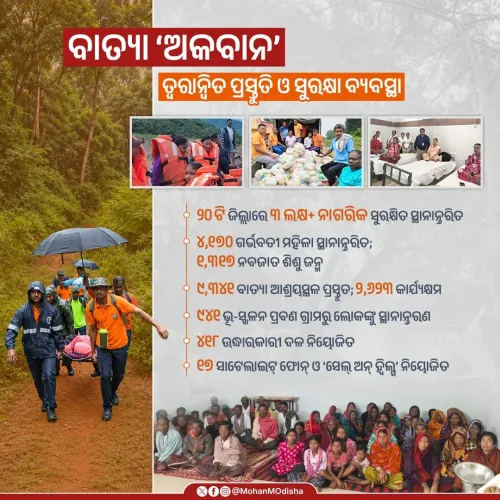
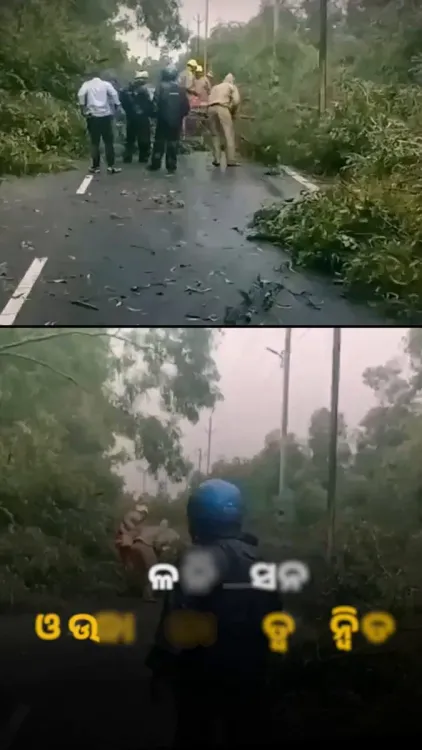
Cyclone Akvan triggered a landslide on the Maa Taratarini Temple road in Ganjam, blocking it with rocks and trees. Odisha CM Mohan Charan Majhi confirmed on November 20 that rescue teams swiftly cleared the debris and restored normal traffic movement.
Key Takeaways
Cyclone Akvan caused a landslide on the road leading to Maa Taratarini Temple in Ganjam district , Odisha.
Fallen rocks and trees fully blocked the route, cutting off access to one of Odisha's major Shakti Peethas .
Rescue teams promptly cleared the debris and restored normal traffic, as confirmed by CM Mohan Charan Majhi on November 20, 2026 .
Ganjam is historically one of Odisha's most cyclone-exposed coastal districts due to its location on the Bay of Bengal .
Odisha's disaster management framework, built after the 1999 super cyclone and refined through Cyclone Fani 2019 , underpins this rapid-response capacity.
A full damage assessment across Ganjam and further state relief measures are still awaited.
A landslide triggered by Cyclone Akvan buried the approach road to the Maa Taratarini Temple in Ganjam district under fallen rocks and trees — but rescue teams moved fast, and Odisha Chief Minister Mohan Charan Majhi confirmed on Friday, November 20 that traffic has been restored.
Landslide blocks a sacred artery in Ganjam
The Maa Taratarini Temple, one of Odisha's most revered Shakti Peethas, draws pilgrims year-round to its hilltop shrine in Kundra, Ganjam. When Cyclone Akvan swept through, the temple access road took a direct hit — rocks and uprooted trees piling up into a full blockade. For devotees and local residents alike, it was an abrupt severing of a route that is as much spiritual as it is practical.
CM Majhi posted both in Odia and English, writing: 'Due to Cyclone Akvan, a landslide blocked the road to Maa Taratarini Temple in Ganjam district with fallen rocks and trees. Rescue teams promptly cleared the debris and took immediate steps to restore normal traffic movement.' The bilingual post signals an administration keen to communicate urgency to both local and national audiences.
Rescue teams and Odisha's rapid-response muscle
Ganjam sits squarely on Odisha's southern coastline — a geography that has made the district a repeat target for Bay of Bengal cyclones across decades. The state's hard-won disaster management architecture, built painstakingly after the catastrophic 1999 super cyclone and stress-tested during Cyclone Fani in 2019, is precisely designed for moments like this: fast debris clearance, rapid traffic restoration, minimum disruption to civilian life.
That playbook appears to have held. Rescue teams mobilised 'promptly,' according to the Chief Minister's post, clearing the landslide and reopening the route without a prolonged closure. The Odisha State Disaster Management Authority has been central to building this rapid-response culture over the last two decades, and Friday's clearance reflects that institutional muscle at work.
Ganjam's vulnerability — and the cost of every blocked hour
The Taratarini Temple road is not just any stretch of tarmac. Thousands of pilgrims travel it every week; local businesses, vendors, and the district's informal economy are tightly woven around the foot traffic it generates. Every hour of blockage carries a real, measurable cost — which is why the speed of clearance matters as much as the clearance itself.
Cyclone Akvan's full damage footprint across Ganjam and other affected districts is yet to be formally assessed, and further official announcements on relief and restoration measures are expected from the state government in the coming days.
Odisha has turned disaster response into one of its most recognisable governance signatures — the question now is whether the rest of the cyclone's trail receives the same speed of attention.
Point of View
Echoing a tradition built by successive state governments. The speed of the response, if independently verified, would reinforce Odisha's reputation as a benchmark state for cyclone preparedness in South Asia. The pending damage assessment, however, will be the real test of whether this response was comprehensive or merely its most visible moment.
NationPress
20 Nov 2026
Frequently Asked Questions
What happened at Maa Taratarini Temple due to Cyclone Akvan?
Cyclone Akvan triggered a landslide on the road to Maa Taratarini Temple in Ganjam district, blocking it with fallen rocks and trees. Rescue teams cleared the debris and restored traffic on November 20, 2026.
Where is Maa Taratarini Temple located?
Maa Taratarini Temple is a major Shakti Peetha pilgrimage site located in Ganjam district in southern Odisha.
What is Cyclone Akvan?
Cyclone Akvan is a cyclonic storm that struck Odisha, causing landslides and blockages in Ganjam district on or around November 20, 2026. Detailed verified data on the cyclone's full track and intensity is still emerging.
How did Odisha respond to the Cyclone Akvan landslide?
Odisha deployed rescue teams that promptly cleared the landslide debris blocking the Taratarini Temple road, restoring normal traffic movement. CM Mohan Charan Majhi confirmed the action publicly on November 20.
Is Ganjam district frequently affected by cyclones?
Yes, Ganjam is one of Odisha's most cyclone-prone coastal districts, located on the Bay of Bengal. The state has built a robust disaster management framework following the devastating 1999 super cyclone and Cyclone Fani in 2019.