Amit Shah Confers President's Colour on Puducherry Police
Synopsis
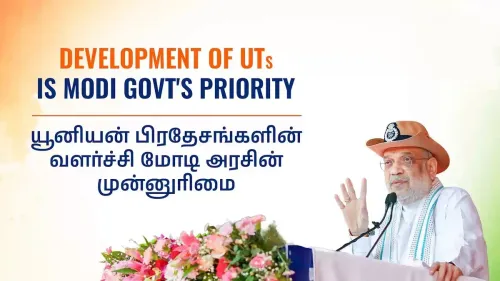
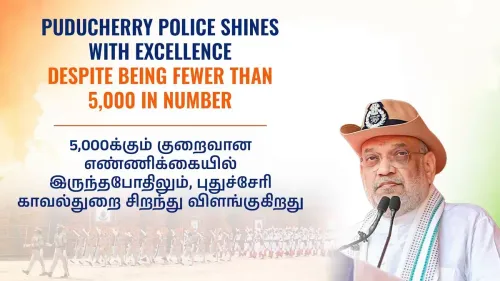
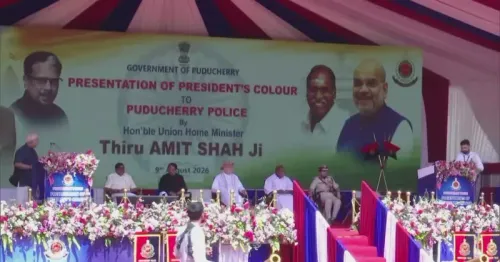
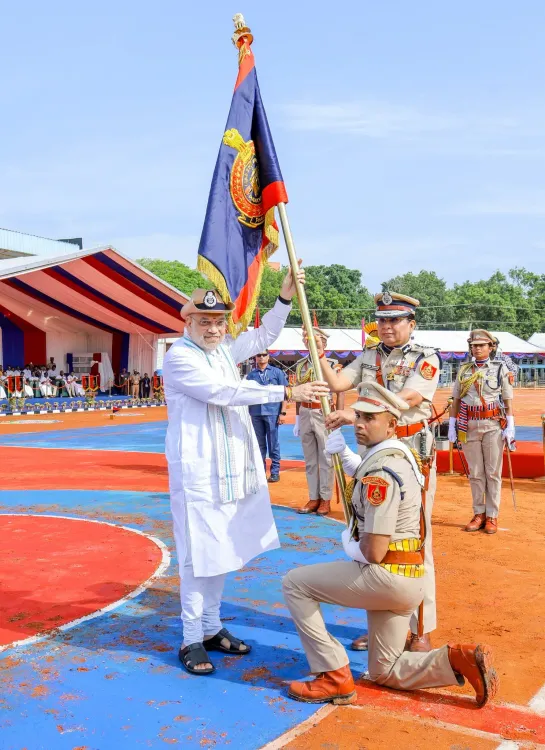
Union Home Minister Amit Shah conferred the President's Colour — India's highest honour for a uniformed force — on the Puducherry Police on August 9, 2026, recognising the force's discipline in policing the UT's four geographically separated enclaves and protecting its spiritual heritage.
Key Takeaways
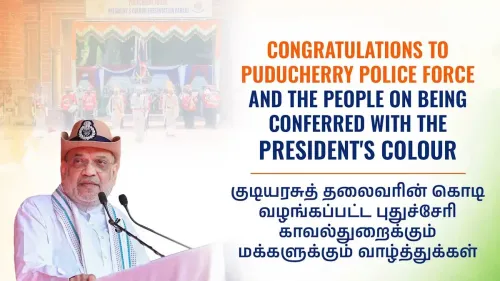
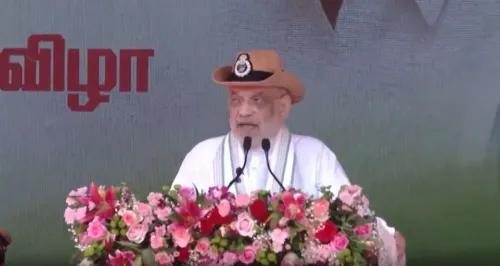
Union Home Minister Amit Shah presented the President's Colour to the Puducherry Police on August 9, 2026 .
The President's Colour is the highest honour the Indian state confers on a police or paramilitary force.
Puducherry UT comprises four non-contiguous enclaves — Puducherry, Karaikal, Mahe, and Yanam — posing unique policing challenges.
Shah commended the force for 'flawless professionalism' and for protecting the UT's spiritual and cultural heritage .
The award follows a broader Ministry of Home Affairs pattern of ceremonial recognition tied to professional standards in UT forces.
A force that patrols four geographically separated enclaves — from the Bay of Bengal coast to a pocket on the Arabian Sea — earned India's highest police honour on Sunday, August 9, 2026. Union Home Minister Amit Shah conferred the President's Colour on the Puducherry Police, recognising decades of disciplined service across one of the country's most unusual administrative territories.
What the President's Colour means for a police force
The President's Colour is the single highest honour the Indian state can bestow on a uniformed force — awarded for exceptional discipline, professionalism, and service rendered to the nation. It is presented in the name of the President of India and is reserved for units that have demonstrated sustained excellence, not a single act of valour. For a UT police force, the distinction carries particular weight: it places Puducherry Police in the company of forces that have received the award from the Ministry of Home Affairs over the years.
Policing four exclaves: the challenge behind the honour
The Union Territory of Puducherry is unlike any other in India. It is made up of four non-contiguous enclaves — Puducherry and Karaikal on the Coromandel Coast, Mahe on the Malabar Coast, and Yanam near the Godavari delta — each surrounded by different state jurisdictions. Coordinating law enforcement across these separated pockets, with different neighbouring state forces and distinct local cultures, demands a level of inter-agency coordination and logistical discipline that most forces never face.
Shah specifically cited the force's record of 'flawless professionalism' in overcoming this geographic challenge, and its role in protecting the UT's 'glorious spiritual heritage' — a reference to Puducherry's significance as a centre of Sri Aurobindo's philosophy and a destination of deep cultural importance to millions.
MHA's pattern of ceremonial recognition for UT forces
The conferment fits a broader pattern in which the Ministry of Home Affairs has used ceremonial honours to reinforce professional standards and morale within police forces that operate under central jurisdiction. Union Territory forces, unlike state police, report directly to the Centre, making such recognition a direct signal from the national government. The award also arrives as the MHA has pushed modernisation initiatives across UT administrations, tying symbolic recognition to an expectation of continued professional development.
Shah extended congratulations to 'all the personnel of the force and the people of the UT' — framing the honour not merely as an institutional accolade but as a moment of civic pride for Puducherry's residents.
For a force that has long operated in the quiet discipline of a small but complex territory, the President's Colour is not just a flag — it is the nation formally taking notice.
Point of View
Shah — who oversees both the MHA and the country's UT governance framework — underscores the Centre's direct stake in Puducherry's law-and-order apparatus. The emphasis on the force's geographic complexity also serves a subtle political purpose: it frames a small, often-overlooked UT as a site of genuine national service, elevating Puducherry's profile ahead of any future administrative or electoral considerations in the region.
NationPress
9 Aug 2026
Frequently Asked Questions
What is the President's Colour awarded to police forces?
The President's Colour is the highest honour the Indian government confers on a police or paramilitary unit, awarded in the name of the President of India for sustained excellence in discipline, professionalism, and service to the nation.
Why did Puducherry Police receive the President's Colour?
Union Home Minister Amit Shah cited the force's 'flawless professionalism' in policing the UT's four geographically separated enclaves and its dedication to protecting Puducherry's spiritual and cultural heritage.
How many regions does Puducherry UT cover?
Puducherry UT consists of four non-contiguous enclaves: Puducherry and Karaikal on the eastern coast, Mahe on the western coast, and Yanam near the Godavari delta in Andhra Pradesh.
Who conferred the President's Colour on Puducherry Police in 2026?
Union Home Minister Amit Shah conferred the President's Colour on the Puducherry Police on August 9, 2026.
Which other police forces have received the President's Colour in India?
Several state and UT police forces have received the President's Colour over the years under the Ministry of Home Affairs, including the Delhi Police, as part of periodic recognition of exceptional service.