Amit Shah Hails Anti-Cheating Bill Passed in Lok Sabha

Synopsis
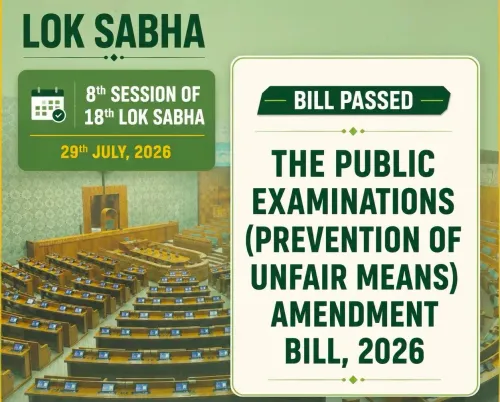
Lok Sabha passed the Public Examinations (Prevention of Unfair Means) Amendment Bill, 2026 on July 29. Union Home Minister Amit Shah welcomed the move, vowing the harshest punishment for those who breach exam sanctity, building on the 2024 anti-cheating law passed after NEET and other scandals.
Key Takeaways
Lok Sabha passed the Public Examinations (Prevention of Unfair Means) Amendment Bill, 2026 on July 29, 2026 .
The bill amends the original Public Examinations (Prevention of Unfair Means) Act, 2024 , which was enacted following widespread exam paper leak controversies.
Union Home Minister Amit Shah said the bill imposes 'the harshest punishment' on those who breach the sanctity of public examinations.
The National Testing Agency (NTA) , which conducts NEET and JEE, was at the centre of the 2023-2024 malpractice controversies that prompted the original legislation.
The bill must now pass the Rajya Sabha before it becomes law; enforcement rules are yet to be framed.
A new legislative shield for India's exam aspirants cleared a major hurdle on Wednesday, July 29, 2026, when Lok Sabha passed the Public Examinations (Prevention of Unfair Means) Amendment Bill, 2026 — tightening the screws on those who exploit the examination system that millions of students stake their futures on. Union Home Minister Amit Shah called it a decisive move to protect the 'dreams and aspirations' of India's youth.
Shah's post minced no words: the bill, he said, lays down 'iron-clad provisions imposing the harshest punishment on those who dare to breach the sanctity of public examinations.' The Modi government, he added, 'will spare no one who attempts to imperil the future of our students.'
The 2024 law that set the stage
The amendment builds on the Public Examinations (Prevention of Unfair Means) Act, 2024 — itself a product of public outrage after a wave of paper leaks and malpractice scandals rocked high-stakes tests in 2023 and 2024. The National Testing Agency (NTA), which conducts flagship entrance examinations including NEET and JEE, found itself at the centre of those controversies. The 2024 law was the government's first legislative response; the 2026 amendment signals that the Centre believes stronger teeth are still needed. The broader pattern is clear: organised exam fraud — involving impersonators, leaked question papers, and coordinated cheating networks — has repeatedly derailed the aspirations of students who prepare for years for a single shot at a government job or a medical seat. Every scandal erodes trust in merit-based selection at a scale that affects millions of families.What the bill means for students and fraudsters alike
While the exact provisions of the 2026 amendment are yet to be fully detailed in public records, the legislative intent is unambiguous — escalate the cost of examination fraud to a point where the risk-reward calculation collapses for bad actors. Shah's language of 'full wrath of the law' signals that enforcement, not just legislation, is the government's intended follow-through. The bill now moves to the Rajya Sabha, where its passage will complete the legislative journey. Separately, the framing of rules and enforcement mechanisms — likely to involve the Ministry of Home Affairs — will determine whether the law's deterrent effect translates from Parliament to the ground. For the crores of students who sit competitive examinations each year, the question was never whether tougher laws were needed. It was whether the system would deliver on that promise. The amendment clears one hurdle. The harder test lies ahead.Point of View
Not a ceiling — an acknowledgement that legislative deterrence must be periodically sharpened as fraud networks adapt. For the BJP, championing student welfare through punitive legislation also serves a political purpose: it directly addresses one of the most emotionally charged grievances among aspirant-class voters who felt betrayed by the NEET and other exam scandals. The real test of the law's credibility, however, will be prosecution rates and conviction timelines — areas where India's earlier exam-integrity frameworks have historically underdelivered. Rajya Sabha passage and the subsequent rule-framing process will reveal how much institutional muscle backs the political rhetoric.
NationPress
29 Jul 2026
Frequently Asked Questions
What is the Public Examinations (Prevention of Unfair Means) Amendment Bill, 2026?
It is a bill passed by Lok Sabha on July 29, 2026, that amends the 2024 law to strengthen punishments for malpractice, paper leaks, and cheating in public examinations in India.
What was the original Public Examinations (Prevention of Unfair Means) Act, 2024?
The 2024 Act was enacted by Parliament to deter unfair practices in public exams after a series of high-profile paper leak and malpractice scandals, including those involving NEET and other national-level tests.
What did Amit Shah say about the 2026 exam bill?
Union Home Minister Amit Shah said the bill lays down 'iron-clad provisions imposing the harshest punishment' on those who breach exam sanctity, and that the Modi government will ensure wrongdoers face 'the full wrath of the law.'
What happens next after Lok Sabha passed the exam bill?
The bill must now be passed by the Rajya Sabha, the upper house of Parliament, before it can receive Presidential assent and become law. Enforcement rules will also need to be framed subsequently.
Which body conducts the exams this law is meant to protect?
The National Testing Agency (NTA) is the primary body conducting major national entrance examinations like NEET and JEE, and has been at the centre of past exam integrity controversies the legislation aims to address.