Amit Shah invokes Tilak's cultural nationalism path
Synopsis
Union Home Minister Amit Shah invoked Lokmanya Bal Gangadhar Tilak on 1 August 2026, declaring that India is now firmly on the path of cultural nationalism Tilak charted and that no force can reverse this trajectory — a statement consistent with the BJP's ideological framing since 2014.
Key Takeaways
Amit Shah posted on 1 August 2026 invoking Lokmanya Tilak's vision of cultural nationalism.
Shah declared that India is now advancing on Tilak's path and 'no one can stop it even if they want to.' Bal Gangadhar Tilak (1856–1920) popularised Ganesh Chaturthi as a mass national-consciousness tool and championed Swaraj.
The RSS , founded in 1925 , drew ideological inspiration from Tilak's emphasis on cultural self-assertion.
The BJP has consistently framed cultural nationalism as the core of Indian identity since 2014 , positioning it against earlier Nehruvian secular approaches.
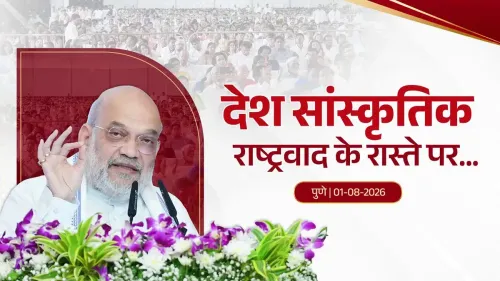
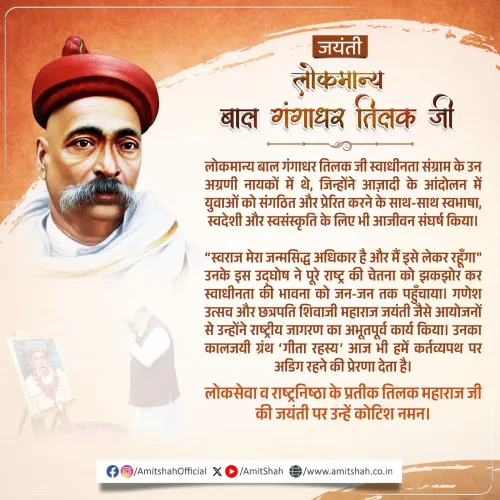
A century after Lokmanya Bal Gangadhar Tilak shaped the soul of India's independence movement, Union Home Minister Amit Shah declared on Saturday, 1 August 2026 that the nation is now firmly walking the path of cultural nationalism Tilak envisioned — and that no force can reverse it.
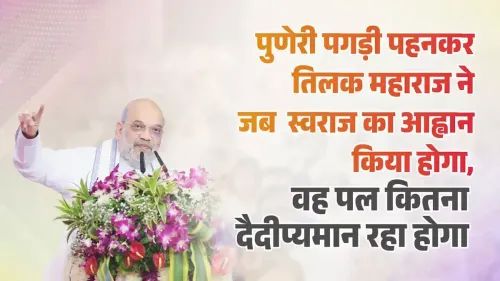
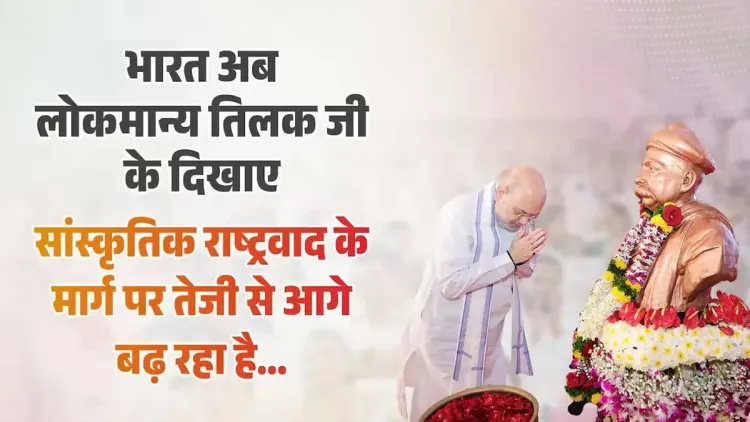
Posting in Hindi on X, Shah wrote: 'Bharat ab Lokmanya Tilak ji ke dikhaye saanskritik rashtravad ke maarg par aage badh raha hai, ab koi chahkar bhi ise rok nahi sakta.' — 'India is now moving forward on the path of cultural nationalism shown by Lokmanya Tilak, and now no one can stop it even if they want to.'
Who was Lokmanya Tilak — and why does his legacy still detonate?
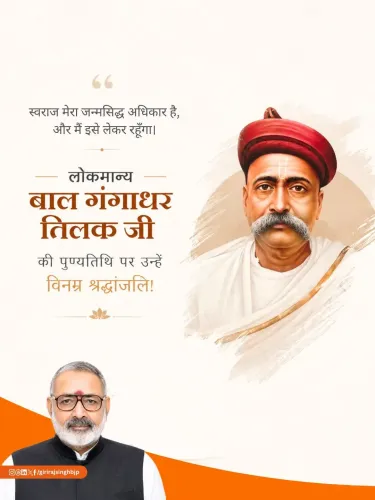
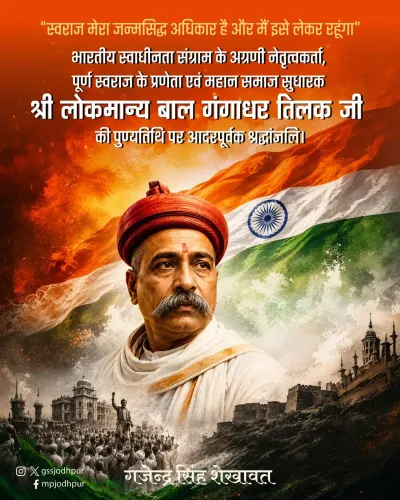
Bal Gangadhar Tilak (1856–1920) was among the first Indian leaders to argue that freedom from British rule required more than political agitation — it demanded a cultural awakening. He popularised the public celebration of Ganesh Chaturthi as a mass mobilisation tool, turning a religious festival into a vehicle for national consciousness. His slogan 'Swaraj is my birthright, and I shall have it' became a rallying cry that cut across caste and class. Tilak believed that a civilisation's identity — its language, its festivals, its shared memory — was the bedrock on which political sovereignty had to be built. That idea never disappeared. It resurfaced as a foundational influence on the RSS, founded in 1925, and has remained a live current in Indian right-wing politics ever since.Shah's framing and the BJP's consistent ideological arc
Shah's invocation is not incidental. Since 2014, the BJP has consistently positioned cultural nationalism — the primacy of India's civilisational heritage in public life and governance — as the defining alternative to what it characterises as the Nehruvian secular consensus. Tilak, in this framing, is cast as a prophet vindicated by history: a leader who understood that culture precedes constitution. The Home Minister's choice of words — 'no one can stop it even if they want to' — signals confidence, even finality. It frames the cultural-nationalist project not as a work in progress but as an irreversible shift in India's self-understanding. Whether that assertion is tested in upcoming parliamentary sessions or reflected in new state-level heritage programmes will be worth watching closely.Point of View
' he is not merely commemorating Tilak but asserting that the ideological contest over India's identity has been settled. The framing is calibrated: Tilak's mass-mobilisation legacy lends the BJP's cultural agenda a pre-partition, pre-partition-era pedigree that sidesteps charges of sectarianism. Watch whether this language migrates into formal policy announcements or legislative priorities in the months ahead.
NationPress
1 Aug 2026
Frequently Asked Questions
What did Amit Shah say about Lokmanya Tilak?
Amit Shah said that India is now moving forward on the path of cultural nationalism shown by Lokmanya Tilak and that no one can stop it even if they want to.
Who was Lokmanya Tilak and what is cultural nationalism?
Lokmanya Bal Gangadhar Tilak (1856–1920) was an Indian independence leader who used cultural symbols like Ganesh Chaturthi to build national consciousness. Cultural nationalism holds that a nation's civilisational and cultural identity is the foundation of its political sovereignty.
Why does the BJP invoke Lokmanya Tilak?
The BJP has consistently cited Tilak since 2014 to ground its cultural-nationalist ideology in a pre-independence, widely respected freedom fighter, positioning it as a continuation of India's civilisational self-assertion rather than a new political project.
What is the connection between Lokmanya Tilak and the RSS?
The RSS, founded in 1925, drew ideological inspiration from Tilak's emphasis on cultural self-assertion and the idea that India's identity must be rooted in its civilisational heritage.
When did Amit Shah make this statement about cultural nationalism?
Amit Shah made the statement on Saturday, 1 August 2026, in a post on X written in Hindi.