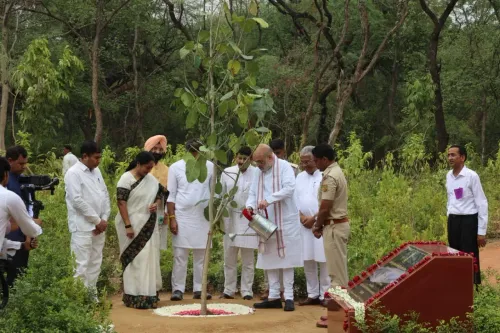
Amit Shah Plants Trees at President's Bodyguard Campus in Delhi
Synopsis
Union Home Minister Amit Shah joined the Mission 70 Lakh Paudharopan Abhiyan at the President's Bodyguard campus in New Delhi on 7 July 2026, pledging to plant over one crore native trees on the Delhi Ridge in four years to combat pollution and restore the city's primary ecological buffer.
Key Takeaways
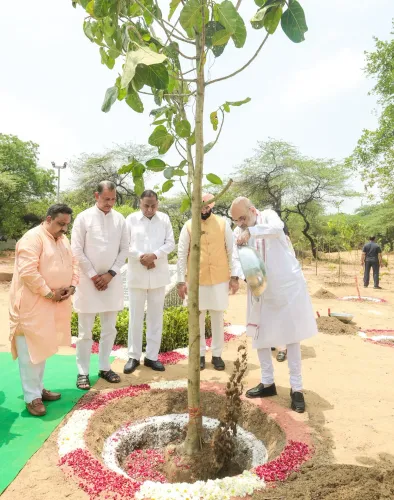
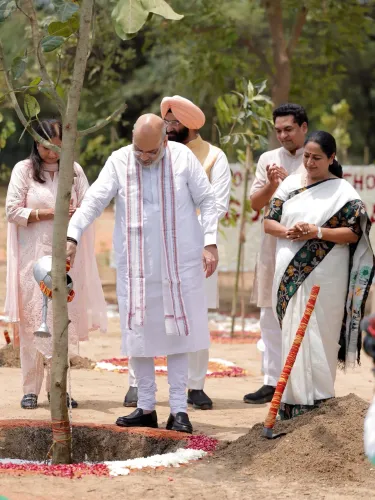
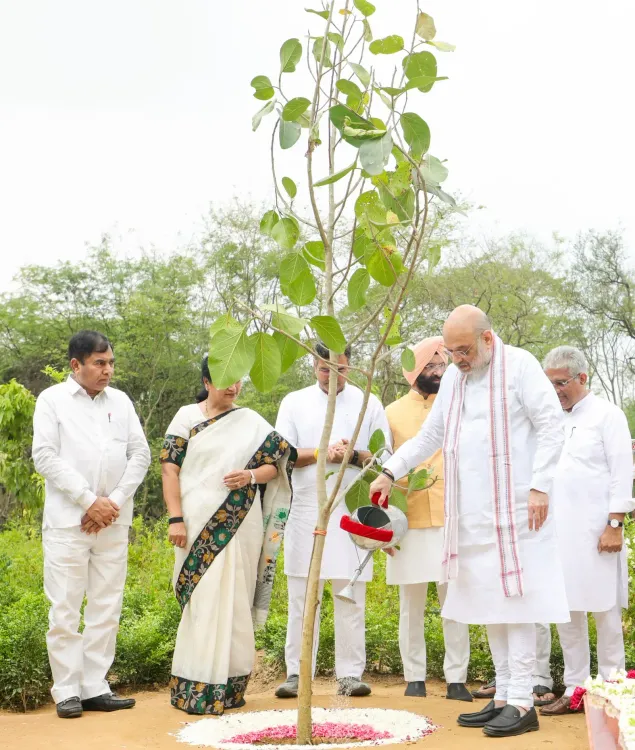
Union Home Minister Amit Shah participated in a tree-plantation drive at the Rashtrapati Angrakshak Dal campus in New Delhi on 7 July 2026 .
The event was held under Mission 70 Lakh Paudharopan Abhiyan , a mass afforestation campaign targeting the Delhi Ridge .
The campaign focuses on planting native (indigenous) tree species to strengthen the Ridge's ecological function rather than ornamental or exotic varieties.
Over one crore trees are to be planted across the Delhi Ridge forest area in the next four years , with the goal of making it 'Delhi's lung'.
The drive is framed as a public-participation (janbhagidari) campaign , with citizens invited to contribute by planting trees.
The initiative aligns with national frameworks including the National Mission for a Green India and the Nagar Van Yojana .
Union Home Minister Amit Shah on Tuesday, 7 July 2026, participated in a tree-plantation drive at the Rashtrapati Angrakshak Dal (President's Bodyguard) campus in New Delhi, as part of the Mission 70 Lakh Paudharopan Abhiyan — a mass afforestation campaign aimed at making Delhi pollution-free by greening the city's Ridge forest with native tree species.
Context
Shah announced the initiative on X, stating in Hindi: 'Delhi ko pradushan mukt banane ke liye Delhi Ridge ko deshi prajatiyon ke vrikshon se hara-bhara kiya ja raha hai' ('The Delhi Ridge is being made green with native tree species to free Delhi from pollution'). He added that the plantation at the President's Bodyguard campus was conducted under the ongoing Mission 70 Lakh Paudharopan Abhiyan, urging citizens to join the public-participation drive and contribute to building a 'Green Delhi'.
The Delhi Ridge is the northern extension of the ancient Aravalli range that runs through the capital, functioning as the city's primary natural forest and ecological buffer. Urban ecologists regard it as Delhi's most significant green lung, capable of absorbing particulate matter and moderating temperatures across the National Capital Region.
Policy Backdrop
The drive fits within a broader national push on urban afforestation. The National Mission for a Green India, approved in 2014, set targets for expanding forest and tree cover with an emphasis on native species and urban areas. Annual plantation campaigns under the Nagar Van Yojana framework, running since 2015, have sought to create contiguous city forests in major urban centres.
The current campaign's emphasis on native or indigenous species (deshi prajatiyaan) marks a deliberate shift from ornamental or fast-growing exotic trees toward ecologically appropriate planting — a principle that forest scientists and urban planners have long advocated for the Ridge's fragile ecosystem. Shah's post stated that over one crore trees will be planted across the Delhi Ridge forest area in the next four years, with the goal of transforming the Ridge into 'Delhi's lung' (Delhi ka phephda).
Stakeholders and Impact
The Rashtrapati Angrakshak Dal — India's oldest mounted cavalry unit, based within the Rashtrapati Bhavan complex — hosted the plantation event, lending institutional visibility to the campaign. Participation by a senior Union Cabinet minister at a symbolic military-heritage campus signals central government ownership of the drive alongside Delhi's civic and forest agencies.
Delhi residents, particularly those in areas bordering the Ridge such as Civil Lines, Saket, and Vasant Kunj, stand to benefit most directly from expanded canopy cover and improved air quality. Seasonal pollution spikes in the October–January window have made Delhi's air quality a recurring public-health concern, and large-scale ecological restoration of the Ridge is seen as a long-term structural intervention.
The campaign's janbhagidari (public-participation) framing invites ordinary citizens to plant trees alongside government agencies — a messaging approach that senior ministers have deployed consistently in environmental drives since 2019.
What's Next
The stated target of planting more than one crore trees across the Delhi Ridge over four years will require sustained coordination between central agencies, the Delhi Forest Department, and civic bodies through successive monsoon plantation windows, when survival rates for saplings are highest. Independent progress audits and geo-tagged monitoring will be critical to verifying outcomes against the Mission's declared numbers.
If the Ridge afforestation target is met and native species take root at scale, it could set a replicable model for other Indian cities seeking to use existing urban forest land as a first line of defence against air pollution — moving urban greening policy from symbolic gestures to measurable ecological outcomes.
Point of View
A domain that has historically been contested between central and Delhi government agencies. The emphasis on native species and the Ridge's contiguous forest patch reflects a maturing policy understanding: ecological restoration, not just tree counts, is what improves air quality. The four-year, one-crore-tree commitment, if tracked rigorously, could become a benchmark for urban forest policy across Indian metros. At the same time, the janbhagidari framing allows the BJP to build a visible public-engagement narrative around environment ahead of future electoral cycles in the capital.
NationPress
7 Jul 2026
Frequently Asked Questions
What is Mission 70 Lakh Paudharopan Abhiyan?
Mission 70 Lakh Paudharopan Abhiyan is a mass tree-plantation campaign aimed at greening the Delhi Ridge with native tree species to reduce pollution. Amit Shah participated in the drive at the President's Bodyguard campus on 7 July 2026.
What is the Delhi Ridge and why is it important?
The Delhi Ridge is the northern extension of the Aravalli mountain range running through the capital, serving as the city's primary natural forest and ecological buffer. It is considered Delhi's 'green lung' because of its role in absorbing air pollutants and moderating urban temperatures.
How many trees will be planted on the Delhi Ridge?
According to Amit Shah's post, over one crore trees will be planted across the Delhi Ridge forest area over the next four years as part of the ongoing afforestation campaign.
Why are native species being used for the Delhi Ridge plantation?
Native or indigenous tree species are ecologically suited to the Ridge's soil and climate, making them more resilient and effective at providing long-term environmental benefits compared to ornamental or exotic varieties that have been planted in urban drives historically.
How can citizens participate in the Delhi tree-plantation campaign?
Amit Shah has invited citizens to join the janbhagidari (public-participation) campaign by planting as many trees as possible and contributing to the goal of a 'Green Delhi'. Residents can connect with local urban forestry agencies and civic bodies conducting plantation drives, particularly during the monsoon season.