Amreli gets ₹403 crore development push as Gujarat marks I-Day
Synopsis
Gujarat picked Amreli to host its state-level Independence Day celebrations — and backed the symbolism with ₹403.21 crore across 66 projects. The bigger policy signal: CM Patel doubled the special development grant for host districts to ₹5 crore, with Amreli the first to benefit. Roads, water supply, safari tourism, and rural infrastructure all feature in a package that reflects how Gujarat is using national festivals as a development delivery mechanism.
Key Takeaways
Amreli received 66 development projects worth ₹403.21 crore on 14 August 2025 as Gujarat's state-level Independence Day host district.
Chief Minister Bhupendra Patel doubled the special grant for host-district local bodies from ₹2.50 crore to ₹5 crore ; Amreli is the first beneficiary.
The package includes ₹114.79 crore in water supply works, ₹157.72 crore in state roads projects, and ₹93.05 crore in rural infrastructure.
Eight major bridges worth ₹193 crore are under construction; Rajula-Jafrabad and Babra-Chavand corridors are planned as high-speed roads.
More than ₹5,000 crore has been allocated for Amreli's development over the past five years, according to the Chief Minister.
Governor Acharya Devvrat called for natural farming adoption and expressed resolve to make Gujarat a 'poison-free state.'
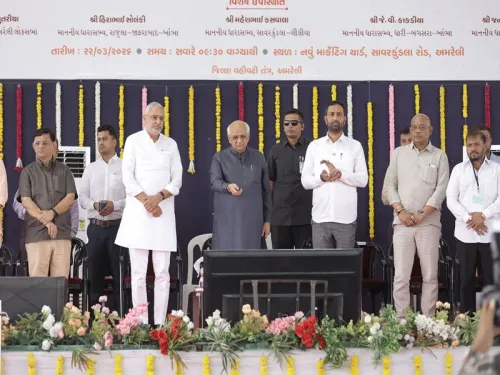
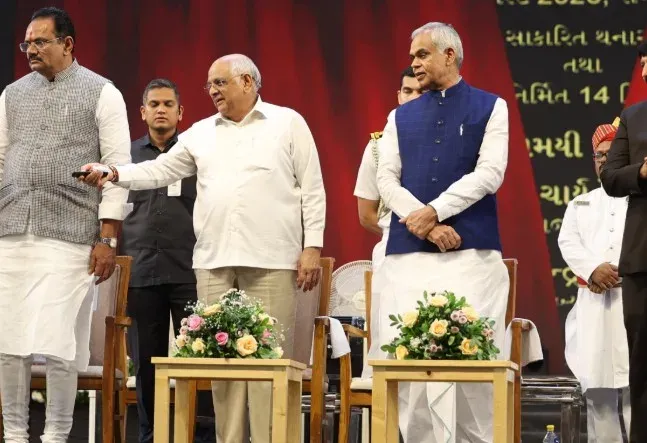
Amreli district in Gujarat received a package of 66 development projects worth ₹403.21 crore on 14 August 2025, as the state chose the district to host its state-level Independence Day celebrations. Chief Minister Bhupendra Patel e-inaugurated and laid foundation stones for the projects at the 'Amrit Gatha Amreli' cultural programme, also announcing a doubling of special grants for local bodies.
Key Developments at the Amrit Gatha Programme
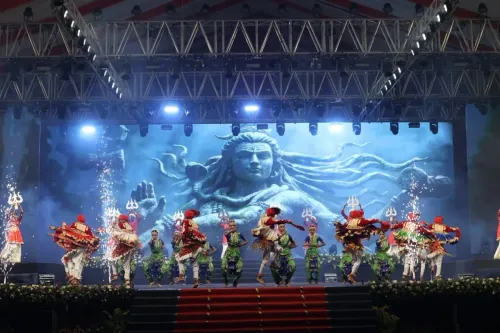
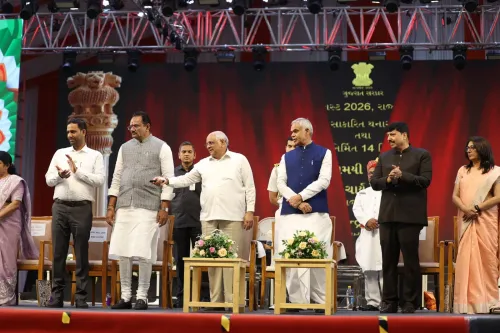
The event was held at Forward School Ground, Amreli, on the eve of the 80th Independence Day, with Governor Acharya Devvrat and Chief Minister Patel presiding. More than 200 artists performed on themes of patriotism, Gujarat's cultural heritage, and Amreli's history. A Coffee Table Book and a 'Vikas Vatika' booklet — prepared jointly by the district administration and District Information Office — were released by the Governor and Chief Minister.
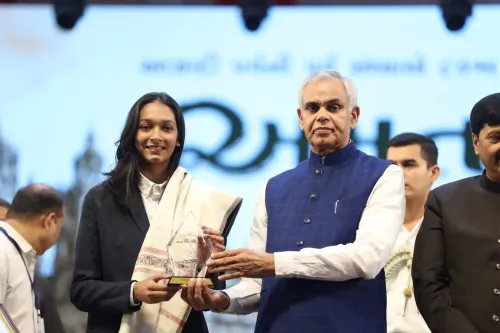
Seventeen distinguished citizens were honoured for contributions spanning water conservation, environment, literature, education, health, sports, music, and social service. Among those recognised was Padma Shri Savjibhai Dholakiya for water conservation and Forum Kagathra for sports achievements.
Breakdown of the ₹403 Crore Package
The development outlay spans multiple departments. Two Gujarat Water Supply and Sewerage Board works worth ₹114.79 crore were inaugurated. The Roads and Buildings Department (State) accounted for ₹157.72 crore across ten projects — six inaugurated works worth ₹98.72 crore and four foundation-stone works worth ₹59 crore. The Roads and Buildings Department (Panchayat) saw foundation stones laid for 47 rural infrastructure works worth ₹93.05 crore. Additional works were launched under the Revenue, Information and Broadcasting, Education, Social Justice and Empowerment, and Health departments.
What the Chief Minister and Governor Said
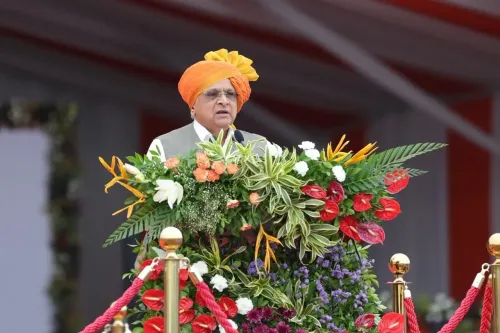
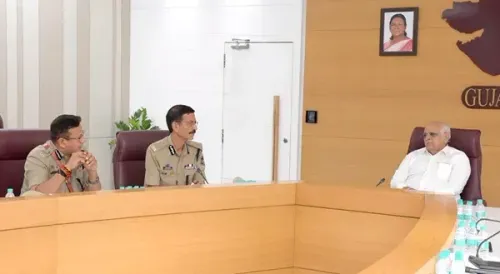
Chief Minister Patel linked the state-level celebration to Amreli's broader development trajectory, noting that the practice of rotating state-level national festival celebrations across districts — an initiative attributed to Prime Minister Narendra Modi — had accelerated development in host areas. He highlighted that more than ₹5,000 crore had been allocated for various development works in Amreli over the past five years.
Patel also pointed to ongoing infrastructure projects: eight major bridges being constructed for ₹193 crore to support transportation and tourism, and the planned development of Rajula-Jafrabad and Babra-Chavand roads as high-speed corridors. He noted that Narmada water had reached Amreli through the Saurashtra Narmada Avtaran Irrigation (SAUNI) Yojana, driving agricultural transformation. More than 7.5 lakh trees have been planted in the district, and Ambardi Safari Park is being developed to create tourism opportunities comparable with Gir while supporting lion conservation.
Governor Devvrat described Amreli as 'a land of valour, literature, character and philanthropy.' He called for greater adoption of natural farming, warning that excessive use of chemical fertilisers and pesticides had polluted soil, degraded food quality, and contributed to disease in humans and animals. He expressed a resolve to make Gujarat a 'poison-free state.'
Special Grants for Local Bodies Doubled
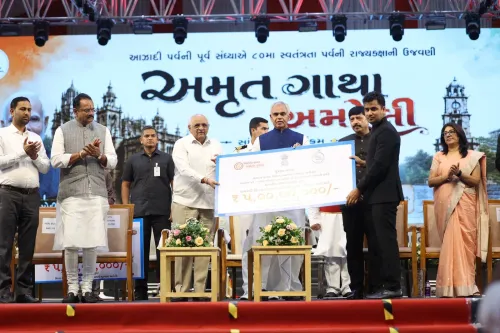
In a significant administrative announcement, Chief Minister Patel declared that the special grant for municipalities and gram panchayats in districts hosting state-level national festival celebrations would be doubled — rising from ₹2.50 crore to ₹5 crore each for the municipal development grant (administered through the District Collector) and the rural development grant (administered through the District Development Officer). Amreli is the first district to benefit from this decision, with Patel presenting cheques of ₹5 crore each to the District Collector and District Development Officer at the event.
Historical and Cultural Context
Chief Minister Patel recalled Amreli's contribution to India's freedom struggle, citing the district's Praja Mandal movement and the role of Savarkundla's Manilal Trivedi in the Non-Cooperation Movement. He also referenced Amreli's literary heritage and its association with luminaries including Zaverchand Meghani, Bhoja Bhagat, Muktanand Swami, poet Kalapi, Dulabhaya Kag, and Ramesh Parekh. The district's historical identity, combined with its current infrastructure push, positions Amreli as a focal point of Gujarat's development narrative heading into the next phase of state planning.
Point of View
However, is execution: Amreli's ₹403 crore package spans nine departments and 66 projects, a breadth that risks dilution without strong inter-departmental coordination. The Ambardi Safari Park and high-speed corridor plans are directionally sound, but Gujarat's tourism and road projects have historically faced timeline slippage. The real test will be whether the foundation stones laid on 14 August translate into completed assets within stated timelines — not just headline numbers at the next celebration.
NationPress
29 Sept 2026
Frequently Asked Questions
What is the ₹403 crore development package announced for Amreli?
It is a package of 66 development projects worth ₹403.21 crore, e-inaugurated or launched by Chief Minister Bhupendra Patel on 14 August 2025 as part of Gujarat's state-level Independence Day celebrations in Amreli. The projects span water supply, roads, rural infrastructure, health, education, and social justice departments.
Why was Amreli chosen for Gujarat's state-level Independence Day celebration?
Gujarat rotates its state-level national festival celebrations across different districts — a practice the Chief Minister attributed to an initiative by Prime Minister Narendra Modi aimed at accelerating development in host areas. Amreli was selected for the 2025 event.
What is the new special grant announced for local bodies?
Chief Minister Patel announced that the special development grant for municipalities and gram panchayats in districts hosting state-level national festival celebrations would be doubled from ₹2.50 crore to ₹5 crore each. Amreli is the first district to receive the enhanced grant.
What major infrastructure projects are planned for Amreli?
Eight major bridges worth ₹193 crore are under construction to support transportation and tourism. The Rajula-Jafrabad and Babra-Chavand roads are planned as high-speed corridors. Ambardi Safari Park is also being developed to boost tourism and support lion conservation, comparable to the Gir sanctuary.
What is the SAUNI Yojana and how has it helped Amreli?
The Saurashtra Narmada Avtaran Irrigation (SAUNI) Yojana is a Gujarat government scheme that channels Narmada river water to the water-scarce Saurashtra region. According to Chief Minister Patel, Narmada water has reached Amreli through the scheme, driving agricultural transformation and water conservation in the district.