Are the Andaman & Nicobar Islands a ‘living laboratory of biodiversity’?
Click to start listening
Synopsis
Discover how the Andaman & Nicobar Islands are pivotal to India's environmental and economic security through their unique biodiversity. Union Minister Dr. Jitendra Singh emphasizes the need for scientific integration with policy to safeguard these vital ecosystems.
Key Takeaways
- Andaman & Nicobar Islands are crucial for India's biodiversity.
- Integration of science and policy is essential for conservation.
- ZSI plays a vital role in research and data generation.
- Public awareness is key to environmental protection.
- Coral reef research is critical for marine ecosystem sustainability.
New Delhi, Jan 19 (NationPress) The Andaman & Nicobar Islands serve as a living laboratory of biodiversity and are pivotal for both the environmental and economic security of India, stated Dr. Jitendra Singh, Union Minister of State (Independent Charge) for Science & Technology and Earth Sciences.
During his recent visit to the union territory, the Minister engaged with scientists and officials at the Regional Centre of the Zoological Survey of India (ZSI) located in Sri Vijaya Puram.
“The Andaman & Nicobar Islands epitomize a living laboratory of biodiversity, where advanced science must work synergistically with conservation efforts and sustainable livelihoods,” Singh remarked. He underscored the importance of integrating scientific research with public policy, conservation strategies, and community engagement.
“Strong scientific institutions are essential for fulfilling India’s environmental objectives and maximizing the potential of the Blue Economy sustainably,” the Minister added.
He highlighted that entities like ZSI are instrumental in generating credible scientific data that informs national policies on biodiversity conservation, climate resilience, and ocean-related economic development.
Since its establishment in 1977, the Andaman & Nicobar Regional Centre of ZSI has dedicated five decades to scientific service. It has become a central institution for research on tropical island biodiversity, conducting nearly 90 research programs across various faunal groups.
The scientists at the Centre have authored 85 books and over 850 research papers published in esteemed national and international journals, significantly contributing to India’s understanding of biodiversity.
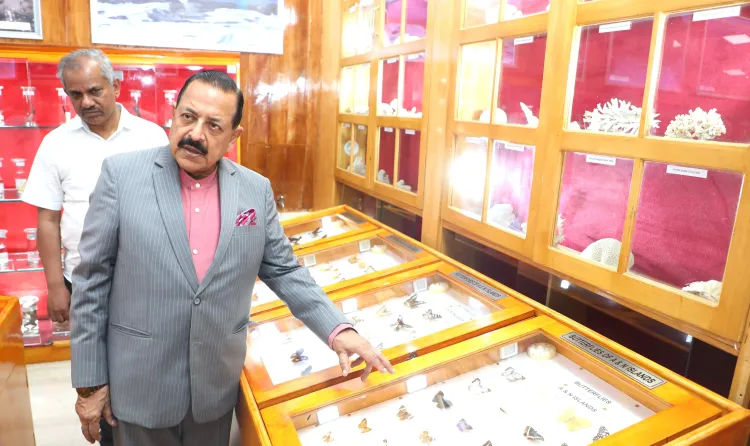
Singh also toured the ZSI Museum, a key tourist and educational hub in the islands, housing approximately 3,500 specimens across 22 faunal groups.
He was informed about the museum’s role in public outreach, awareness, and education, with an annual visitor count between 75,000 and 100,000, including students, researchers, and tourists. The Minister expressed keen interest in the curated collections, type specimens, and displays of endemic, endangered, and threatened fauna from the archipelago.
Singh was also briefed on ZSI Port Blair’s role as the nodal centre for India’s first National Coral Reef Research Institute (NCRRI), which aims to enhance coral reef research and monitoring within Indian waters. He noted that such specialized institutions are critical for protecting fragile marine ecosystems and enabling evidence-based marine governance.
Point of View
The insights from scientific institutions like the ZSI underscore the necessity for informed policymaking that prioritizes ecological sustainability. This approach is vital for preserving the rich natural resources of the archipelago and enhancing community livelihoods.
NationPress
19/01/2026
Frequently Asked Questions
Why are the Andaman & Nicobar Islands considered a biodiversity lab?
The islands are home to a unique array of flora and fauna, making them a crucial site for biodiversity research and conservation efforts.
What role does the ZSI play in biodiversity conservation?
The ZSI conducts research and generates data that inform national policies on biodiversity conservation and climate resilience.
How does scientific research benefit local communities?
Integrating scientific insights with public policy can lead to sustainable livelihoods while preserving local ecosystems.